Feb. 25, 2022

2022 Housing Market Foreast In Connecticut

2022 Housing Market Forecast [INFOGRAPHIC]

2022 Housing Market Forecast [INFOGRAPHIC] | MyKCM

Some Highlights

  • What does the coming year hold for the housing market? Here’s what experts project for 2022.
  • Mortgage rates are projected to rise and so are home prices. Experts are forecasting buyer demand will remain strong as people try to capitalize on rates and prices before they climb, creating another strong year for home sales.
  • Let’s connect so you can make your best move in the new year.
Feb. 24, 2022

The Path To Homeownership Cam Be Steeper for Some Americans In Connecticut

The Path To Homeownership Can Be Steeper for Some Americans In Connecticut 

The Path To Homeownership Can Be Steeper for Some Americans | MyKCM

As we celebrate Black History Month, we honor and recognize the past and present experiences of Black Americans. A significant part of this experience is investing in a home of their own. While equitable access to housing has come a long way, the path to homeownership is still steeper for households of color. It’s an important experience to talk about, along with how working with the right real estate experts can make all the difference for diverse homebuyers.

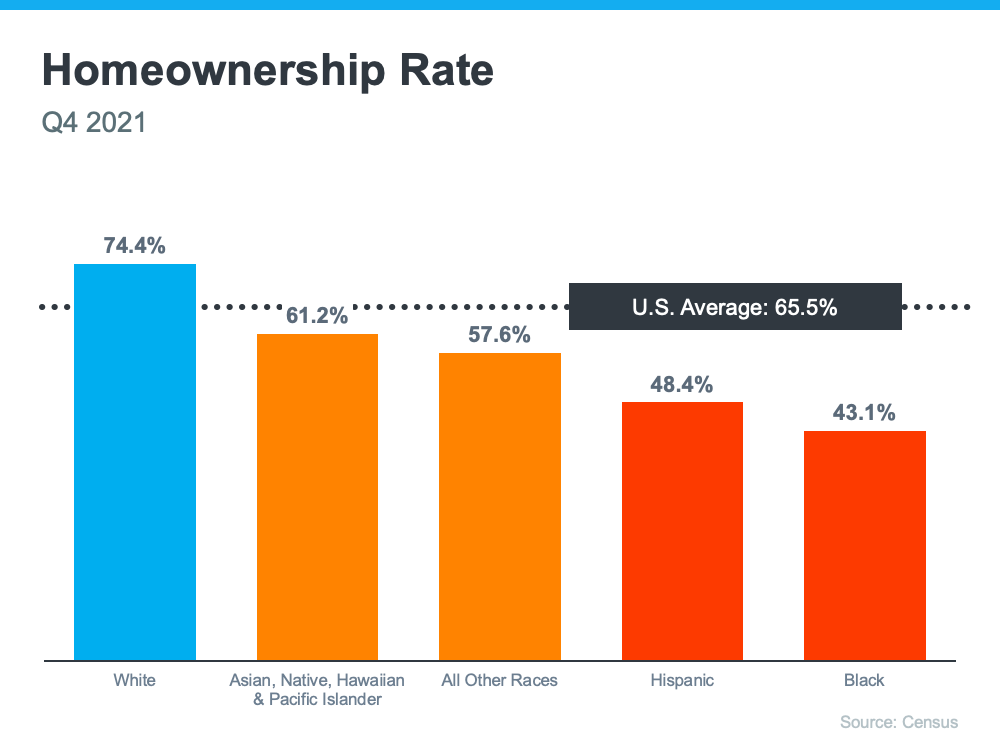
We know it’s a more challenging journey to achieve homeownership for some because there’s still a measurable gap between the overall average U.S. homeownership rate and that of non-white groups. Today, the lowest homeownership rate persists in the Black community (see graph below):

The Path To Homeownership Can Be Steeper for Some Americans | MyKCM

Homeownership is an essential piece for building household wealth that can be passed down to future generations. However, there are obstacles in the homebuying process that can negatively impact certain racial and ethnic groups, including the Black community. This can delay or prevent many from achieving homeownership, challenging their ability to grow their net worth. A report by Vanessa G. Perry of the George Washington University School of Business and Janneke Ratcliffe of the Urban Institute explains:

“. . . households of color have much lower homeownership rates than white households and consequently hold, at the median, just one-eighth the wealth of white households.”

On top of that, when Black households do become homeowners, research shows they pay more for those homes overall than the average household. Raheem Hanifa, a Research Analyst for the Joint Center for Housing Studies of Harvard Universitytells us:

“Black homeowners not only have primary mortgages with higher interest rates than white homeowners with similar incomes, they also have higher interest rates than white homeowners with substantially lower incomes, . . . Black homeowners have experienced systemic barriers to homeownership and wealth-building opportunities that have limited their ability to access credit, which is a key component in receiving low mortgage interest rates.”

For Black homebuyers, the inequity that remains in housing can be a point of pain and frustration. That’s why it’s so important for members of diverse groups to have the right team of experts on their sides throughout the homebuying process. These professionals aren’t only experienced advisors who understand the market and give the best advice. They’re also compassionate allies who will advocate for your best interests every step of the way.

Bottom Line

Opportunities in real estate improve every day, but there are still equity challenges that many face. Let’s connect to make sure you have an advocate on your side as you walk the path to homeownership.

Feb. 23, 2022

Buyers Want To Know: Why Is Housing Supply Still So Low In Connecticut

Buyers Want To Know: Why Is Housing Supply Still So Low In Connecticut?

Buyers Want To Know: Why Is Housing Supply Still So Low? | MyKCM

One key question that’s top of mind for homebuyers this year is: why is it so hard to find a house to buy? The truth is, we’re in the ultimate sellers’ market, so real estate is ultra-competitive for buyers right now. The number of buyers searching for a home greatly outweighs how many homes are available for sale in Connecticut

While low inventory in the housing market isn’t new, it’s a challenge that continues to grow over time. Here’s a look at two reasons why today’s housing supply is low and what that means for you.

1. New Home Construction Fell Behind for Several Years

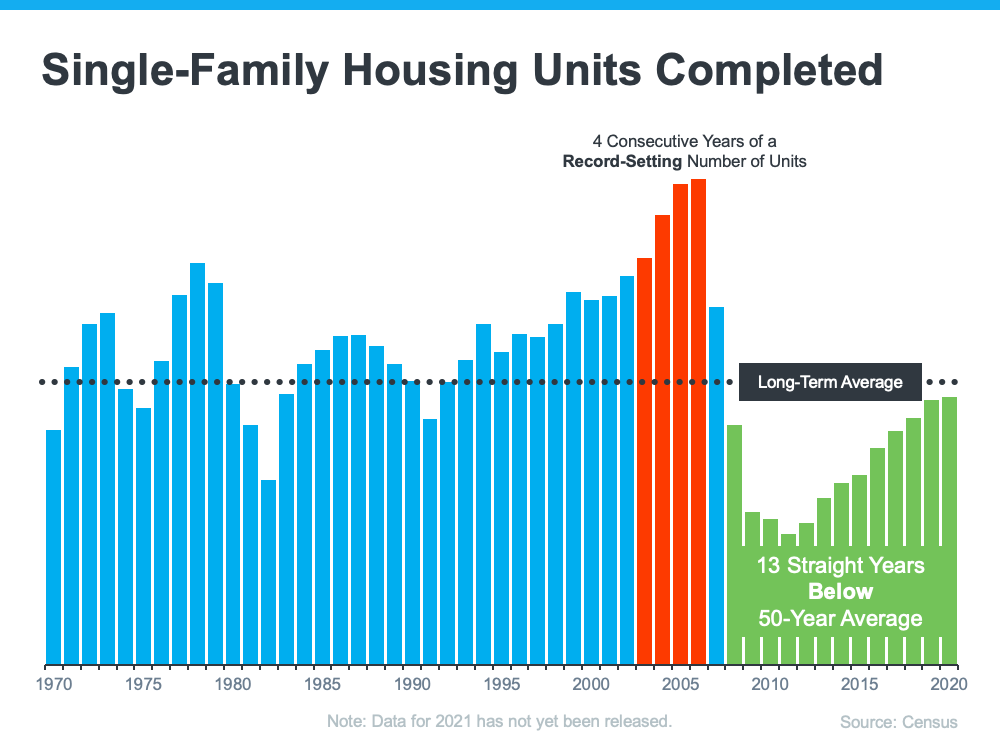
The graph below shows new home construction for single-family homes over the past five decades, including the long-term average for housing units completed. Builders exceeded that average during the housing bubble (shown in red on the graph). The result was an oversupply of homes on the market, so home values declined. That was one of the factors that led to the housing crash back in 2008.

Since then, the level of new home construction has fallen off. For the last 13 straight years, builders haven’t been able to construct enough homes to meet the historical average (as illustrated in green on the graph). That underbuilding left us with a multi-year inventory deficit going into the pandemic.
Buyers Want To Know: Why Is Housing Supply Still So Low? | MyKCM

2. The Pandemic’s Impact on the Housing Market

Then, when the pandemic hit, it fueled a renewed appreciation and focus on the meaning of home. Having a safe space to live, work, school, and exercise became even more important for Americans throughout the country. So, as mortgage rates dropped to at or below 3%, buyers eagerly entered the market looking to capitalize on those low rates to secure a home that would fulfill their changing needs. At the same time, sellers hesitated to put their houses on the market as concerns about the pandemic mounted.

The result? The number of homes available for sale dropped even further. A recent article from realtor.com explains:

Last month, the number of home listings dropped 26.8% compared with the same time a year earlier. This meant there were about 177,000 fewer homes listed in what’s already typically a slower month due to the holidays and colder weather. . . .”

What Does All of This Mean for You?

For a buyer, low inventory can be a challenge. You want to find the home of your dreams, and you don’t want to settle. But what if there just aren’t that many homes to choose from?

There is some good news. Experts are projecting more homes will soon become available thanks to sellers re-entering the market. Danielle Hale, Chief Economist at realtor.com, shares this hope, but offers perspective:

We expect that we’ll start to see a turnaround and inventory will stabilize and start to go up a little bit in 2022. . . . But that means we’re looking at inventory levels of roughly half of what we saw before the pandemic. For buyers, the market is likely to continue to move fast. If you see a home you like, you want to jump on it right away.

Basically, inventory is still low, even though more homes are coming. But you shouldn’t put your plans on hold because you’re waiting for those additional houses to hit the market.  Instead, stick with your search and persevere through today’s low inventory. You can find your next home if you’re patient and focused.

Remember your goals and why finding a home is so important. Those things should be the driving force behind your search. Share them with your agent and be clear about your priorities. Your trusted advisor is your greatest support as you navigate today’s low housing supply to find the home of your dreams.

Bottom Line 

If you’re planning to buy this year, the key to success will be patience given today’s low inventory. Let’s connect to discuss what’s happening in our area, what homes are available, and why it’s still worthwhile to prioritize your home search today.

Feb. 22, 2022

Before Moving - Remember Future Needs In Connecticut

Before Moving - Remember Future Needs In Connecticut

We are spending more time at home than ever before. This impacts how we view and use our homes. If your home no longer fits your needs in the new environment, you may be considering a right-size move. The open floor plans and great room layouts that have been so popular over the past years may not allow for the various workspaces your family needs now. Separate and private areas for work and school needs may require more rooms or nooks, causing you to wonder if a larger home makes sense.

The fact is, before you buy a larger home, consider your long-term needs. Will the kids be returning to the classroom? Will you need extra rooms in the future? Most people need to stay in a home for 5-7 years to recoup the cost of moving, planning for this time frame is an important factor in considering a move.

Another consideration is the real estate market itself. Most of the country is experiencing a strong sellers' market. Homes are selling for over the asking price. Not only can this make the move difficult to achieve, but potential drop in future prices can saddle you with a home for longer than your intended timeframe. Before deciding to move, consider the impact today's move could have on your future prices and can saddle you with a home for longer than your intended timeframe.

Before deciding to move, consider the impact today's move could have on your future. It's advised to always plan to stay in a home for at least 7 years and if your potential new home doesn't fit into that model, it may make sense to redesign/remodel your current home. 

Posted in Home Owner Tips
Feb. 21, 2022

With Mortgage Rates Climbing Now's the Time To Act In Connecticut

With Mortgage Rates Climbing, Now’s the Time To Act In Connecticut

With Mortgage Rates Climbing, Now’s the Time To Act | MyKCM

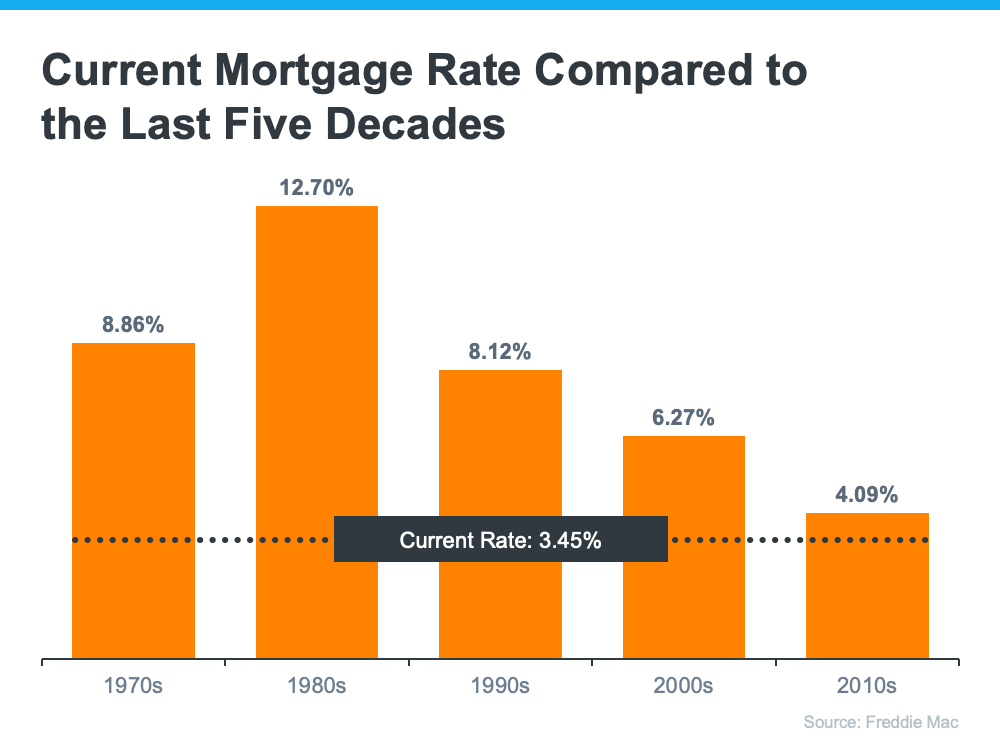
Last week, the average 30-year fixed mortgage rate from Freddie Mac jumped from 3.22% to 3.45%. That’s the highest point it’s been in almost two years. If you’re thinking about buying a home, this news may have come as a bit of a shock. But the truth is, it wasn’t entirely unexpected. Experts have been calling for rates to rise in their 2022 projections, and the forecast is now becoming a reality. Here’s a look at the projections from Freddie Mac for this year:

  • Q1 2022: 3.4%
  • Q2 2022: 3.5%
  • Q3 2022: 3.6%
  • Q4 2022: 3.7%

As the numbers show, this jump in rates is in line with the expectations from Freddie Mac. And what they also indicate is that mortgage rates are projected to continue climbing throughout the year. But should you be worried about rising mortgage rates? What does that really mean for you?

As rates increase even modestly, they impact your monthly mortgage payment and overall affordability. If you’re looking to buy a home, rising mortgage rates should be an incentive to act sooner rather than later.

The good news is, even though rates are climbing, they’re still worth taking advantage of. Historical data shows that today’s rate, even at 3.45%, is still well below the average for each of the last five decades (see chart below):

With Mortgage Rates Climbing, Now’s the Time To Act | MyKCM

That means you still have a great opportunity to buy now with a rate that’s better than what your loved ones may have paid in decades past. If you buy a home while rates are in the mid-3s, your monthly mortgage payment will be locked in at that rate for the life of your loan. As you can see from the chart above, a lot can change in that time frame. Buying now is a great way to protect yourself from rising costs and future rate increases while also securing your payment amount for the long term.

Nadia Evangelou, Senior Economist and Director of Forecasting at the National Association of Realtors (NAR), says:

Mortgage rates surged in the second week of the new year. The 30-year fixed mortgage rate rose to 3.45% from 3.22% the previous week. If inflation continues to grow at the current pace, rates will move up even faster in the following months.”

Bottom Line

Mortgage rates are increasing, and they’re forecast to be even higher by the end of 2022. If you’re planning to buy this year, acting soon may be your most affordable option. Let’s connect to start the homebuying process today.

Feb. 18, 2022

Sellers: Don't Wait Until Spring To Make Your Move In Connecticut

Sellers: Don’t Wait Until Spring To Make Your Move In Connecticut

Sellers: Don’t Wait Until Spring To Make Your Move | MyKCM

As you plan out your goals for the year, moving up to your dream home may top the list. But, how do you know when to make your move? You want to time it just right so you can get the most out of the sale of your current house. You also want to know you’re making a good investment when you buy your new home. What you may not realize is, that opportunity to get the best of both worlds is already here.

You don’t want to wait until spring to spring into action. The current market conditions make this winter an ideal time to move. Here’s why.

1. The Number of Homes on the Market Is Still Low

Today’s limited supply of houses for sale is putting sellers in the driver’s seat. There are far more buyers in the market than there are homes available, and that means buyers are eagerly waiting for your house. Listing your house now makes it the center of attention. As a seller, that means when it’s priced correctly, you can expect it to sell quickly and get multiple strong offers this season. Just remember, experts project more inventory will come to market as we move through the winter months. The realtor.com 2022 forecast says this:

“After years of declining, the inventory of homes for sale is finally expected to rebound from all-time lows.”

Selling now may help you maximize the return on your investment before your house has to face more competition from other sellers.

2. Your Equity Is Growing in Record Amounts

Current homeowners are sitting on record amounts of equity thanks to today’s home price appreciation. According to the latest report from CoreLogicthe average homeowner gained $56,700 in equity over the past 12 months.

That much equity can open doors for you to make a move. If you’ve been holding off on selling because you’re worried about how rising prices will impact your own home search, rest assured your equity can help fuel your next move. It may be just what you need to cover a large portion – if not all – of the down payment on your next purchase.

3. While Rising, Mortgage Rates Are Still Historically Low

In January of last year, mortgage rates hit the lowest point ever recorded. Today, rates are starting to rise, but that doesn’t mean you’ve missed out on locking in a low rate. Current mortgage rates are still far below what they’ve been in recent decades:

  • In the 2000s, the average mortgage rate was 6.27%
  • In the 1990s, the average rate was 8.12%

Even with mortgage rates rising above 3%, they’re still worth taking advantage of. You just want to do so sooner rather than later. Experts are projecting rates will continue to rise throughout this year, and when they do, it’ll cost you more to purchase your next home.

4. Home Prices Are Going To Keep Rising with Time

According to industry leaders, home prices will also continue appreciating this year. While experts are forecasting more moderate home price growth than last year, it’s important to note prices will still be moving in an upward direction throughout 2022.

What does that mean for you? If you’re selling so you can move into a bigger home or downsize to the home of your dreams, you want to consider moving now before rates and prices rise further. If you’re ready, you have an opportunity to get ahead of the curve by purchasing your next home before rates and prices climb higher.

Bottom Line

If you’re considering selling to move up or downsize, this may be your moment, especially with today’s low mortgage rates and limited inventory. Let’s connect today to get set up for homebuying success this year.

Posted in Home Owner Tips
Feb. 17, 2022

Risk of Removing Buyer;s Contingencies In Connecticut

Risk of Removing Buyer's Contingencies In Connecticut

Typical real estate offers include a wide variety of standard contingencies. These can include home inspections, appraisal, and loan approval. In a fast-moving, seller's market, one of the ways to make an offer more appealing is to remove contingencies.

Real estate contingencies are intended to protect the buyer from unforeseen issues. Once these contingencies are removed, the buyer typically has no recourse from these issues. The most important contingencies include:\

  • Home Inspections - including mold, well/septic, structural, geological

  • Lending Approvals - including appraisal, title, loan rate and terms. final loan approval

  • Property Condition - this relates to the final walk-through, ensuring the property has been maintained during the escrow period.

Any or all of these items can create problems during, and even after, the closing period. Without the contingencies in place, the buyer is obligated to conclude the sale and any financial incurred by the seller for not doing so including the forfeiture of their deposit.

Most of the United States is experiencing an advancing market. This means prices are rising at a steady pace. As a result, both buyers and sellers expect to settle on a price higher than recent, comparable sales. Buyers are desperate to have offers accepted and are willing to compromise on contingencies designed to protect them. Ensure you thoroughly review all contingencies or the waiver of them with your agent prior to making an offer 


Feb. 16, 2022

Achieving the Dream of Homeownership In Connecticut

Achieving the Dream of Homeownership In Connecticut

Achieving the Dream of Homeownership | MyKCM

Homeownership has long been considered the American Dream, and it’s one every American should feel confident and powerful pursuing. But owning a home is also a deeply personal dream. Our home provides us with safety and security, and it’s a place where we can grow and flourish.

Today, we remember the legacy of Dr. Martin Luther King, Jr. Many of us will remember his passion and determination for the causes he championed, including his famous “I Have a Dream” speech in 1963. As we reflect on his message today, it may inspire your own dream of homeownership. And if so, know you’re not alone. With a trusted real estate advisor at your side, you can begin your journey toward homeownership by answering the questions below.

1. Where Do I Start?

The process of buying a home is not one to enter into lightly. You need to decide on key things like how long you plan on living in an area, how much space you need, what kind of commute works for you, and how much you can spend.

Then, when you decide you’re ready to buy, you’ll need to apply for a mortgage. Your lender will look at several factors to determine how much you’re able to borrow, including your credit history. Lenders want to understand how well you’ve managed paying your student loans, credit cards, car loans, and other past debts.

According to Freddie Mac:

“To get a rough estimate of what you can afford, most lenders suggest that you should spend no more than 28% of your monthly gross (pre-tax) income on your mortgage payment, including principal, interest, taxes and insurance.”

2. How Do I Save Enough for a Down Payment?

Speaking of how much you can afford, you’ll want to know what to save for a down payment. While the idea of saving for a down payment can be daunting, there are many different options and resources that can help.

According to Business Insider, automatic savings can bring you one step closer to achieving your target down payment:

“If you receive your paycheck as a direct deposit, you may want to arrange for your company to send a percentage of each check directly into a savings account for the down payment. . . . The automatic-savings strategy makes it so you don't have to constantly remember to save money.”

Before you know it, you’ll have enough for a down payment if you’re disciplined and thoughtful about your process. And the best part is, you may need to save less for your down payment than you think. Your agent and lender can help you understand your options.

3. How Can I Reach My Financial Goals?

Another way to increase your savings is by sticking to a planned budget. If you’ve never budgeted before, there are tools available. For example, MoneyFit.org provides a budgeting worksheet you can use to create your own plan and five rules to follow when you’re saving. They recommend you:

  1. Identify Goals
  2. Record Expenses
  3. Record Earnings
  4. Compare and Calculate
  5. Fix Weak Spots

If you’re already budgeting, consider finding ways to tighten your spending a bit more to accelerate your journey to homeownership. After all, putting even a little extra into your savings each month can truly add up over time.

Bottom Line

As you set out to realize your dream of homeownership this year, know that it’s achievable with careful planning. Most importantly, let’s connect today so you don’t have to walk alone on this journey.

Posted in Events
Feb. 15, 2022

Prospect Officials Seek Residence input on funds

Prospect Officials Seek Residence input on funds

Prospect, Connecticut - A town subcommittee is finalizing a survey to get resident feedback on how to spend on COVID-19 relief funds. The town received $1.4 million out of its total $2.8 million federal American Rescue Plan funds in June. The town's American Rescue Plan Act Funds Subcommittee consisting of town council members Theresa C. Graveline, Kathryn Zandri, Megan Patchkofsky and Michael Palmerie Jr. Discussed some of the options on what to spend the funds on and how to get public input. The goal for this meeting tonight was to get started, get sort of a wish list, see who else we want to contact directly and then talk about how we're going to engage the public," Graveline said at the subcommittee's virtual meeting on Wednesday.

Feb. 14, 2022

When Is the Right Time To Sell In Connecticut

When Is the Right Time To Sell In Connecticut [INFOGRAPHIC]

When Is the Right Time To Sell [INFOGRAPHIC] | MyKCM

Some Highlights

  • If you’re trying to decide when to list your house, the time is now. There are plenty of buyers eagerly waiting for your home to hit the market.
  • The latest data indicates home showings are rising. There are more buyers than homes for sale right now. That means you’ll likely receive multiple offers, and your home won’t be on the market long.
  • Today’s market favors sellers. If you’re ready to move, let’s meet to discuss the benefits you can expect when you sell this season.