July 16, 2021

6 Reasons to Celebrate National Homeownership Month In Connecticut

6 Reasons to Celebrate National Homeownership Month In Connecticut

6 Reasons to Celebrate National Homeownership Month | MyKCM

Our homes are so much more than the houses we live in. For many, they’ve also become our workplaces, schools for our children, and safe harbors in which we’ve weathered the toughest moments of a global pandemic. Today, 65.6% of Americans call their homes their own, a rate that has risen to its highest point in 8 years.

As National Homeownership Month kicks off this June, homeowners have every reason to celebrate. A survey by Gallup just ranked real estate as the best investment you can make for the eighth year in a row. However, unlike other investment options, the benefits of owning a home aren’t purely financial. Here are the top ways Americans are winning by owning a home.

Non-Financial Benefits:

1. Civic Participation: Owning a home is owning a part of your neighborhood. Homeowners have a stronger connection to their neighborhoods and are more committed to volunteer work and other ways to get involved.

2. Pride of Ownership: Owning a home is having a space that is uniquely yours. You can customize it to your personal liking and make it reflect your personality and values.

3. A Safe Space: Owning a home gives you a sense of security and privacy – two things that have become even more valuable as we’ve tackled the challenges of the recent health crisis.

Financial Benefits:

1. Forced Savings: Owning a home builds equity. Your equity grows with each payment you make toward your mortgage. This form of forced savings can be used down the road to help you accomplish your biggest financial goals.

2. Appreciation: Owning a home is making an investment that steadily gains value, and experts project home values will continue to rise in the years to come.

3. Stability: Owning a home means having better control over your future housing payments. Over the years, a mortgage stays relatively steady, but rent costs continue to rise.

Bottom Line

If you own your home, take time this June to celebrate the ways homeownership has added value to your life. If you hope to become a homeowner this year, let’s connect today to take the first steps toward achieving your goal.

Posted in Events
July 15, 2021

What Do Experts See on the Horzion for the Second Half of the Year In Connecticut

What Do Experts See on the Horizon for the Second Half of the Year?

What Do Experts See on the Horizon for the Second Half of the Year? | MyKCM

As we move into the latter half of the year, questions about what’s to come are top of mind for buyers and sellers. Near record-low mortgage rates coupled with rising home price appreciation kicked off a robust housing market in the first half of 2021, but what does the forecast tell us about what’s on the horizon?

Mortgage Rates Will Likely Increase, but Remain Low

Many experts are projecting a rise in interest rates. The latest Quarterly Forecast from Freddie Mac states:

We forecast that mortgage rates will continue to rise through the end of next year. We estimate the 30-year fixed mortgage rate will average 3.4% in the fourth quarter of 2021, rising to 3.8% in the fourth quarter of 2022.”

However, even as mortgage rates rise, the anticipated increase is expected to be modest at most, and still well below historical averages. Rates remaining low is good news for homebuyers who are looking to maximize their purchasing power. The same report from Freddie Mac goes on to say:

“While higher mortgage rates will help slow the pace of home sales and moderate house price growth, we expect overall housing market activity will remain robust. Our forecast has total home sales, the sum of new and existing home sales, at 7.1 million in 2021....”

Home Price Appreciation Will Continue, but Price Growth Will Likely Slow

Joe Seydl, Senior Markets Economist at J.P. Morganprojects home prices to continue rising as well, indicating buyers interested in purchasing a home should do so sooner rather than later. Waiting for rates or home prices to fall may not be wise:

“Homebuyers—interest rates are still historically low, though they are inching up. Housing prices have spiked during the last six-to-nine months, but we don’t expect them to fall soon, and we believe they are more likely to keep rising. If you are looking to purchase a new home, conditions now may be better than 12 months hence.”

Other experts remain optimistic about home prices, too. The graph below highlights 2021 home price forecasts from multiple industry leaders:
What Do Experts See on the Horizon for the Second Half of the Year? | MyKCM

Inventory Remains a Challenge, but There’s Reason To Be Optimistic

Home prices are rising, but they should moderate as more housing inventory comes to market. George Ratiu, Senior Economist at realtor.comnotes there are signs that we may see the current inventory challenges lessen, slowing the fast-paced home price appreciation and creating more choices for buyers:

We have seen more new listings this year compared with 2020 in 11 of the last 13 weeks. The influx of new sellers over the last couple of months has been especially helpful in slowing price gains.”

New home starts are also showing signs of improvement, which further bolsters hopes of more options coming to market. Robert Dietz, Chief Economist at the National Association of Home Builders (NAHB), writes:

“As an indicator of the economic impact of housing, there are now 652,000 single-family homes under construction. This is 28% higher than a year ago.”

Finally, while it may not fundamentally change the market conditions we’re currently experiencing, another reason to be optimistic more homes might come to market: our improving economy. Mark Fleming, Chief Economist at First American, notes:

“A growing economy in the summer months has multiple implications for the housing market. Growing consumer confidence, a stronger labor market, and higher wages bode well for housing demand. While a growing economy and improving public health conditions may also spur hesitant existing owners to list their homes for sale, it’s unlikely to significantly ease the super sellers’ market conditions.

Bottom Line

As we look at the forecast for prices, interest rates, inventory, and home sales, experts remain optimistic about what’s on the horizon for the second half of 2021. Let’s connect today to discuss how we can navigate the market together in the coming months.

Posted in CT Buyer Tips
July 14, 2021

The Truths Young Homebuyers In Connecticut Need To Hear

The Truths Young Homebuyers In Connecticut Need To Hear

The Truths Young Homebuyers Need To Hear | MyKCM

For many young or first-time homebuyers, purchasing a home can feel intimidating. A recent survey shows some homebuyers ages 25 to 40 may be unsure about the homebuying process and what they can afford. It found:

  • “1 in 4 underestimated their buying potential by $150k or more”
  • “1 in 4 underestimated the increase in value by $100k or more”
  • “47% don’t know what a good interest rate is”

Because they feel uncertain, many young homebuyers have given up on their search, or worse, they’ve decided homebuying isn’t for them and never started on their journey to begin with.

If you’re interested in buying but aren’t sure where to begin, here are three key concepts about homeownership you should understand before you get started.

1. What You Need To Know About Down Payments

Saving for a down payment is sometimes viewed as one of the biggest obstacles for homebuyers, but that doesn’t have to be the case. As Freddie Mac says:

The most damaging down payment myth—since it stops the homebuying process before it can start—is the belief that 20% is necessary.”

According to the most recent Home Buyers and Sellers Generational Trends Report from the National Association of Realtors (NAR), the median down payment for homes purchased between July 2019 and June 2020 was only 12%. That number is even lower when we control for age – for buyers in the 22 to 30 age range, the median down payment was only 6%.

2. You May Be Able To Afford More Home Than You Think

Working remotely, exercising, and generally spending more time than ever in our homes has changed what many people are looking for in their living space. However, some young homebuyers don’t feel they can afford a home that suits their growing needs and have decided to continue renting instead. That means they’ll miss out on some of the long-term benefits of owning a home. As an article recently published by NAR points out:

“Many young adults are underestimating how much they need for homeownership, the survey finds. Millennials underestimated how much home they can afford right now, how much interest they would pay over a 30-year mortgage, and how much home values appreciate, on average, over 10 years...”

Knowing how much home you can afford when starting the buying process is critical and could be the game-changer that gets you from renting to buying.

3. Homeownership Will Become Less Affordable the Longer You Wait

Finally, with mortgage rates starting to rise along with home prices appreciating, putting off buying a home now could cost you much more later. Sam Khater, Chief Economist at Freddie Mac, notes:

As the economy progresses and inflation remains elevated, we expect that rates will continually rise in the second half of the year.”

Most experts forecast interest rates will rise in the months ahead, and even the smallest increase can influence your buying powerIf you’ve been on the fence about buying a home, there’s no time like the present.

Bottom Line

If you feel overwhelmed by the prospect of starting your home search, you’re not alone. Let’s connect today so we can talk more about the process, what you’ll need to start your search, and what to expect. 

Posted in CT Buyer Tips
July 13, 2021

Selling Your House In Connecticut? Make Sure You Price It Right.

Selling Your House In Connecticut? Make Sure You Price It Right.

Selling Your House? Make Sure You Price It Right. | MyKCM

There’s no denying we’re in a sellers’ market. With low inventory and high buyer demand, homes today are selling above the asking price at a record rate. According to the latest Realtors Confidence Index Survey from the National Association of Realtors (NAR):

  • Homes typically sell within 17 days (compared to 26 days one year ago).
  • The average home sold has five offers to pick from.
  • 54% of offers are over the asking price.

Because so many buyers are competing for so few homes, bidding wars are driving up home prices. According to an average of leading expert projections, existing home prices are expected to increase by 8.9% this year.

Yet even in today’s red-hot sellers’ market, it’s important to price your house right. While it may be tempting to price your house on the high side to capitalize on this trend, doing so could limit your house’s potential.

Why Pricing Your House Right Matters

Here’s the thing – a high price tag doesn’t mean you’re going to cash in big on the sale. While you may be trying to maximize your return, the tradeoff may be steep. A high list price is more likely to deter buyers, sit on the market longer, or require a price drop that can raise questions among prospective buyers.

Instead, focus on setting a price that’s fair. Real estate professionals know the value of your home. By pricing your house based on its current condition and similar homes that have recently sold in your area, your agent can help you set a price that’s realistic and obtainable – and that’s good news for you and for buyers.Selling Your House? Make Sure You Price It Right. | MyKCMWhen you price your house right, you increase your home’s visibility, which drives more buyers to your front door. The more buyers that tour your home, the more likely you’ll have a multi-offer scenario to create a bidding war. When multiple buyers compete for your house, that sets you up for a bigger win.

Bottom Line

When it comes to pricing your house, working with a local real estate professional is essential. Let’s connect so we can optimize your exposure, your timeline, and the return on your investment, too.

Posted in CT Seller Tips
July 12, 2021

What Do Experts See on the Horizon for the Second Half of the Year In Connecticut

What Do Experts See on the Horizon for the Second Half of the Year In Connecticut

What Do Experts See on the Horizon for the Second Half of the Year? | MyKCM

As we move into the latter half of the year, questions about what’s to come are top of mind for buyers and sellers. Near record-low mortgage rates coupled with rising home price appreciation kicked off a robust housing market in the first half of 2021, but what does the forecast tell us about what’s on the horizon?

Mortgage Rates Will Likely Increase, but Remain Low

Many experts are projecting a rise in interest rates. The latest Quarterly Forecast from Freddie Mac states:

We forecast that mortgage rates will continue to rise through the end of next year. We estimate the 30-year fixed mortgage rate will average 3.4% in the fourth quarter of 2021, rising to 3.8% in the fourth quarter of 2022.”

However, even as mortgage rates rise, the anticipated increase is expected to be modest at most, and still well below historical averages. Rates remaining low is good news for homebuyers who are looking to maximize their purchasing power. The same report from Freddie Mac goes on to say:

“While higher mortgage rates will help slow the pace of home sales and moderate house price growth, we expect overall housing market activity will remain robust. Our forecast has total home sales, the sum of new and existing home sales, at 7.1 million in 2021....”

Home Price Appreciation Will Continue, but Price Growth Will Likely Slow

Joe Seydl, Senior Markets Economist at J.P. Morganprojects home prices to continue rising as well, indicating buyers interested in purchasing a home should do so sooner rather than later. Waiting for rates or home prices to fall may not be wise:

“Homebuyers—interest rates are still historically low, though they are inching up. Housing prices have spiked during the last six-to-nine months, but we don’t expect them to fall soon, and we believe they are more likely to keep rising. If you are looking to purchase a new home, conditions now may be better than 12 months hence.”

Other experts remain optimistic about home prices, too. The graph below highlights 2021 home price forecasts from multiple industry leaders:
What Do Experts See on the Horizon for the Second Half of the Year? | MyKCM

Inventory Remains a Challenge, but There’s Reason To Be Optimistic

Home prices are rising, but they should moderate as more housing inventory comes to market. George Ratiu, Senior Economist at realtor.comnotes there are signs that we may see the current inventory challenges lessen, slowing the fast-paced home price appreciation and creating more choices for buyers:

We have seen more new listings this year compared with 2020 in 11 of the last 13 weeks. The influx of new sellers over the last couple of months has been especially helpful in slowing price gains.”

New home starts are also showing signs of improvement, which further bolsters hopes of more options coming to market. Robert Dietz, Chief Economist at the National Association of Home Builders (NAHB), writes:

“As an indicator of the economic impact of housing, there are now 652,000 single-family homes under construction. This is 28% higher than a year ago.”

Finally, while it may not fundamentally change the market conditions we’re currently experiencing, another reason to be optimistic more homes might come to market: our improving economy. Mark Fleming, Chief Economist at First American, notes:

“A growing economy in the summer months has multiple implications for the housing market. Growing consumer confidence, a stronger labor market, and higher wages bode well for housing demand. While a growing economy and improving public health conditions may also spur hesitant existing owners to list their homes for sale, it’s unlikely to significantly ease the super sellers’ market conditions.

Bottom Line

As we look at the forecast for prices, interest rates, inventory, and home sales, experts remain optimistic about what’s on the horizon for the second half of 2021. Let’s connect today to discuss how we can navigate the market together in the coming months.

Posted in Market Activity
July 9, 2021

6 Simple Graphs Proving This Is Nothing Like Last Time In Connecticut

6 Simple Graphs Proving This Is Nothing Like Last Time In Connecticut

6 Simple Graphs Proving This Is Nothing Like Last Time | MyKCM

Last March, many involved in the residential housing industry feared the market would be crushed under the pressure of a once-in-a-lifetime pandemic. Instead, real estate had one of its best years ever. Home sales and prices were both up substantially over the year before. 2020 was so strong that many now fear the market’s exuberance mirrors that of the last housing boom and, as a result, we’re now headed for another crash.

However, there are many reasons this real estate market is nothing like 2008. Here are six visuals to show the dramatic differences.

1. Mortgage standards are nothing like they were back then.

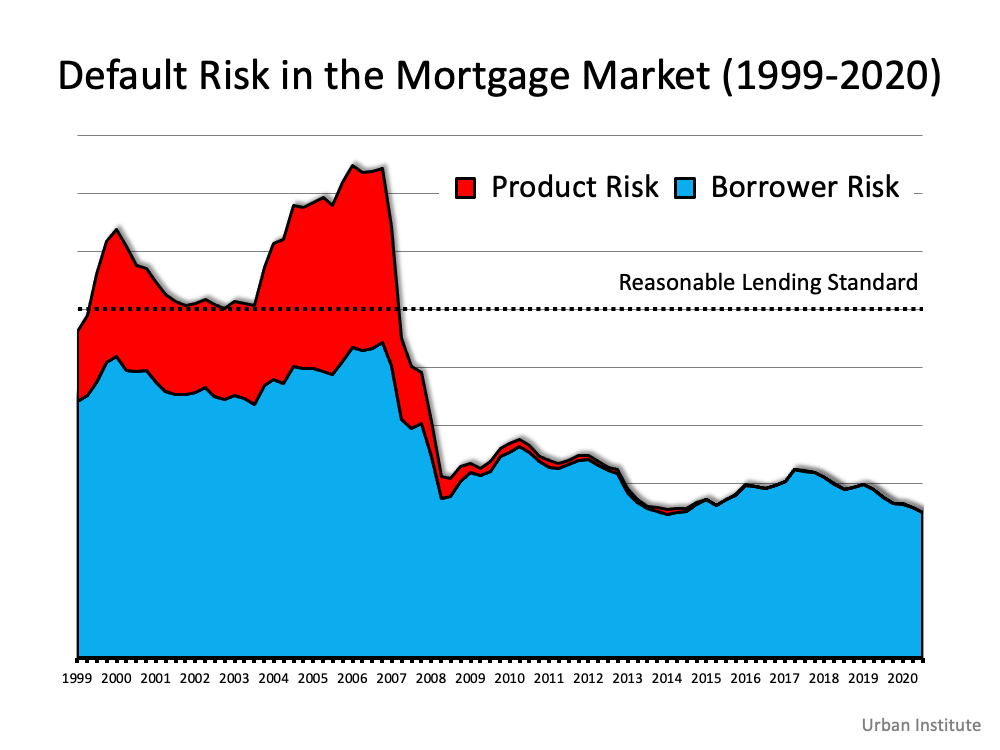
During the housing bubble, it was difficult not to get a mortgage. Today, it’s tough to qualify. Recently, the Urban Institute released their latest Housing Credit Availability Index (HCAI) which “measures the percentage of owner-occupied home purchase loans that are likely to default—that is, go unpaid for more than 90 days past their due date. A lower HCAI indicates that lenders are unwilling to tolerate defaults and are imposing tighter lending standards, making it harder to get a loan. A higher HCAI indicates that lenders are willing to tolerate defaults and are taking more risks, making it easier to get a loan.

The index shows that lenders were comfortable taking on high levels of risk during the housing boom of 2004-2006. It also reveals that today, the HCAI is under 5 percent, which is the lowest it’s been since the introduction of the index. The report explains:

“Significant space remains to safely expand the credit box. If the current default risk was doubled across all channels, risk would still be well within the pre-crisis standard of 12.5 percent from 2001 to 2003 for the whole mortgage market.”
6 Simple Graphs Proving This Is Nothing Like Last Time | MyKCMThis is nothing like the last time.

2. Prices aren’t soaring out of control.

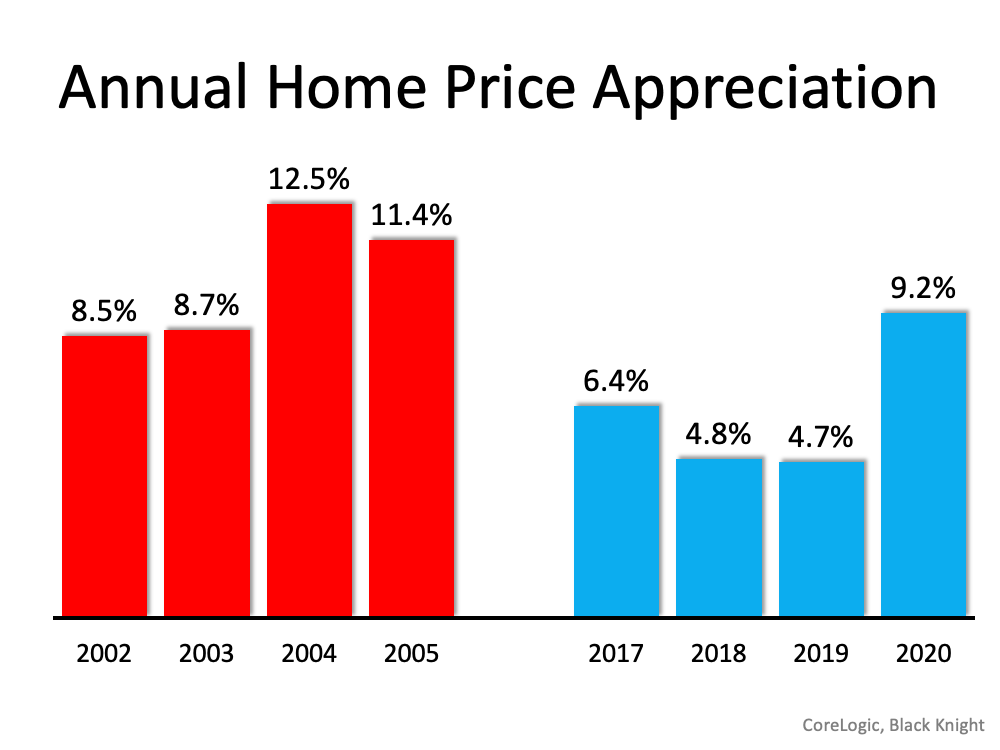
Below is a graph showing annual home price appreciation over the past four years compared to the four years leading up to the height of the housing bubble. Though price appreciation was quite strong last year, it’s nowhere near the rise in prices that preceded the crash.6 Simple Graphs Proving This Is Nothing Like Last Time | MyKCMThere’s a stark difference between these two periods of time. Normal appreciation is 3.8%. So, while current appreciation is higher than the historic norm, it’s certainly not accelerating out of control as it did in the early 2000s.
This is nothing like the last time.

3. We don’t have a surplus of homes on the market. We have a shortage.

The months’ supply of inventory needed to sustain a normal real estate market is approximately six months. Anything more than that is an overabundance and will causes prices to depreciate. Anything less than that is a shortage and will lead to continued appreciation. As the next graph shows, there were too many homes for sale in 2007, and that caused prices to tumble. Today, there’s a shortage of inventory, which is causing an acceleration in home values.6 Simple Graphs Proving This Is Nothing Like Last Time | MyKCMThis is nothing like the last time.
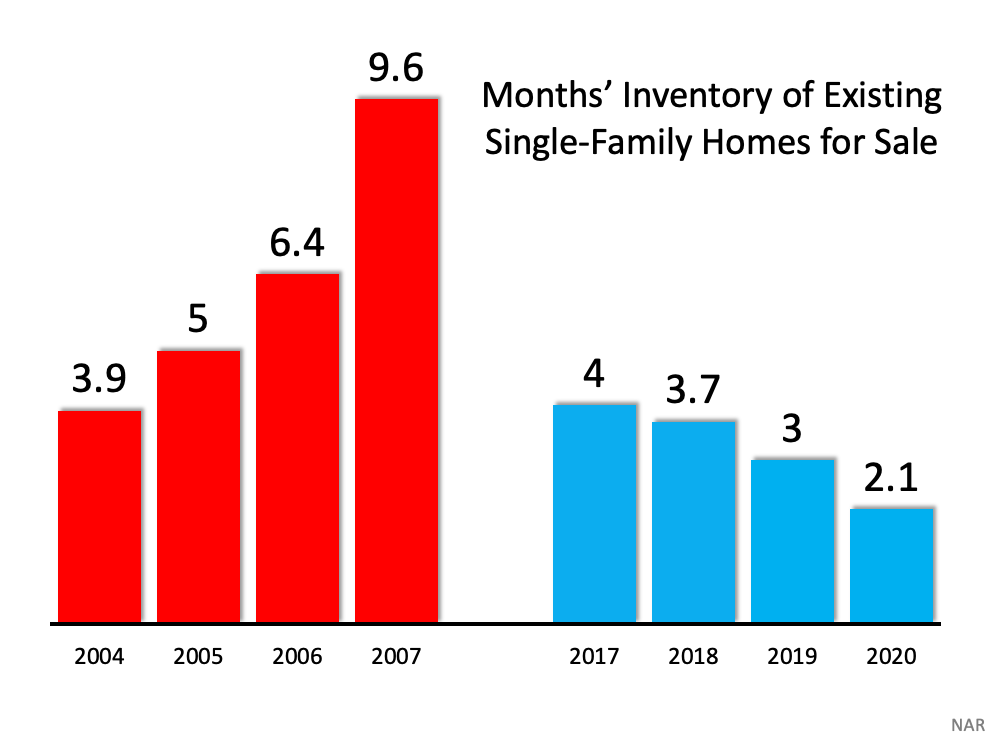
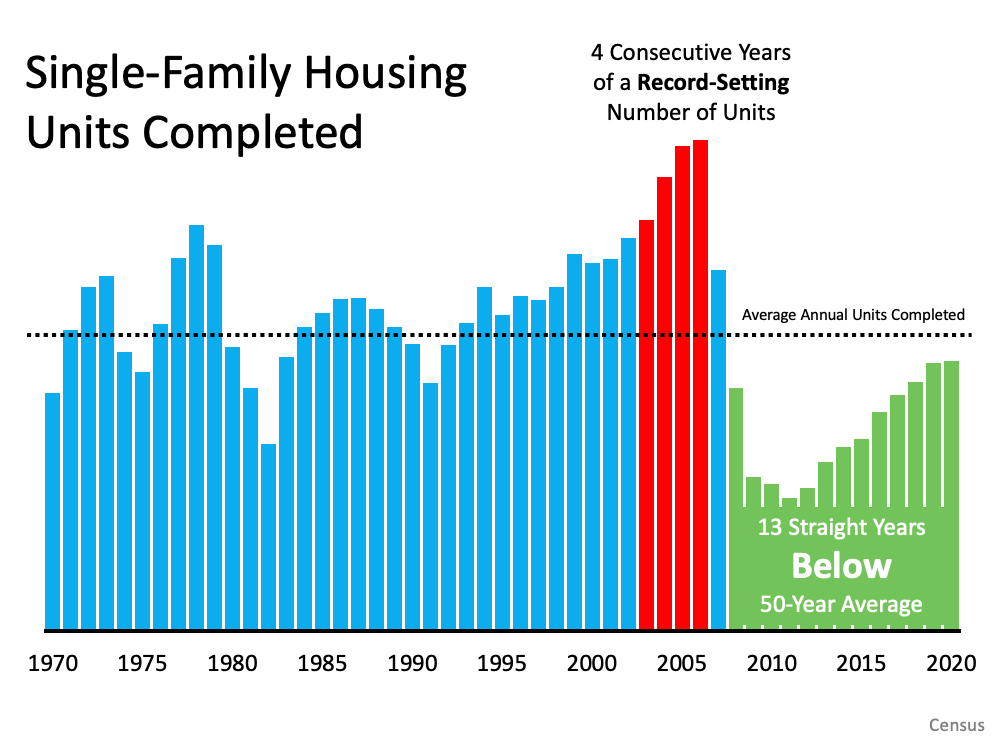
4. New construction isn't making up the difference in inventory needed.

Some may think new construction is filling the void. However, if we compare today to right before the housing crash, we can see that an overabundance of newly built homes was a major challenge then, but isn’t now.6 Simple Graphs Proving This Is Nothing Like Last Time | MyKCMThis is nothing like the last time.
5. Houses aren’t becoming too expensive to buy.

The affordability formula has three components: the price of the home, the wages earned by the purchaser, and the mortgage rate available at the time. Fifteen years ago, prices were high, wages were low, and mortgage rates were over 6%. Today, prices are still high. Wages, however, have increased, and the mortgage rate is about 3%. That means the average homeowner pays less of their monthly income toward their mortgage payment than they did back then. Here’s a chart showing that difference:6 Simple Graphs Proving This Is Nothing Like Last Time | MyKCMAs Mark Fleming, Chief Economist for First Americanexplains:
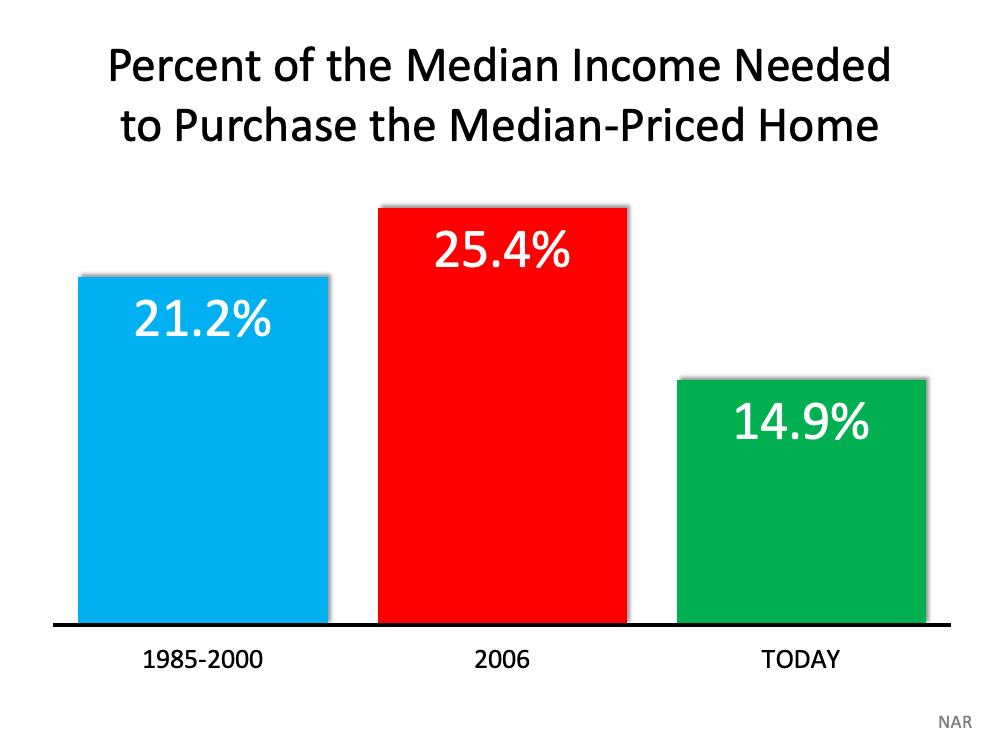
“Lower mortgage interest rates and rising incomes correspond with higher house prices as home buyers can afford to borrow and buy more. If housing is appropriately valued, house-buying power should equal or outpace the median sale price of a home. Looking back at the bubble years, house prices exceeded house-buying power in 2006, but today house-buying power is nearly twice as high as the median sale price nationally.”

This is nothing like the last time.

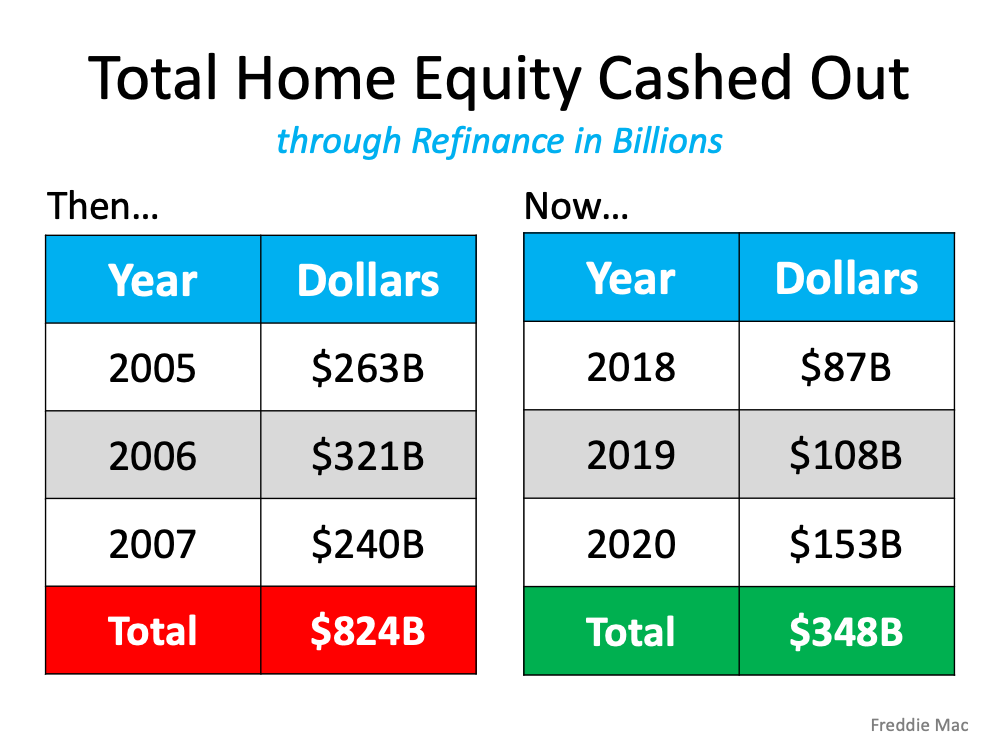
6. People are equity rich, not tapped out.

In the run-up to the housing bubble, homeowners were using their homes as personal ATM machines. Many immediately withdrew their equity once it built up, and they learned their lesson in the process. Prices have risen nicely over the last few years, leading to over 50% of homes in the country having greater than 50% equity – and owners have not been tapping into it like the last time. Here’s a table comparing the equity withdrawal over the last three years compared to 2005, 2006, and 2007. Homeowners have cashed out almost $500 billion dollars less than before:6 Simple Graphs Proving This Is Nothing Like Last Time | MyKCMDuring the crash, home values began to fall, and sellers found themselves in a negative equity situation (where the amount of the mortgage they owed was greater than the value of their home). Some decided to walk away from their homes, and that led to a wave of distressed property listings (foreclosures and short sales), which sold at huge discounts, thus lowering the value of other homes in the area. With the average home equity now standing at over $190,000, this won’t happen today.
This is nothing like the last time.

Bottom Line

If you’re concerned that we’re making the same mistakes that led to the housing crash, take a look at the charts and graphs above to help alleviate your fears.

Posted in Community
July 8, 2021

How Smart Is it to Buy a Home Today In Connecticut

How Smart Is It to Buy a Home Today In Connecticut

How Smart Is It to Buy a Home Today? | MyKCM

Whether you’re buying your first home or selling your current house, if your needs are changing and you think you need to move, the decision can be complicated. You may have to take personal or professional considerations into account, and only you can judge what impact those factors should have on your desire to move.

However, there’s one category that provides a simple answer. When deciding to buy now or wait until next year, the financial aspect of the purchase is easy to evaluate. You just need to ask yourself two questions:

  1. Do I think home values will be higher a year from now?
  2. Do I think mortgage rates will be higher a year from now?

From a purely financial standpoint, if the answer is ‘yes’ to either question, you should strongly consider buying now. If the answer to both questions is ‘yes,’ you should definitely buy now.

Nobody can guarantee what home values or mortgage rates will be by the end of this year. The experts, however, seem certain the answer to both questions above is a resounding ‘yes.’ Mortgage rates are expected to rise and home values are expected to appreciate rather nicely.

What does this mean to you?

Let’s look at how waiting would impact your financial situation. Here are the assumptions made for this example:

  • The experts are right - mortgage rates will be 3.18% at the end of the year
  • The experts are right - home values will appreciate by 5.9%
  • You want to buy a home valued at $350,000 today
  • You decide on a 10% down payment

How Smart Is It to Buy a Home Today? | MyKCMHere’s the financial impact of waiting:

  • You pay an extra $20,650 for the house
  • You need an additional $2,065 for a down payment
  • You pay an extra $116/month in your mortgage payment ($1,392 additional per year)
  • You don’t gain the $20,650 increase in wealth through equity build-up

Bottom Line

There are many things to consider when buying a home. However, from a purely financial aspect, if you find a home that meets your needs, buying now makes much more sense than buying next year.

Posted in CT Buyer Tips
July 7, 2021

Why You May Want To Crash in on Your Second Home

Why You May Want To Cash in on Your Second Home In Connecticut

Why You May Want To Cash in on Your Second Home | MyKCM

When stay-at-home mandates were enforced last year, many households realized their homes didn’t really fulfill their new lifestyle needs. An office (in some cases two), a media room, space for children to learn, a gym, and a large yard are all examples of amenities that became highly desirable almost overnight.

Zelman & Associates recently reported that sales of primary residences grew by 9% in 2020. That increase in demand was met by the lowest supply of homes for sale in history. High demand and low supply caused prices to skyrocket over the past twelve months. Here are three home price indexes released most recently that show how home values have risen:

Prices increased by double digits in every region of the country and in 19 of 20 major metros. Chicago was the only exception, where prices still rose by 9%.

What does this mean to those who purchased a second home during the pandemic?

Many people didn’t want to give up a home in the city or close to their office. Instead, they purchased a larger second home farther away and moved there to stay safe and have more space. According to the same Zelman report, sales for second homes rose an astonishing 27% in 2020.

That large second-home retreat on a lake or in the mountains would demand a higher price than the average house. Let’s assume a buyer purchased such a home for $500,000. Assuming the middle 13.2% appreciation shown above, that home would now be worth about $566,000.

Those who bought second homes to improve their lifestyle during the height of the pandemic, or those who just wanted to be in a safer environment, also made a great investment.

What should these homeowners do now as the pandemic is receding, and the economy is reopening?

The buyers of those second homes now have a decision to make. Many will move back to the original home they still own (the one that’s closer to work, friends, and family). Should they keep the second home? That could depend on answers to questions like these:

  • Now that you may have to go back to the office (at least a few days a week) and students are required to physically attend school, would you still use the second house enough to warrant the expenses of an additional home?
  • Would you go to the second home on most weekends, or would you return to the movie theater, attend sporting events, eat out at fine restaurants, or spend your time traveling again?

Bottom Line

If you purchased a larger second home during the pandemic, you were able to make day-to-day life much easier for those important to you. You also made it much safer. However, with those goals already accomplished, you now need to decide whether to continue paying the extra expenses or sell the house and cash in your profit. If you decide selling makes sense, let’s connect today to discuss the value of your second home.

Posted in Events
July 5, 2021

Save Time and Effort by Selling with an Agent In Connecticut

Save Time and Effort by Selling with an Agent In Connecticut

Save Time and Effort by Selling with an Agent | MyKCM

Selling a house is a time-consuming process – especially if you decide to do it on your own, known as a For Sale By Owner (FSBO). From conducting market research to reviewing legal documents, handling negotiations, and more, it’s an involved and highly detailed process that requires a lot of expertise to navigate effectively. That’s one of the reasons why the percentage of people selling their own house has declined from 19% to 8% (See graph below):Save Time and Effort by Selling with an Agent | MyKCMTo help you understand just how much time and effort it takes to sell on your own, here’s a look at a few of the things you need to think about before putting that “For Sale” sign up in your yard.

1. Making a Good First Impression

While it may sound simple, there are a lot of proven best practices to consider when prepping a house for sale.

  • Do you need to take down your personal art?
  • What’s the right amount of landscaping to boost your curb appeal?
  • What wall colors are most appealing to buyers?

If you do this work on your own, you may invest capital and many hours into the wrong thingsYour time is money – don’t waste it. An agent can help steer you in the right direction based on current market conditions to save you time and effort. Since we’re in a hot sellers' market, you don’t want to delay listing your house by focusing on things that won’t change your bottom line. These market conditions may not last, so lean on an agent to capitalize on today's low inventory while you can.

2. Pricing It Right

Real estate professionals have mission-critical information on what sells and how to maximize your profit. They’re experienced when it comes to looking at recent comparable homes that have sold in your area and understanding what price is right for your neighborhood. They use that data to price your house appropriately, maximizing your return.

In a FSBO, you’re operating without this expertise, so you’ll have to do your own homework on how to set a price that’s appropriate for your area and the condition of your home. Even with your own research, you may not find the most up-to-date information and could risk setting a price that’s inaccurate or unrealistic. If you price your house too high, you could turn buyers away before they’re even in the front door, or run into problems when it comes time for the appraisal.

3. Maximizing Your Buyer Pool (and Profit)

Contrary to popular belief, FSBOs may actually net less profit than sellers who use an agent. One of the factors that can drive profit up is effective exposure. Simply put, real estate professionals can get your house in front of more buyers via their social media followers, agency resources, and proven sales strategies. The more buyers that view a home, the more likely a bidding war becomes. According to the National Association of Realtors (NAR), the average house for sale today gets 5 offers. Using an agent to boost your exposure may help boost your sale price too.

4. Navigating Negotiations

When it comes to selling your house as a FSBO, you’ll have to handle all of the negotiations. Here are just a few of the people you’ll work with:

  • The buyer, who wants the best deal possible
  • The buyer’s agent, who will use their expertise to advocate for the buyer
  • The inspection company, which works for the buyer and will almost always find concerns with the house
  • The appraiser, who assesses the property’s value to protect the lender

As part of their training, agents are taught how to negotiate every aspect of the real estate transaction and how to mediate potential snags that may pop up. When appraisals come in low and in countless other situations, they know what levers to pull, how to address the buyer and seller emotions that come with it, and when to ask for second opinions. Navigating all of this on your own takes time –a lot of it.

5. Juggling Legal Documentation

Speaking of time, consider how much free time you have to review the fine print. Just in terms of documentation, more disclosures and regulations are now mandatory. That means the stack of legal documents you need to handle as the seller is growing. It can be hard to know and truly understand all the terms and requirements. Instead of going at it alone, use an agent as your shield and advisor to help you avoid potential legal missteps.

Bottom Line

Selling your house on your own is a lot of responsibility. It’s time consuming and requires an immense amount of effort and expertise. Before you decide to sell your house yourself, let’s discuss your options so we can make sure you get the most out of the sale.

Posted in Events
July 2, 2021

Before Moving In Connecticut Remember Future Needs

Before Moving - Remember Future Needs

We are spending more time at home than ever before. This impacts how we view and use our homes. If your home no longer fits your needs in this new environment, you may be considering a right-size move. The open floorplans and great room layouts that have been so popular over the past few years may not allow for the various workspaces your family needs now. Separate and private areas for work and school needs may require more rooms or nooks, causing you to wonder if a larger home makes sense.


The fact is, before you buy a larger home, consider your long-term needs. Will the kids be returning to the classroom? Will you need extra rooms in the future? Most people need to stay in a home for 5-7 years to recoup the cost of moving, planning for this time frame is an important factor in considering a move. 

Another consideration is the real estate market itself. Most of the country is experiencing a strong sellers’ market. Homes are selling for over the asking price. Not only can this make the move difficult to achieve, but the potential drop in future prices can saddle you with a home for longer than your intended timeframe.


Before deciding to move, consider the impact today’s move could have on your future. It’s advised to always plan to stay in a home for at least 7 years and if your potential new home doesn’t fit into that model, it may make more sense to redesign/remodel your current home. 

Posted in Events