


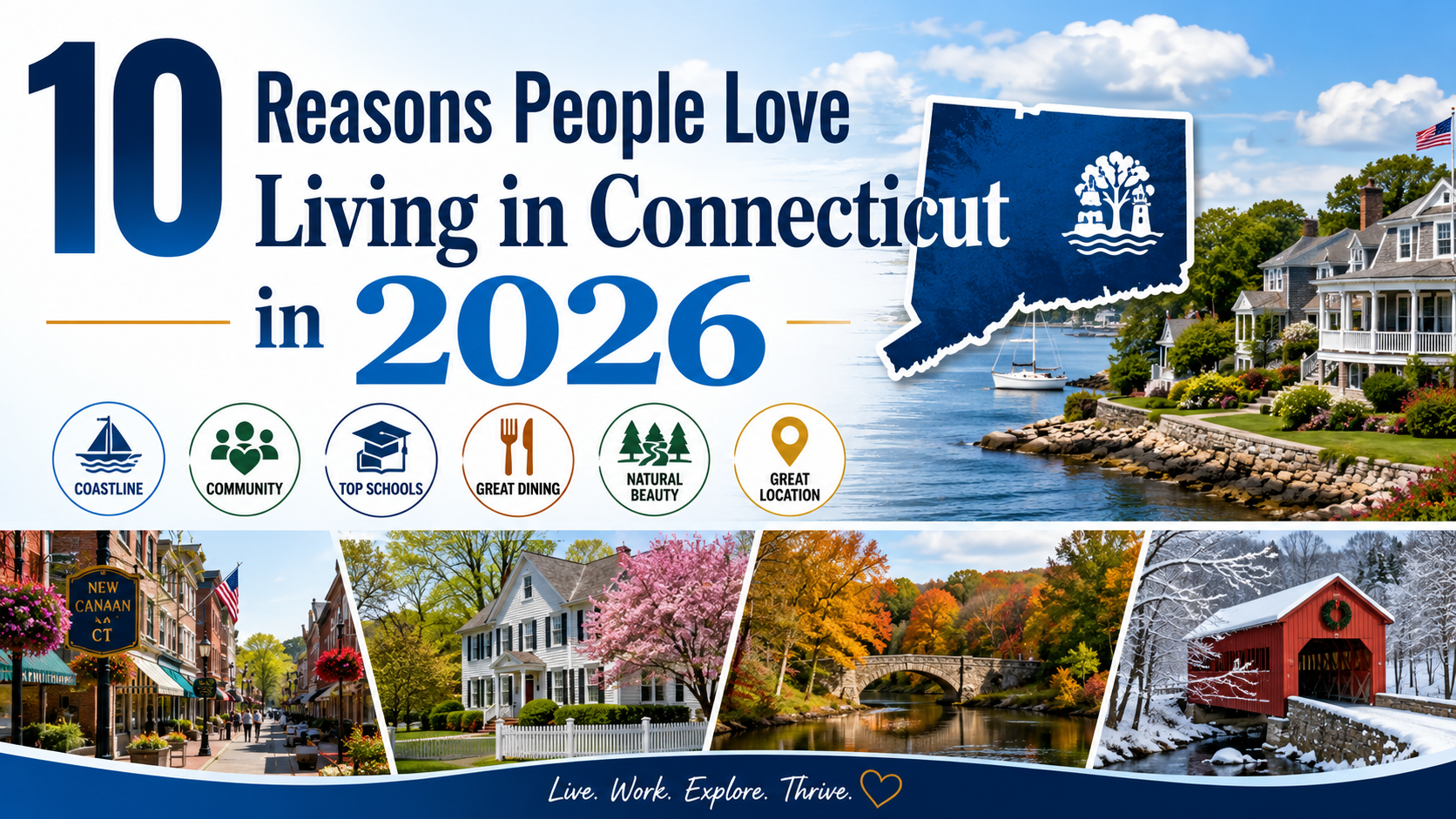
If you're thinking about living in Connecticut in 2026, you clicked on the right article. I'm going over the top reasons people genuinely love it here — and I'd bet at least one of them is something you assumed belonged on the list of reasons people avoid Connecticut.
I've spent my entire life here, so this is coming from real experience — not from someone who visited once, ate a lobster roll, took a selfie in Mystic, and declared themselves an expert.
Connecticut gets seriously misunderstood. People hear "high taxes, cold winters" and picture some gloomy, expensive corner of New England where everyone wears navy blue and argues about baseball. Then they actually get here and find it's more beautiful, more comfortable, and a lot more interesting than they expected.
(We do argue about baseball, though. Yankees, Red Sox, or Mets depends entirely on which part of the state you're in and where you grew up. That's part of the fun.)
Let's get into it.
1. The Community Is Real
This is the first thing people fall in love with. Connecticut is made up of 169 towns — not sprawling anonymous cities. You're not just another face in the crowd. Even in the busier areas, you still get that small-town feel.
Neighbors talk to neighbors. People hold doors. Total strangers apologize to each other in grocery store parking lots for absolutely no reason.
We've got roughly 3.6 million residents spread across those 169 towns, and every single one has its own personality, its own traditions, and its own loyal locals who will fight you — politely, of course — over whose pizza place is actually the best.
For buyers coming from out of state, this matters more than you'd think. You're not just buying a house, you're buying a neighborhood where people notice you exist. Block parties, farmers markets, Little League games, charity 5Ks where half the people walk and everybody gets a medal. It adds up to belonging fairly quickly.
The part that surprises people
Connecticut has an unusually high rate of civic participation. Library board meetings, historical societies, volunteer fire departments (shout-out to the Prospect Fire Department). This isn't a state where people just show up, live quietly, and leave.
That means when you move here, you're not walking into a ghost town. You're walking into a place that already has structure and community — and people will welcome you, assuming you bring decent coffee to the first meeting.
2. Four Real Seasons — and Very Different Ones Depending Where You Live
Connecticut gives you all four seasons whether you asked for them or not.
Summers are warm but rarely brutal — low-to-mid 80s on average. You'll get a few genuinely gross humid weeks in July and August, but nothing like the South.
Fall is basically a three-month postcard. Pumpkins, cider, and trees that look like they're on fire with color.
Winter is cold and snowy, and perfect for anyone who secretly enjoys sweaters and complaining about shoveling.
Spring is when everything turns green again and people remember why they live here.
The microclimate thing nobody warns you about
This is real, and it affects where you should buy. I was showing property in Milford recently and they had about half the snow on the ground that we had up here in Prospect.
Coastal towns like Milford and Madison are moderated by Long Island Sound — noticeably milder winters, and cooler summers thanks to the breeze off the water. Head up into the hills and you'll get heavier snowfall and crisper air, but the views make up for it.
It's genuinely wild how different one part of this state is from another.
And we're prepared for it
Connecticut has excellent infrastructure for storms, snow removal, and seasonal transitions. Town budgets revolve around keeping roads safe and power on. When it snows, plows are out immediately. When a hurricane is coming, people already have flashlights and batteries ready.
I have friends in the Carolinas where three inches shuts down the state. Here, three inches is a Tuesday.
Why this matters for your home search: knowing which town matches your personal tolerance for snow, heat, and cold is exactly the kind of local nuance that doesn't show up online. Buyers often assume New England weather is uniform. It absolutely isn't, and choosing the right area is the difference between surviving where you live and actually enjoying it.
3. The Local Culture and Events
Connecticut packs a ridiculous amount into a small space — historic downtown festivals, holiday parades, summer concerts on town greens that predate most of our bridges, art shows, and community fairs that have been running longer than some countries have existed.
Here's something buyers never expect: Connecticut has one of the highest numbers of nonprofits per capita in the country, with roughly 20,000 registered organizations in this little state. That means almost every weekend there's a fundraiser, a cause, or a community event.
Social life here isn't entertainment for its own sake. It's tied into the community. People care about their towns and they show up.
Then there are the town rivalries and traditions — the Cheshire Fall Festival, the Prospect Pumpkin Fest, the Southington Apple Harvest Festival, the Durham Fair, the Yale-Harvard game in New Haven where people wear scarves that cost more than your car payment. Big-time energy in bite-size settings. Something fun is always happening, and you can still be home in your pajamas by 9:00 if that's your vibe.
From a real estate perspective, this is more than charm. Towns with strong traditions and real community involvement hold their value, because people stay once they get there. That's not just a nice place to visit — that's a smart place to invest.
4. Outdoor Access Everywhere
Connecticut is the third smallest state by area, and it is absolutely loaded with landscape — coastline, lakes, forests, rivers, and trails. You're never far from fresh air.
We've got roughly 250,000 acres of state parks and forests. You can kayak the Farmington River, hike Sleeping Giant, swim at Hammonasset Beach, or spend a lazy day on Bantam Lake. (If you row past, say hi.) There are trails, fishing spots, rock climbing, and hidden waterfalls all over the place — and because the state is small, you can be at the beach in the morning and biking in the woods that afternoon.
Two facts that surprise almost everyone
Connecticut is one of the most tree-covered states in the country — somewhere around 57% of the state is still forested. People assume it's wall-to-wall houses and strip malls. It's really trees with nice neighborhoods tucked in between.
And there are more than 90 named waterfalls here — in a state you can drive across in about two hours. Chapman Falls, Kent Falls, Enders Falls. Some are tourist magnets, others are known mostly to locals.
For families and active buyers, this is a genuine quality-of-life upgrade. You're not forced to choose between a city with no green space and the middle of nowhere. You get a charming town with great schools and trails ten minutes away. That balance is rare.
5. The Food Scene Is Not What You Think
Connecticut takes eating seriously — pizza especially, and I mean aggressively seriously. Tell someone from New Haven that New York has better pizza and they'll look at you like you insulted their grandmother.
We've got famous New Haven-style apizza, endless Italian restaurants, great seafood along the shore, diners serving breakfast all day, and farm-to-table spots opening constantly.
The objection I hear: people assume Connecticut is all fine dining. That's just wrong. There are somewhere north of 8,000 eating and drinking establishments here — everything from high-end steakhouses in Fairfield County that need a reservation a month out, to a hole-in-the-wall taco place in Waterbury that will change your life for twelve dollars.
You can eat like royalty or eat on a budget, and both are excellent.
One more thing buyers don't expect: Connecticut ranks near the top nationally for specialty food producers. Small-batch bakeries, craft breweries, artisan coffee roasters, award-winning creameries like Arethusa, chocolate makers shipping worldwide. We quietly compete with Vermont and Maine as a food destination — a fact most people don't discover until their jeans start fitting differently around month six.
Real estate is local, and so is food. Living near great restaurants, breweries, coffee shops, and farmers markets is a real part of why people choose the town they choose. It's not just the house. It's the life around the house.
6. Home Prices Are More Reasonable Than You've Heard
Connecticut isn't the cheapest state in the country — I won't pretend otherwise. But it's far more affordable than most people assume, especially compared to what's around us.
As of early 2026, the median home price statewide sits right around $425,000 depending on the market you're looking at. Compare that to New York City or Boston, where the median runs double or triple. Suddenly Connecticut looks like a bargain wearing a bow tie and holding a lobster roll.
Average rent statewide runs around $2,200 a month, which is why a lot of people run the numbers and realize buying makes more financial sense than they expected.
Yes, let's talk about property taxes
It's a completely fair concern, and our taxes do run higher than southern states. But what most buyers don't expect is how dramatically taxes vary from town to town.
Connecticut is a state where you can effectively choose your tax level by choosing your town. Washington's mill rate has recently sat around 10.85. Hartford's has been up near 68.95. That's not a typo — you can cut your tax bill roughly in half by choosing a different town twenty minutes away.
Towns like Watertown, Wolcott, New Hartford, and Prospect often carry meaningfully lower rates than the coastal Fairfield County communities.
The programs nobody uses because nobody knows about them
Connecticut offers a real range of first-time buyer assistance and energy efficiency incentives. Between CHFA loan programs, down payment assistance, and rebates for insulation and heating system upgrades, buyers are regularly shocked at how many financial tools exist here.
There are programs specifically designed to help people buy homes in Connecticut that go completely unused simply because people never heard of them. Ask before you assume you don't qualify.
7. The Job Market Is a Quiet Powerhouse
People underestimate this constantly.
Major employers here include Yale University, Hartford HealthCare, UConn, Sikorsky, Pratt & Whitney, Electric Boat, and a deep bench of insurance and technology companies along the Hartford corridor. These are institutions employing tens of thousands of people and anchoring entire regions.
Unemployment has been running right around 4%, and median household income sits just over $90,000 — among the highest in the country. This is not a state struggling economically.
Remote work changed things here
Recent data suggests something in the range of 14–16% of Connecticut's workforce now works from home at least part-time, and some towns saw those numbers jump dramatically after the pandemic — Weston, for example, where a very large share of residents now work remotely.
The state adapted well: co-working spaces, upgraded internet infrastructure, and towns actively courting professionals who no longer need to commute daily into New York or Boston.
And then there's defense
Connecticut ranks among the top states nationally for defense manufacturing. We build submarines, helicopters, and jet engines here. That creates long-term economic stability with strong pay scales that most people relocating here have no idea about.
Stable jobs create stable home values. When you buy in a town with strong employment, good schools, and economic diversity, you're not just buying a house — you're making a reasonably protected investment.
8. Schools and Neighborhoods
Connecticut consistently ranks among the best-educated states in America, with over 40% of adults holding a bachelor's degree or higher. That emphasis flows directly into our public schools.
Towns like West Hartford, Cheshire, Glastonbury, Ridgefield, and Greenwich are nationally recognized. But plenty of smaller towns have strong programs, safe walkable neighborhoods, and deeply involved parents. You don't have to live in the wealthiest zip code to get a great education here.
The overcrowding objection
Buyers often worry about packed classrooms. In reality, many Connecticut districts have seen declining enrollment over the past decade, which means smaller class sizes and more individual attention. That's the opposite of what most people assume.
The option most parents don't know about
Connecticut has a substantial network of magnet schools and technical high schools. Programs like Kaynor Tech and Platt Tech offer agricultural science, specialized STEM tracks, and genuine alternatives to traditional public education.
Parents moving here often discover they have more choices, not fewer — traditional public school, a magnet program focused on science and technology, or a technical school where your kid graduates with an actual trade certificate.
And good schools mean strong resale. When you buy in a town with a solid school system and reasonable taxes, your home holds value even when the market shifts.
9. You're Sitting Between New York and Boston
Connecticut's location is one of its most underrated assets.
Major highways — I-84, I-91, I-95, and the Merritt Parkway — run through the state. Bradley International in Windsor Locks gets you almost anywhere in the world. Metro-North runs straight into Grand Central, putting New York City within about two hours, with Boston in a similar range depending on where you start.
It's the ideal setup if you want access to major cities without paying to live in one. Red Sox game, Patriots game, Broadway show — all reachable.
The traffic objection, answered honestly
Yes, some highways get busy, particularly I-95 at rush hour and the Merritt (which is only two lanes each direction).
But here's what surprises people: Connecticut has more back roads and alternate routes than GPS can keep up with. This state was laid out in the 1700s, long before anyone planned for highways, so there are countless little connectors, scenic routes, and shortcuts in every single town.
Relocating buyers often assume a 40-mile commute means California-style gridlock. Here, 40 miles can mean a scenic drive through beautiful towns with almost no traffic — depending entirely on where you live and which route you take.
Understanding those patterns, and knowing which roads to avoid and which back routes to use, is a real part of smart home buying here.
10. The Charm and the Hidden Gems
Connecticut is full of historic homes, stone walls older than the country, antique shops, covered bridges, and town greens that feel like a Hallmark movie set — except people actually live here.
We have castles. Real stone castles. Gillette Castle sits along the Connecticut River, built by an eccentric actor. Hearthstone Castle is in Danbury. There are a few private castle-style estates scattered around too. Nobody moves here expecting a medieval vibe, and yet you can go visit a castle on a Sunday afternoon.
And the college density is remarkable — over 40 colleges and universities in a state this size. Yale, UConn, Wesleyan, Trinity, Connecticut College, Quinnipiac, the University of New Haven, and on and on. That keeps towns youthful, cultured, and economically strong, and it gives you access to lectures, galleries, performances, and some genuinely elite basketball.
Whether you want shoreline towns, rural horse property, classic suburbs, or a walkable downtown with coffee shops and bookstores, Connecticut gives you distinct options without a five-hour drive between them.
It's a state that rewards people who dig a little deeper.
Buyer and Seller Takeaways
If you're buying here:
- Compare mill rates as seriously as you compare list prices. The town line can matter more to your monthly payment than the house itself.
- Ask about CHFA programs, down payment assistance, and energy rebates before assuming you don't qualify. A lot of money goes unclaimed here.
- Factor microclimate into your search. Shoreline and hill towns are genuinely different living experiences in January.
- If schools matter, look beyond the famous districts — and look at magnet and technical options, which many families don't know exist.
- Drive your prospective commute at the actual hour you'd be driving it, and ask locals about back routes.
If you're selling here:
- Community and lifestyle sell homes in Connecticut. Farmers markets, trails, festivals, and walkability belong in your listing narrative, not just square footage.
- If you're in a lower-mill-rate town, lead with it. Relocating buyers are actively comparing tax burdens right now.
- Proximity to parks, water access, and highway connectors are real differentiators worth calling out explicitly.
Thinking About Making Connecticut Home?
When you're relocating, there's a lot to weigh — home prices, taxes, commute, school quality, future resale. You can spend weeks researching and still miss the details that matter most.
That's where working with a team that knows this market inside and out changes everything. Matching people with the town that fits their budget and their lifestyle is one of the biggest things we do. We know which towns are undervalued, where the tax advantages are, and which neighborhoods are genuinely on the rise versus simply overhyped.
Whether you're moving next month or five years from now, that kind of insight early saves you time, money, and stress.
If Connecticut is even on your radar, reach out and let's build a strategy that actually works.
Dave Jones Realty Dave Jones, Broker/Owner 📞 203-910-2638 ✉️ Dave@davejonesrealty.com 🌐 www.searchallcthomes.com