


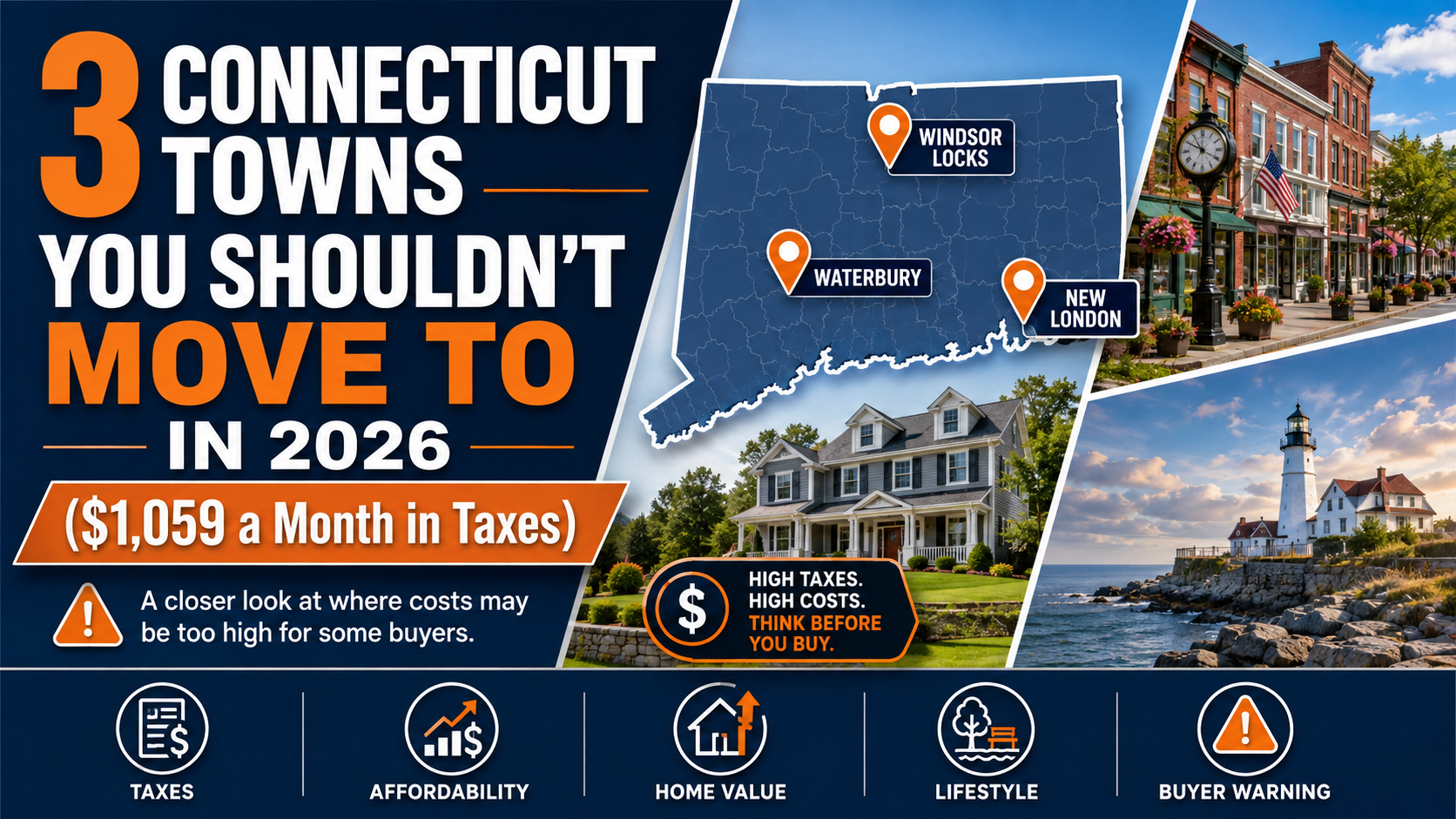
Somewhere on your Connecticut home search is a town where the house comes with a tax bill that starts at $1,059 a month — before you've paid a single dollar toward the mortgage.
I'm Dave Jones with Dave Jones Realty. There are three of those towns, and I need to talk you out of them — or into them. It depends entirely on who you are.
And one of them flips before we're done. The town you'd cross off in two seconds is probably the best buy in Connecticut right now.
Town #1 — Hamden
Hamden is a real town, and I want to say that before I say anything else.
You've got Quinnipiac University. You've got Sleeping Giant State Park. You're ten minutes from New Haven. You have actual restaurants on actual sidewalks in a downtown that functions. This isn't a place I'm picking on because it's easy.
The median sales price last year was $350,000 — right in the middle of where most buyers are working. And you look at that number, look at what $350,000 buys here compared to a lot of places, and it looks like you found something.
Here's what nobody puts in the listing.
| Hamden | |
|---|---|
| Median sales price | $350,000 |
| Mill rate | 51.88 (down from 55.61) |
| Est. annual tax at median | $12,711 |
| Monthly tax | $1,059 |
That's among the highest mill rates in Connecticut — Hartford is the only town I'd expect to run higher.
I've watched this kill deals
My friend Tony was under contract on a place. He'd been outbid on multiple properties and we finally found the right one — he loved it. We sent the application to the mortgage broker.
The broker came back and said he'd been underwriting Tony at roughly $6,000 a year in taxes. The actual number was about $13,000.
Tony could not buy that house unless the purchase price dropped by $85,000. We had to terminate the contract. The taxes killed the deal.
And it wasn't a one-off. I had a buyer relocating from out of the area with a clean pre-approval who'd done all their homework on purchase price. They found a Hamden house they loved and were emotionally moved in before we ran the escrow. Same outcome.
The house was affordable. They were approved for the house. The town wasn't affordable — they weren't approved for the town.
This is why we now run the specific tax number on every single property before anybody gets attached.
So Hamden filters on one question
Is your budget built on purchase price, or on monthly payment?
If you're a purchase-price buyer, Hamden looks like a bargain and it will wreck you. If you're a monthly-payment buyer and you've already run the escrow and the number still clears — you get a legitimately good town at a price you won't find in most of New Haven County.
Some people should absolutely buy in Hamden. Most of you shouldn't.
The fair case for it
I'm not going to skip this because of the tax number.
If you work in New Haven or anywhere along that stretch, you're ten to fifteen minutes from work. You're not sitting on I-84 for forty-five minutes twice a day. Time is the one thing you never get back, and that doesn't show up in any spreadsheet.
You've got Sleeping Giant. You've got the rail trail. You've got a hospital system and grocery stores open when you actually need them. That's not nothing — plenty of Connecticut towns make you drive twenty-five minutes for a gallon of milk and charge you nearly as much in taxes anyway.
And the mill rate came down this year, from 55.61 to 51.88. Now, when a mill rate drops it's usually because assessments went up, so don't read that as a straight discount. But it's a real data point and it's worth knowing.
I'm not going to tell you $12,711 is fine because it used to be worse. It's still $12,711.
The honest version: if you work down there, if you're staying a long time, and if you've run the actual monthly number with your own eyes and it clears — Hamden can be a good decision. If any one of those three is shaky, it isn't.
What I mean by "filter"
I'm going to keep using that word, so let me define it, because it isn't an insult.
When I say a town filters you out, I'm not talking about whether you're good enough for the town. I'm talking about a match.
These are not bad towns. Not one of them. All three are genuinely excellent places to own a house — for one very specific kind of buyer.
There's how you actually live, how far you'll drive, how you make your money, what you want a Saturday to look like, how much cushion is in your monthly budget. Every town in this state has its own answer to those baked right in. And the town doesn't care what you were hoping for.
I'll put myself in the middle of it
I live in Prospect and I have my whole life. I love it here. And I know exactly what the drive is, and what happens when you need something at nine at night. The answer is you're not getting it tonight. You go to other towns for most things.
I know the difference between visiting a quiet town and paying the mortgage in a quiet town. Those are two completely different things and people blur them constantly.
And I've made the mistake myself, so I'm not lecturing from a hill. We bought a place up on Bantam Lake in Morris, and I had a whole picture in my head about how much time I'd spend there — every season, all year. The reality is the drive is the drive. In the middle of January when it's dark at 4:30, the picture in my head and what I actually do are not the same thing.
I love that house. I love the lake. But I own it as a second place, and if I'd tried to make it my only place I'd have learned something the hard way.
That's all a filter is: the gap between the picture and the paperwork.
And these filters are almost never about money alone. People assume it's about whether you can afford it. Usually it's about whether the thing you're paying for is the thing you actually wanted. Somebody who's home all day and somebody who's out the door at six in the morning are buying two completely different houses.
So for the next two, don't ask whether the town is good. Ask whether it's aimed at you.
Town #2 — East Hampton
East Hampton is gorgeous. There's a beautiful lake sitting right in the middle of it, a real town center, and that Connecticut small-town look people move here specifically to get. When somebody pictures Connecticut before they've ever visited, they're picturing something close to East Hampton.
It gets you both things at once, which is rare — the water, the quiet, and you're still close enough to Middletown and Hartford that you're not cut off.
That combination is exactly why the price did what it did. The market found out.
And this town is dangerous for a completely different reason than Hamden. Hamden's problem is a number you can see if you bother to look it up. East Hampton's problem is timing, and timing is invisible.
| East Hampton | |
|---|---|
| 2024 median | $369,000 |
| 2025 median | $440,000 (+19.2%) |
| Mill rate 4 years ago | 34.53 |
| Mill rate now | 39.71 |
| Est. annual tax at median | $12,231 |
| Monthly tax | ~$1,019 |
Now watch what the mill rate did at the same time.
A 19.2% price jump in twelve months isn't automatically a problem — prices go up, that's the whole reason people buy houses. But the tax rate climbed underneath it simultaneously, and there was no revaluation in there.
That matters. When a town revalues, the mill rate usually drops — not because your bill went down, but because assessments went up to meet it. That's not what happened here. This is a mill rate that just climbed, year after year, on its own.
Both numbers are moving the wrong direction for you at once.
And note: that's over $1,000 a month on a house that cost less than the Hamden example. Buyers think they're saving. They're not.
What worries me about the timing
My friend Steve has been trying to buy over in Cromwell. Multiple strong offers, clean terms, and he kept losing them — and this is somebody who does this for a living. He knows exactly how to write an offer and still couldn't get one accepted.
When a guy who does this professionally gets beaten repeatedly, that isn't bad luck. That's the market. There's real pressure across that whole middle stretch of the state right now.
Pressure is great if you already own there — pressure is how equity happens. But if you're buying into it, pressure means competing, and competing means paying whatever it takes to win. And paying whatever it takes to win is exactly how people end up at the top of a 19% year.
The math that should give you pause
Buy at $440,000. Suppose the market flattens for three years, which it sometimes does. Then you have to sell.
You're paying commission and closing costs out of a number that hasn't moved. You could very easily walk away from the closing table writing a check. And in the meantime you'd have paid roughly $36,000 in property tax to live there.
I'm not saying that's what will happen. I don't know what the market does next, and neither does anybody who tells you they do. I'm saying you have to be honest with yourself that it could — before it does.
When you buy in the middle of a 19% year, you're paying whatever the market decided that town was worth on the day you signed, and you're inheriting a tax rate that's been climbing every year with no revaluation to explain it.
East Hampton filters on one question: how long are you staying?
Long horizon — ten, fifteen, twenty years? You're fine. Time smooths everything out, and it's a beautiful place to own a home.
Short horizon? If there's a real chance you're moving again in three or four years, if the job is uncertain, if this might not be the last stop — East Hampton at this exact moment is a bad bet. And I'd tell you that to your face.
Town #3 — Norfolk (the one that flips)
Norfolk sits all the way up in the northwest corner of Litchfield County, and I'm not exaggerating: it's one of the most beautiful towns in Connecticut. Stone buildings, real history, enormous stretches of protected land. Haystack Mountain is up there. There's a chamber music festival that's been running for generations.
It's also the town that will chew up more of you reading this than the other two combined.
Let me be completely straight about what you'd be signing up for
Norfolk sits at high elevation and is consistently one of the coldest spots in Connecticut. Winter starts earlier and ends later. That's not a personality trait — it's a real thing that affects your driving, your heating bill, your roof, and your patience.
There's no full-size supermarket in town. You're driving to Torrington or over to Canaan for a real grocery run. That's not a fifteen-minute errand. That's a chunk of your afternoon, every week, in February, in the dark.
The job market up there is genuinely thin. Norfolk is not going to hand you a career. If you're moving here, you need to bring your income with you — remote work, retirement, a pension, a trade you run yourself. The town is beautiful. It is not your employer.
The housing stock is old. Very old homes plus real winters means you either own tools or you have an excellent relationship with a contractor. Either way, nobody's showing up in twenty minutes. Trades in that corner of the state are stretched thin. When something breaks in January, you get in line.
Picture the second week of February
It's been gray for eleven days. The nearest real grocery store is a solid twenty-five minutes up the road. The town plows when it can. You own a generator because you need one, not because you're the kind of person who buys a generator. And the closest neighbor is far enough away that knowing them takes actual effort.
Some of you just read that and felt your shoulders drop. That sounded like heaven.
Some of you read it and felt a knot in your stomach.
Both reactions are correct. They're just correct for different people. That's the entire point.
The mistake isn't picking the wrong one. The mistake is not knowing which one you are — and finding out after you've spent the money.
Who actually thrives up there
It's a real pattern and it isn't who you'd guess. It's people whose life didn't depend on the town.
Somebody whose work is on a laptop and always has been. Somebody who's finished working with income locked in. Somebody who runs a trade out of their own truck and brings the job wherever they go.
Those people thrive, because they were never asking Norfolk for anything except the house and the quiet — and Norfolk has plenty of both.
The people who struggle are the ones who need the town to provide something. A job. A short commute. Convenience. Somebody to show up when the pipes freeze. Norfolk doesn't have those.
It's not the price, not the taxes, not the drive. It's whether you need the town to give you something.
Most of you should not move to Norfolk. I'm being straight with you. If you need a supermarket, a commute under forty minutes, or somebody who can come fix it today — Norfolk will take that dream apart in about eleven months.
And here's why it flips
| Norfolk | |
|---|---|
| Median sales price | $299,000 |
| Change from prior year | −23.1% |
| Mill rate | 22.49 |
| Est. annual tax at median | $4,707 |
| Monthly tax | $392 |
| Last revaluation | 2026 |
Under $300,000 in Litchfield County, in one of the prettiest towns in the state.
$392 a month in taxes — against the $1,059 I opened this article with.
That's a difference of over $8,000 a year, every year, for as long as you own it. Stay ten years and that's $80,000.
And Norfolk revalued this year, so the assessment is current. Nothing is coming to surprise you.
Prices came down 23.1% last year while most of the state went up, which means there's real room to negotiate right now.
For the right buyer, Norfolk is the best value in Connecticut today — and almost nobody is looking at it.
Before you sign anything
Wherever you land, do not sign until somebody has run the real monthly number for you. Not the listing price. Not last year's tax figure. The actual number, on the actual property, with the actual assessment.
Get on a Zoom with me and my team. We'll build a real budget — where you work, how you live, what has to be close by, what the house actually needs to have. Then we'll find the town that fits, at a monthly payment that works.
It costs you nothing, and you'll know more in fifteen to thirty minutes than you got out of three months scrolling listings.
Call or text: 203-910-2638 Email: Dave@davejonesrealty.com Search every home in Connecticut: www.searchallcthomes.com
We've got over 150 agents covering every corner of the state.
Tax figures are estimates calculated as median sale price × 0.70 × (mill rate ÷ 1,000) and are illustrative only — your actual bill depends on the town's assessed value for the specific property. Mill rates are set annually and revaluation schedules vary by municipality; confirm both with the town before making an offer. Market data reflects the most recent reporting period available at the time of writing; year-over-year median changes in small towns can reflect the mix of homes that happened to sell rather than a broad market move. Views on which towns represent good value are opinion, not investment advice, and past performance does not predict future results. For school information, we recommend GreatSchools.org and visiting districts directly. Buyers researching any Connecticut community should conduct their own independent due diligence on all factors relevant to their decision.
Dave Jones Realty LLC | Serving New Haven, Hartford, and Litchfield Counties