


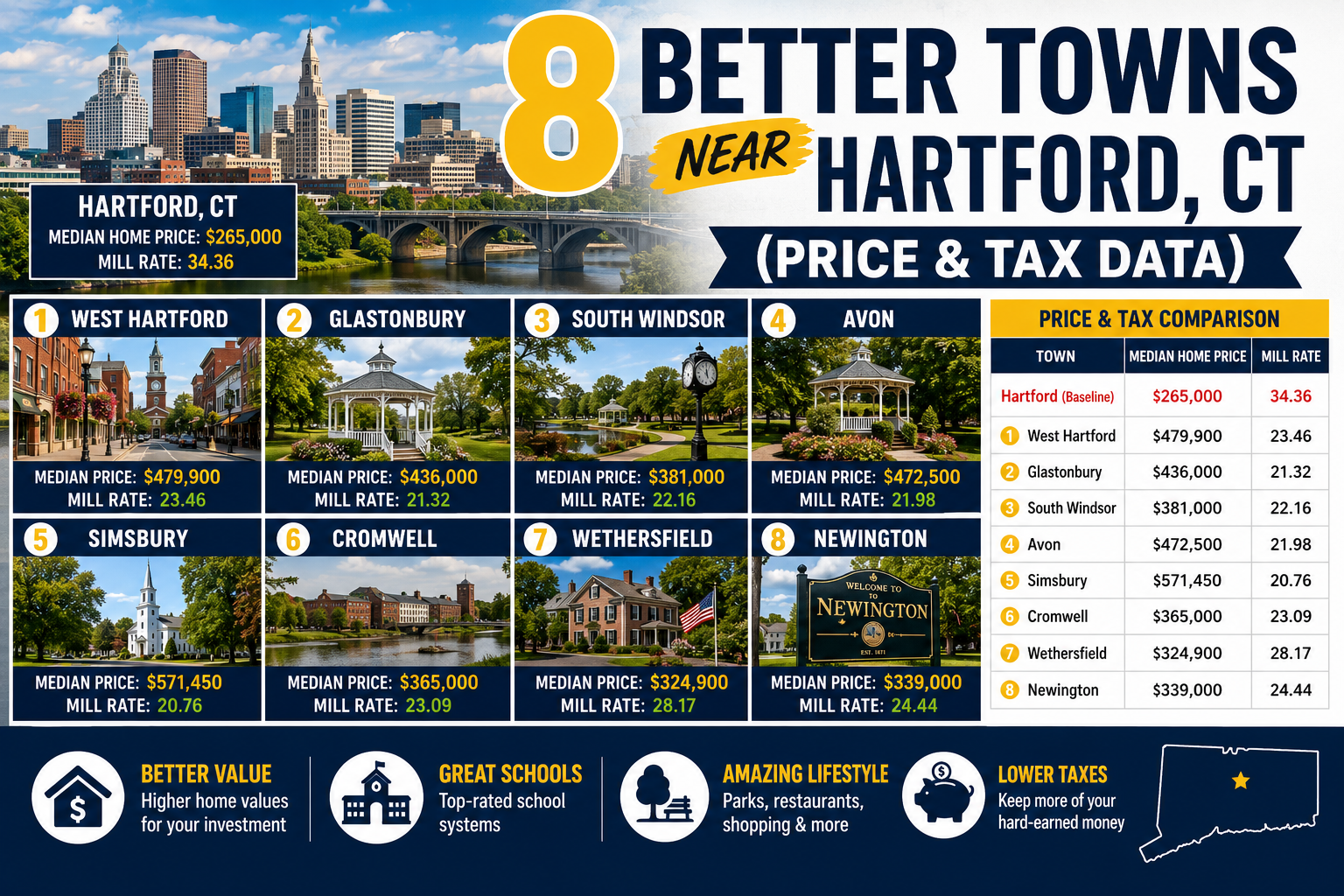
 Thinking about moving to Hartford, Connecticut? Before you do anything, hear this: some of the best places to live in the area aren't Hartford itself. Within 20 to 30 minutes, there are towns with more space, better long-term value, stronger school perception, and in some cases significantly lower taxes.
I'm Dave Jones, broker/owner of Dave Jones Realty and a lifelong Connecticut resident. Here are eight towns that might make you rethink your move — and a couple you won't expect.
A quick note on the numbers: these reflect 2025 full-year Smart MLS data and fiscal-year 2026 mill rates. Markets move, so treat these as a snapshot and reach out for current figures on any town. For a baseline: Hartford city's 2025 median was about $244,000 with a mill rate in the 70s — so once you factor taxes, schools, and ten years of equity, the suburbs tell a very different story than the sticker price suggests.
1. West Hartford — Walkability Without the Baggage
No surprise it leads. If you like the idea of Hartford's energy but want walkability, great restaurants, and a real downtown scene, West Hartford delivers all of it. Blue Back Square has a Whole Foods, a movie theater, a bookstore, and great dining, all walking distance from residential streets, plus Park Road and Bishop's Corner. Suburban, but not sleepy.
The 2025 median was about $520,000, up around 9.5%, with homes averaging just 14 days on market — one of the tightest markets in Hartford County — and sellers getting a striking 107.3% of list. Buyers are fighting over these homes.
The honest catch: the 2026 mill rate is 44.78, the highest on this list. West Hartford is not a tax bargain — you're buying reputation, walkability, top-performing schools, and hard-to-beat resale strength. (For comparison, Hartford city's mill rate is in the 70s, so the gap narrows once taxes enter the math.) Demand here skews heavily toward young professionals and remote workers who relocated post-pandemic specifically wanting a walkable suburb — and that demand supports resale.
2. Glastonbury — Affluent Without the Stuffiness
Glastonbury sits on the east side of the Connecticut River, about 10 miles from Hartford, with a distinctive identity: affluent and suburban, but grounded by an agricultural heritage of apple orchards and farm stands alongside upscale neighborhoods.
The 2025 median was about $567,500, up around 8.9%, with homes selling in about 17 days at 105.9% of list. The 2026 mill rate is 32.83 — significantly lower than West Hartford. Glastonbury consistently ranks among the state's top school districts (check GreatSchools.org for current ratings).
A lot of buyers sleep on Glastonbury thinking it's too far — it isn't. It's 10 minutes to Hartford, with easy access to I-84 and Route 2, and because it's on the east side of the river it sees less traffic competition than towns to the west. For Hartford-metro or remote workers, it delivers serious quality of life per dollar.
3. Simsbury — The Farmington Valley Surprise
Most people outside Connecticut have never heard of Simsbury, and that's part of the appeal. It's a gorgeous New England town in the Farmington Valley — a historic downtown, Talcott Mountain State Park with Heublein Tower on the ridgeline, incredible hiking and views, and exactly the character people picture when they imagine small-town Connecticut.
The data jumps out. The 2025 median was about $508,750, up around 11.8% — the biggest price gain on this list — with homes averaging just 13 days on market (the fastest of the eight) and sellers receiving 107.9% of list (also the highest). The 2026 mill rate is 33.02 — reasonable.
The market has figured out Simsbury, and buyers are competing hard because they see the value. Snag something here before prices climb further and you'll look smart in five years. It also has a quietly strong arts scene — the Simsbury Meadows Performing Arts Center hosts major outdoor events every summer — the kind of lifestyle detail that never shows up on a listing but matters enormously.
4. Avon — The Best-Kept Secret
Avon is small (about 18,000 people), tucked into the Farmington Valley next to Simsbury — tight-knit, low-density, the kind of town where people stay 20-plus years because they have no reason to leave.
The 2025 median was about $587,150 — the highest on this list — up around 6.8%. But here's what makes it compelling: the mill rate is only 30.75, the lowest of any town here. So yes, homes cost more, but your annual tax burden per dollar of assessed value is lower than anywhere else on the list. Homes moved in about 22 days at 103.4% of list — competitive, but with slightly more breathing room than Simsbury or West Hartford.
Avon draws a high share of executive-level buyers, with insurance and healthcare companies headquartered in Hartford relocating people here regularly. That creates a consistent, strong buyer pool — great for your resale value.
(Quick pause: if you'd love to see what's actually available in any of these towns, that's exactly what my team is here for. Reach out anytime.)
5. Farmington — Old Money, New Energy, and Room to Breathe
Farmington has incredible historic character — a village center dating to the 1600s, Miss Porter's School (one of the most prestigious prep schools in the country) right on Main Street, and the Farmington River running through town for kayaking, fly fishing, and hiking.
Here's the interesting part: the 2025 median was about $456,500 — down about 1.3% from the year before, a slight softening in a market where nearly everything else climbed. For buyers, that's opportunity — you're not fighting the feeding frenzy of Simsbury or West Hartford. Homes still averaged just 20 days at 104% of list, and the 2026 mill rate is 26.62, one of the lowest on this list. That combination — relative price softening, low mill rate, genuine lifestyle appeal — makes Farmington a genuinely interesting buy right now.
It also has real cultural depth: the Hill-Stead Museum, a national historic landmark, hosts outdoor poetry festivals on its grounds every summer. That matters to a certain buyer, and those buyers keep demand stable long term.
6. Southington — The Value Play
Southington sits in southern Hartford County along I-84, with a strong, proud working-class identity and a real sense of community you don't always find in the more affluent suburbs. The Apple Harvest Festival every fall draws tens of thousands — this town shows up for itself.
The 2025 median was about $421,000, up a solid 9.4%, with homes selling in about 17 days at 102.9% of list, and a 2026 mill rate of 33.21 — very reasonable. You've got a town appreciating faster than most, moving quickly, and coming in roughly $150,000 cheaper than Glastonbury with a comparable tax rate. For buyers priced out of top-tier Hartford suburbs, Southington doesn't feel like a compromise — it feels like a smart play.
Its highway access is excellent (I-84 and Route 10), making it genuinely commutable to Hartford, New Haven, and even north to Boston or south to New York — dual-market appeal that gives it a larger buyer pool than you'd expect for its size.
7. Rocky Hill — Affordable, Underrated, and Yes, Dinosaurs
Rocky Hill is a small town on the Connecticut River just south of Wethersfield, about 8 miles from Hartford. It's modest and quiet without the name recognition of Glastonbury or Simsbury — which is exactly why the price is interesting.
The 2025 median was about $365,000 — the most affordable on this list — up around 3.8%, which signals a healthy, moving market that isn't overheated. Homes averaged just 16 days at 103.3% of list, and the mill rate is 30.24. Rocky Hill also has one of the highest condo shares in Hartford County (around 50%), so if you're looking at condos or townhouses, the inventory here is deep.
And the dinosaurs: Dinosaur State Park has one of the largest dinosaur track sites in North America — real, 200-million-year-old tracks under a giant geodesic dome, where you can make casts of the tracks in summer. Rocky Hill is also one of the more diverse towns in the county, and that shows up in a genuinely interesting local restaurant scene. Underrated across the board.
8. Canton (and Collinsville) — Historic Character on the River
I saved this one on purpose. Canton is a small Farmington Valley town about 20 minutes northwest of Hartford, and Collinsville is the historic mill village at its heart. The Collins Company made axes and machetes here starting in 1826 and shipped them worldwide; the old factory buildings still stand on the Farmington River, now converted into shops, restaurants, and apartments. It's one of the most visually stunning small villages in the entire state.
The 2025 median was about $456,500, up around 3.8%, with homes averaging 22 days at 104.9% of list — quite strong for a smaller market — and a 2026 mill rate of 33.50. The Farmington River Trail runs right through Collinsville, with kayaking, tubing, cycling, and hiking all within walking distance of restaurants and coffee shops.
Canton has been drawing remote workers from New York and Boston who specifically want the Farmington Valley lifestyle — the outdoors, the creative community, the small-town feel without generic suburbia. That in-migration is just beginning, which means it's a town to be in before it's fully discovered.
Buyer and Seller Takeaways
If you're buying around Hartford:
- Separate where you work from where you live — Hartford can be the job anchor without being home base.
- Weigh mill rate against price, not price alone. Avon (30.75) and Farmington (26.62) carry lower rates; West Hartford (44.78) is a premium you pay for reputation and resale.
- Match your budget tier: Rocky Hill and Southington for accessible entry; Glastonbury, Avon, and West Hartford for premium; Simsbury and Canton for lifestyle-forward value.
- Watch the outliers — Farmington's slight 2025 softening is a rare opening in a hot region, and Canton's early in-migration wave is a get-in-before-discovery play.
- In the fastest markets (Simsbury ~13 days, West Hartford ~14), be pre-approved and ready to move above asking.
- Do your own school and safety research by exact address; don't rely on any single data point.
If you're selling in one of these towns:
- Lead with what your town does best: walkability and schools in West Hartford, space and orchards in Glastonbury, Farmington Valley character in Simsbury/Avon/Canton, value and commute in Southington/Rocky Hill.
- Where you have a mill-rate advantage (Avon, Farmington), put it in front of value-focused buyers running the math.
- Price to current comparable sales — 2025 appreciation varied widely town to town, and even softened slightly in Farmington, so a neighbor's number isn't automatically yours.
Which Town Fits You?
I've lived here my whole life — I shop in these towns, eat in them, and go to events in all of them, so I know what sells and what sits. If you're trying to figure out where you actually belong in Connecticut, that's a conversation I'd genuinely like to have.
Reach out and my team will help you browse real inventory and find the fit.
Dave Jones Realty Dave Jones, Broker/Owner 📞 203-910-2638 ✉️ Dave@davejonesrealty.com 🌐 www.searchallcthomes.com