


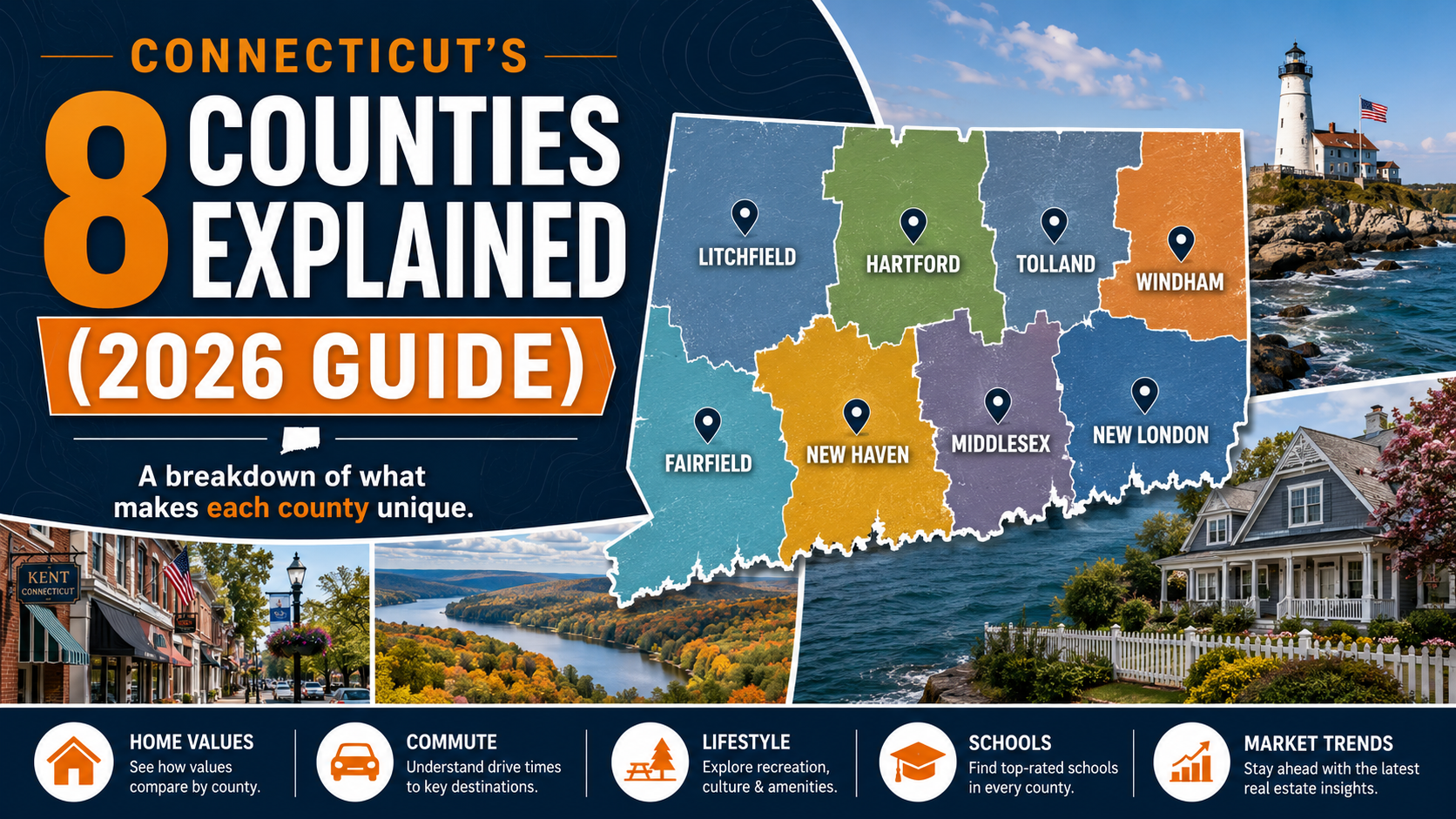
 Connecticut is one of the most interesting states to think about from a real estate perspective, because your experience can differ dramatically depending on which part of the state you buy in. The state has eight counties, and this is the overview to start with if you're relocating or just trying to figure out which part of Connecticut fits you.
A quick note on the numbers: the county median prices below reflect 2025 full-year data. They move, so treat them as a snapshot — and reach out for current figures on any specific town.
1. Fairfield County — "New York's Backyard"
Southwest Connecticut, running along the New York border and Long Island Sound from Greenwich up through Danbury. If you've heard "the Gold Coast," this is it — the wealthiest county in the state by a significant margin.
Towns like Greenwich, Westport, Darien, New Canaan, Wilton, and Ridgefield carry real weight in the national real estate conversation; Greenwich is essentially an extension of Manhattan money, home to finance executives who want far more space than New York offers while keeping a practical Metro-North commute.
But Fairfield isn't only mansion country. It also includes Bridgeport (the largest city in the state, with a very different profile), Stamford (genuine urban density, a real skyline, and a growing tech and financial presence), and accessible mid-range suburbs like Trumbull, Monroe, and Newtown. What ties it together: excellent schools, proximity to New York, Sound access, and a culture that's suburban and deeply connected to one of the world's most dynamic cities. If you need to stay plugged into New York City, this is your county.
2025 median: around $660,000 — the highest of any county, and that number actually understates the top end because it's pulled down by the more affordable eastern cities.
2. New Haven County — The Academic and Industrial Heart
Move east along the coast and you hit New Haven County — historic, diverse, and economically complex. The anchor is New Haven itself: home to Yale University, some of the best pizza in the country, an international academic community, a strong arts scene, and Yale-New Haven Hospital, one of the top medical centers in the country. Neighborhoods like East Rock and Wooster Square are walkable and beautiful.
But the county is much more than New Haven. Milford offers shoreline access at an accessible price, Cheshire and Wallingford consistently rank among the state's most desirable family suburbs, and Waterbury — the county's second-largest city — has its own distinct history and opportunity.
2025 median: around $380,000 — genuinely accessible by Connecticut standards, spanning starter homes in Meriden and Derby up to six- and seven-figure properties in Woodbridge and North Haven. It's a strong fit if you want good schools and suburban stability without Fairfield County prices, while staying connected to Yale and the medical community.
3. Hartford County — The Capital and Insurance Corridor
North-central Connecticut, the state capital, and in many ways the state's spine. Hartford brings the infrastructure and institutional employment of a capital, anchored by insurance (Travelers, The Hartford, Aetna) and state government — plus the Yard Goats and, nearby, UConn basketball.
But the more interesting real estate story is the suburbs. West Hartford is one of the most consistently popular towns buyers ask us about — walkable town center, top-ranked schools, character-rich housing, and broad appeal. Just beyond it: Glastonbury (upscale, excellent schools), Simsbury (more rural and scenic, still commutable), the Farmington River Valley towns of Farmington, Canton, and Avon (quieter, suburban), and Southington, Newington, and Wethersfield for value-focused buyers who want a foothold without a premium.
Hartford itself is complicated — it's had real economic struggles and the realities of a large city — but it's also home to the Wadsworth Atheneum (one of the oldest art museums in the country) and the Bushnell, with real investment flowing in and a trajectory pointing up.
2025 median: around $370,000 — exceptional value for what the suburban ring offers.
4. Litchfield County — The Scenic Escape
The northwestern corner, the state's largest county by land area, bordered by New York and Massachusetts. This is the Connecticut people romanticize, and the romanticization is mostly earned — hills, lakes, rivers, farmland, covered bridges, and movie-worthy fall foliage.
The county seat, Litchfield, is a remarkably preserved colonial town with a painting-worthy green. Mix in Kent, Washington, Salisbury, and Sharon — towns that draw artists, second-home buyers, and people leaving New York for a slower pace, with prices that reflect that demand. But there's an accessible side too: Torrington (the largest city, more traditionally working-class), plus Winsted, New Milford, Barkhamsted, and Harwinton, where the landscape is beautiful and prices are meaningfully lower.
Outdoor life is exceptional — Bantam Lake (the largest natural lake in the state), the Appalachian Trail, the nationally recognized trout fishing on the Farmington River, and Mohawk Mountain for skiing. Remote work has accelerated what was already happening: people will drive longer to the train to live somewhere like this.
2025 median: just over $400,000, up around 8%.
5. Middlesex County — The Connecticut River Valley Hidden Gem
The south-central part of the state, straddling the Connecticut River on its final run to Long Island Sound, and genuinely underappreciated. The county seat, Middletown, is home to Wesleyan University, which lends cultural energy, great restaurants, and a walkable downtown you don't always find in a city this size.
Head south along the river and you hit Chester, Deep River, and Essex — among the most charming communities in the state. Essex is frequently cited nationally as one of the best small towns in America, with a preserved maritime village, 18th-century architecture, and a working harbor. The river has kept its natural character — osprey, bald eagles, tidal marshes — in a way that shapes daily life. Inland, Killingworth, Haddam, and East Haddam offer more rural, wooded settings at accessible prices.
2025 median: around $435,000. In my view, one of the more undervalued counties relative to what it offers — the quality-of-life radius within 30–40 minutes of your door is surprisingly strong, and I think more buyers will figure that out.
6. New London County — Coastline Meets Defense
The southeast corner, defined by two things you don't often find together: an extraordinary natural coastline and a massive military and defense presence. The naval submarine base in Groton and the General Dynamics division that builds the submarines employ tens of thousands, giving the county an economic stability that isn't dependent on white-collar commuter patterns — which creates consistent housing demand.
The coast is exceptional. Mystic is one of the most visited destinations in the state, with a world-class seaport museum; Old Lyme is famous as the birthplace of American Impressionism; Stonington is one of the most beautiful small towns in New England; and ferry connections to Block Island and Long Island are a real perk. Inland, Ledyard, Colchester, and Salem offer accessible rural options.
2025 median: around $395,000 — very reasonable for coastal access, and well below comparable water-access areas in Fairfield. For buyers where water is part of the lifestyle rather than just a backdrop, this is one of the most honest values in the state.
7. Tolland County — University Country
Northeast-central Connecticut, shaped almost entirely by the University of Connecticut in Mansfield — a major research university with medical and law schools and tens of thousands of students and faculty. That's the economic engine, and it creates a housing market meaningfully different from purely suburban or rural counties.
The towns around UConn mix university-connected residents with longtime locals. Vernon is a traditional mill town evolving steadily; Tolland itself is one of the state's better-kept secrets, with an attractive historic green, great schools, and a value-oriented price point. Hartford is a doable 30–40-minute commute, and there's enough local employment that people don't always need to leave the county. The landscape is classic rolling New England — not as dramatic as Litchfield, but peaceful and very livable.
2025 median: around $387,000 — one of the most accessible counties in the state, and genuinely underrated for what you get.
8. Windham County — The Quiet Corner
The northeast corner: the most rural, most affordable, and most off-the-radar county, bordering both Massachusetts and Rhode Island. No major interstate, no dominant city — the largest town, Putnam, has under 10,000 people, and that's the whole point.
This is where the 20th century moved more slowly. Putnam's old mill buildings have become antique shops and small businesses in a downtown with a real following among collectors. Woodstock is one of the most beautiful towns in the state, its fairgrounds hosting one of the oldest country fairs in America, and Pomfret adds an unexpected educational anchor. The outdoors are excellent — Bigelow Hollow, Mashamoquet, and some of the best fishing and hunting in the state. Remote work has reached even here: people from Providence, Hartford, and Boston are discovering you can get a three-acre farmhouse for what a condo costs in a commuter suburb.
2025 median: around $375,000, up nearly 9%. Not for everybody, but if you genuinely want land, quiet, and a slower pace, it's one of the most compelling price points in the state.
Connecticut Median Home Prices by County (2025)
For quick comparison — all approximate, full-year 2025:
- Fairfield: ~$660,000 (highest)
- Middlesex: ~$435,000
- Litchfield: ~$400,000+
- New London: ~$395,000
- Tolland: ~$387,000
- New Haven: ~$380,000
- Windham: ~$375,000
- Hartford: ~$370,000 (most accessible)
Buyer and Seller Takeaways
If you're buying:
- Start with the county, then narrow to the town. Optimizing for a New York commute points you to Fairfield; for value and stability, look at Hartford, New Haven, or Tolland; for coastline, New London; for scenery and land, Litchfield or Windham.
- Remember county medians hide huge internal range — Fairfield spans Bridgeport to Greenwich, and New Haven spans Meriden to Woodbridge. The town matters more than the county average.
- Weigh the "quality-of-life radius" — what's within 30–40 minutes of your door — not just the commute. Middlesex and New London score higher on that than their reputations suggest.
- Once you've narrowed to a county, dig into specific towns and verify schools and taxes at the address level.
If you're selling:
- Position your home within its county's identity — New York access and schools in Fairfield, value and stability in the Hartford/New Haven ring, water and lifestyle in New London and Middlesex, land and quiet in Litchfield and Windham.
- Price to your specific town's current comparable sales, not the county median — the spread within each county is wide.
Which County Is Right for You?
The right county depends entirely on what you're optimizing for — commute, budget, schools, water, land, or pace of life. This overview is the starting point; the next step is finding the specific town inside it that fits your life and budget.
If a county caught your attention, reach out and let's have an honest conversation about where in Connecticut fits your future.
Dave Jones Realty Dave Jones, Broker/Owner 📞 203-910-2638 ✉️ Dave@davejonesrealty.com 🌐 www.searchallcthomes.com