


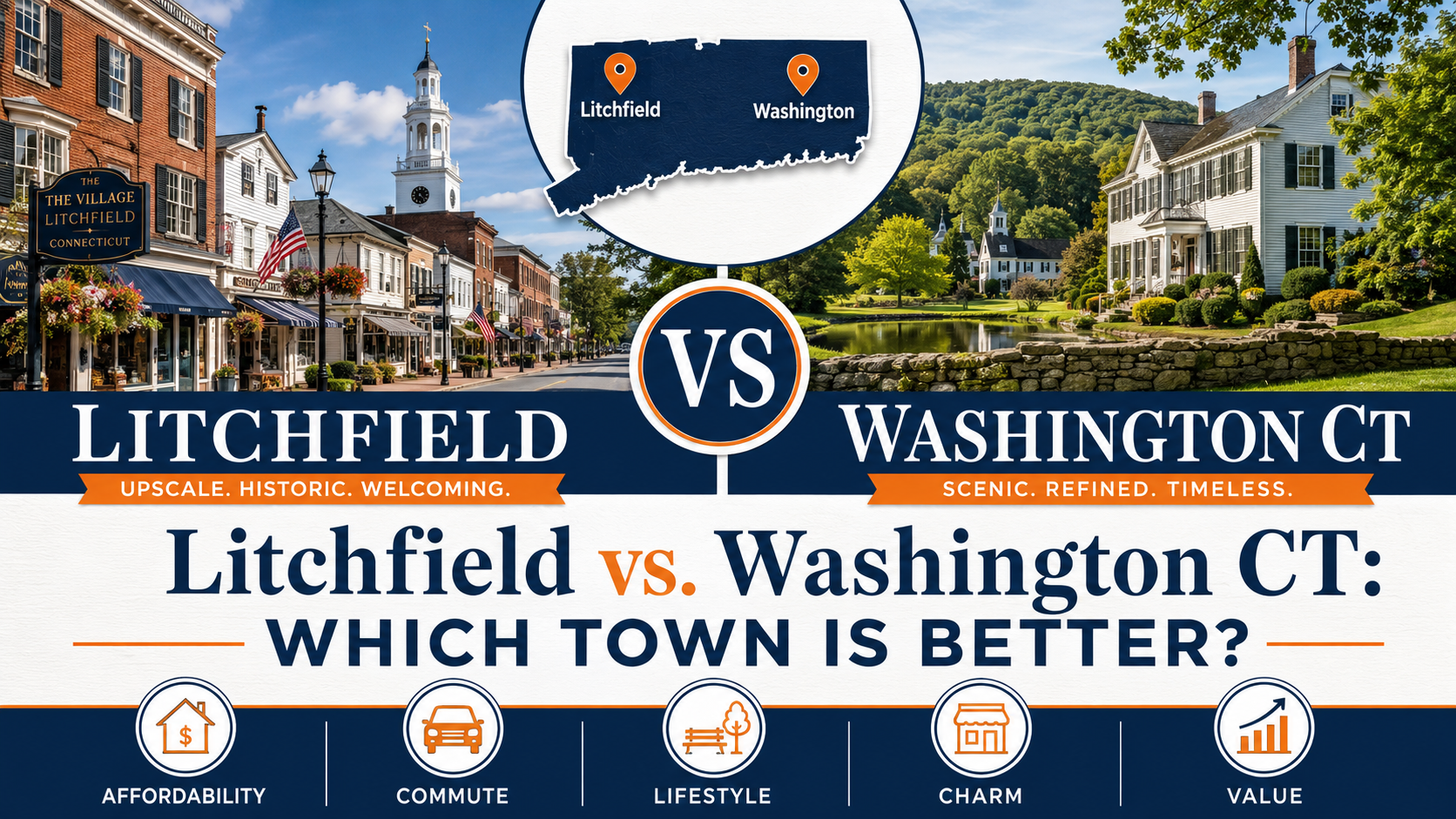
 If you're deciding between Litchfield and Washington, Connecticut, you're choosing between two of the most desirable towns in all of Litchfield County. On the surface they can seem similar — both historic, both beautiful, both offering that classic New England small-town charm people move to Connecticut for.
But once you break them down, they're not the same decision at all, and that's exactly where buyers get tripped up.
So let's settle it. I'm putting Litchfield and Washington head-to-head across 10 categories, each worth half a star — win the category, get the half-star; if both are strong, they split it — for a final rating out of five. By the end, you'll understand not just which town is more expensive or more exclusive, but which one makes more sense for you.
A quick note on the numbers: the market data below reflects 2025 full-year figures and early-2026 mill rates. In small, high-end markets like these, a handful of sales can swing the percentages, so treat these as a point-in-time read — and reach out if you want current figures.
Round 1: Entry Price
Let's start with what pulls most buyers in. Based on 2025 full-year data, Litchfield's median sales price was about $527,000, while Washington's was about $765,000 — roughly $238,000 higher on average. That's a massive gap, and for buyers trying to get into Litchfield County, it can be the difference between buying and being priced out entirely.
Litchfield's lower price reflects accessibility — still exclusive, but not prohibitive. Washington's higher price reflects scarcity, privacy, and buying into one of the most sought-after towns in the state.
If the question is simply "where can I buy for less," the answer is clearly Litchfield.
Litchfield — half a star.
Round 2: Property Taxes
Now the part that changes the game for long-term ownership — and this is where Washington dominates.
Litchfield's mill rate for fiscal year 2026 was 20, which is genuinely one of the lower rates in the state. But Washington's was 10.85 — the lowest mill rate in all of Connecticut.
Here's what that means in real dollars on a $500,000 home: roughly $10,000 a year in Litchfield versus about $5,000 a year in Washington. That's around a $4,500 difference every single year — and over a 30-year mortgage, well over $130,000 in tax savings.
Here's the kicker: even though Washington homes cost more up front, the tax savings can make the monthly payment comparable to — or even lower than — a cheaper home in Litchfield. Washington is more expensive to buy but significantly cheaper to own, and over time that matters more than purchase price.
Washington — half a star.
Before we move on, make sure this lands: Litchfield wins Round 1 because it's cheaper to buy; Washington wins Round 2 because its tax savings are large enough to offset a big chunk of the higher price. This isn't just Litchfield versus Washington — it's entry point versus long-term value.
Round 3: Market Momentum
Market momentum tells you a lot about demand, buyer confidence, and trajectory.
In 2025, Litchfield closed about 95 sales at a median of $527,000 (down slightly from the prior year), with roughly 58 days on market. A little slower, values softened slightly, homes took a bit longer.
Washington closed about 53 sales at a median of $765,000 — down close to 30% from 2024 — with about 89 days on market. That's notable volatility.
What does it mean? Both markets cooled slightly, and both saw relatively flat volume. But Washington's median drop is significant. That likely doesn't mean values crashed — it more likely reflects a shift in the mix of homes sold (fewer ultra-high-end sales, more mid-range), which is common in a small, high-price market. Litchfield's market is simply more stable; Washington's is more volatile given the smaller sample and higher price point.
For stability, Litchfield has the edge.
Litchfield — half a star.
Round 4: The Buying Experience
With nearly double the sales volume, Litchfield has more inventory — more opportunity to find the right property without waiting months for something to appear.
Washington has far fewer sales and longer days on market, so it requires patience. When the right property hits, you need to be ready — but you're also not competing against dozens of buyers on every listing.
Both markets are selective and both reward decisiveness, but Litchfield's higher inventory flow gives buyers more options and more chances to find the right fit.
Litchfield — half a star.
(Quick side note: figuring out which town actually fits your price point and priorities is exactly what my team does every day. Reach out and we'll point you in the right direction.)
Round 5: Commute and Daily Access
Both are rural Litchfield County towns, so neither is a quick hop to Hartford or New Haven — but there are real differences.
Litchfield is more centrally located in the county, with easier access to Route 8 south toward Waterbury and I-84. Figure roughly 45–50 minutes to Hartford and 25–30 to Waterbury, plus more daily infrastructure right in town — grocery stores, pharmacies, restaurants — without driving far.
Washington is more remote and further from major highways. Hartford is closer to an hour, Waterbury is 35–40 minutes, and daily errands generally mean driving to neighboring towns.
Both are rural, but Litchfield is more accessible for daily life.
Litchfield — half a star.
Round 6: Perception
We're not ranking schools here — always do your own research, and GreatSchools.org lets you plug in an exact address — but perception plays a huge role in real estate.
Washington is one of the most prestigious addresses in Connecticut. Say you live in Washington and people know exactly what it means: privacy, exclusivity, understated wealth. Litchfield also has strong name recognition and a great reputation as a historic, charming, well-maintained New England town — but it doesn't carry quite the same level of exclusivity, which is evident in the sales volume alone.
Both have solid school systems, but Washington's elite-address perception gives it the edge here.
Washington — half a star.
Round 7: Lifestyle and Daily Feel
One of the biggest differences, and not something you can fully grasp online.
Litchfield feels like a town. It has a village center, local businesses, a town green, restaurants, and a farmers market. You can walk around, grab coffee, and run into people — there's a real sense of community from having a central gathering place.
Washington feels like the countryside. It's more spread out, with homes tucked away on private roads. You're not walking to anything or bumping into neighbors at the coffee shop — you have privacy and seclusion (it's why so many well-known names call Washington home) and the quiet that comes with it.
Neither is better; it depends entirely on what you want. This is where being honest with yourself matters, because the wrong choice here doesn't show up immediately — it shows up after you've lived there a while.
Split — both get half a star.
Round 8: Things to Do and Amenities
Litchfield has the advantage. It's a larger town with more restaurants, shops, community events, and overall activity, and the walkable village center gives you options without driving far. Washington has fewer concentrated amenities, so you're driving to neighboring towns for most shopping, dining, and entertainment — the trade-off being privacy and exclusivity.
For buyers who value having things nearby and a more active local scene, Litchfield wins clearly.
Litchfield — half a star.
Round 9: Space and Outdoor Lifestyle
Here Washington stands out. It's one of the most rural, private, secluded towns in the entire state — homes on large parcels, real separation from neighbors, an environment completely removed from suburban or even small-town density.
Litchfield offers space and beautiful properties too, but it's slightly more developed, with the village center and more traffic through town, and a bit less of that remote-countryside feel.
For buyers chasing maximum privacy, space, and true rural lifestyle, Washington is the clear winner.
Washington — half a star.
Round 10: Resale Strength
Finally, how each performs at sale time.
Washington has the lowest mill rate in Connecticut, and that's built into the town's fundamentals — it isn't changing. That attracts affluent, tax-efficient buyers and creates consistent demand from a specific, highly qualified pool. The pool is smaller, but it's motivated.
Litchfield has strong resale value too — well-known, highly desirable, with solid schools and classic New England appeal that keep homes selling reliably. But Washington's mix of exclusivity, name recognition, and an unbeatable tax structure gives it the long-term edge.
Washington — half a star.
The Final Score
- Litchfield: 3 out of 5 stars
- Washington: 2.5 out of 5 stars
Let me be clear about what that does not mean: it doesn't mean Litchfield is better. It means Litchfield won more of the categories we scored — the ones built around accessibility, affordability, and daily convenience (entry price, market momentum, buying experience, commute, amenities, plus a lifestyle tie).
Choose Litchfield if you want community, convenience, a town center with local activity, easier commuting, and a lower entry price — and you're okay paying higher property taxes for those benefits.
Choose Washington if you want privacy, exclusivity, and unbeatable tax efficiency — and you can afford the higher purchase price. Even though you pay more up front, you save every year on taxes.
The wrong move is picking Litchfield just because it scored higher, then realizing two years later you wish you had more tax efficiency or privacy. The equally wrong move is picking Washington for the prestige, then feeling isolated six months in. Figure out what you actually need — not what sounds nice — and pick the town that delivers it.
Buyer and Seller Takeaways
If you're buying between these two:
- Run the full monthly payment, not the sticker price. Washington's rock-bottom mill rate can make a pricier home carry comparably to — or less than — a cheaper Litchfield home. This is the single most important number in this matchup.
- Be brutally honest about privacy versus community. Walkable village life (Litchfield) versus secluded countryside (Washington) is the real decision, and it's the one buyers regret getting wrong.
- In Washington, be ready to move when the right home appears — low volume means patience, then decisiveness.
- In Litchfield, use the deeper inventory to your advantage and take the time to compare properties.
- Research schools by exact address, not town name.
If you're selling in either town:
- In Washington, lead with the lowest-mill-rate-in-the-state advantage and the privacy/exclusivity story — that's what your specific, motivated buyer pool is paying for.
- In Litchfield, lean on walkable village charm, community, and reliable demand across a broader buyer base.
- In both, price to current data, not last year's — these markets cooled slightly in 2025, so accurate pricing and presentation matter more than they did at the peak.
Team Litchfield or Team Washington?
Both are exceptional towns. They simply win for different buyers, and the right answer comes down to whether you value accessibility or exclusivity — community or privacy — entry price or long-term tax efficiency.
If you're seriously weighing Litchfield, Washington, or anywhere in Connecticut, don't guess. My team will walk you through the real differences, show you properties in both, and help you get it right the first time.
Dave Jones Realty Dave Jones, Broker/Owner 📞 203-910-2638 ✉️ Dave@davejonesrealty.com 🌐 www.searchallcthomes.com