Nov. 12, 2021

Seller Pricing for a Slowing Market

Seller Pricing for a Slowing Market

An unexpected byproduct of the pandemic has been a booming housing market. As Covid-19 hit the country, the housing supply was already low, and the lockdown depressed the volume even more. As more homebuyers began looking for new homes, fueled by the ability to work-from-home and low interest rates, sellers have been experiencing a strong seller’s market.

As we end 2021, however, signs may start to point to a market slowdown. Interest rates are starting to rise, and the higher home prices have discouraged potential buyers from purchasing.

So, what does this mean for a seller this fall and winter? Amidst concern over the slowing market, sellers already in the market or considering listing their home should plan for a potential slowdown.

No one likes to leave money on the table, but it’s more important than ever to have a real conversation about list price with a professional real estate agent. Whereas just a few months ago, a new home would sell the first weekend for an over-asking price, new listings should now consider that it could take longer. Listing the property slightly below what might have been appropriate last spring, could help generate quick interest and result in a contract.

Pricing strategy is the single most important aspect of listing a home for sale. Price dictates how quickly a home attracts attention and offers. If the market is showing signs of slowing, savvy buyers will wait. Sellers need to consider their listing price carefully to avoid price reductions later for a home that is sitting on the market.

Posted in Events
Nov. 11, 2021

Experts Project Mortgage Rates Will Continue To Rise in 2021

Experts Project Mortgage Rates Will Continue To Rise in 2022

Experts Project Mortgage Rates Will Continue To Rise in 2022 | MyKCM

Mortgage rates are one of several factors that impact how much you can afford if you’re buying a home. When rates are low, they help you get more house for your money. Within the last year, mortgage rates have hit the lowest point ever recorded, and they’ve hovered in the historic-low territory. But even over the past few weeks, rates have started to rise. This past week, the average 30-year fixed rate was 3.14%.

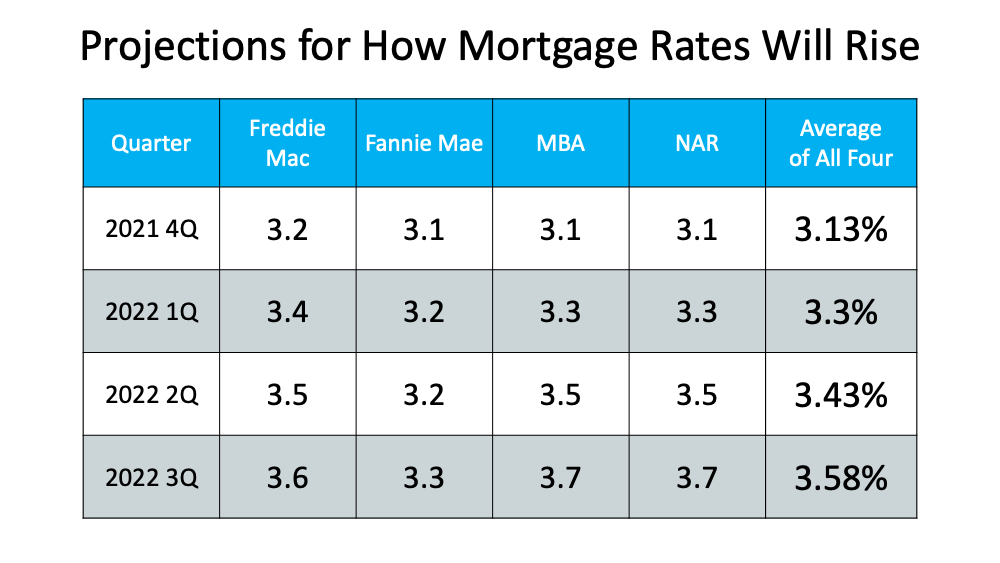
What does this mean if you’re thinking about making a move? Waiting until next year will cost you more in the long run. Here’s a look at what several experts project for mortgage rates going into 2022.

Freddie Mac:

“The average 30-year fixed-rate mortgage (FRM) is expected to be 3.0 percent in 2021 and 3.5 percent in 2022.”

Doug Duncan, Senior VP & Chief Economist, Fannie Mae:

“Right now, we forecast mortgage rates to average 3.3 percent in 2022, which, though slightly higher than 2020 and 2021, by historical standards remains extremely low and supportive of mortgage demand and affordability.” 

First American:

“Consensus forecasts predict that mortgage rates will hit 3.2 percent by the end of the year, and 3.7 percent by the end of 2022.”

If rates rise even a half-point percentage over the next year, it will impact what you pay each month over the life of your loan – and that can really add up. So, the reality is, as prices and mortgage rates rise, it will cost more to purchase a home.

As you can see from the quotes above, industry experts project rates will rise in the months ahead. Here’s a table that compares other expert views and gives an average of those projections:Experts Project Mortgage Rates Will Continue To Rise in 2022 | MyKCMWhether you’re thinking about buying your first home, moving up to your dream home, or downsizing because your needs have changed, purchasing before mortgage rates rise even higher will help you take advantage of today’s homebuying affordability. That could be just the game-changer you need to achieve your homeownership goals.

Bottom Line

If you’re thinking of buying or selling over the next year, it may be wise to make your move sooner rather than later – before mortgage rates climb higher.

Nov. 10, 2021

Sellers Have Incredible Leverage in Today's Market In Connecticut

Sellers Have Incredible Leverage in Today’s Market In Connecticut

Sellers Have Incredible Leverage in Today’s Market | MyKCM

With mortgage rates climbing above 3% for the first time in months, serious buyers are more motivated than ever to find a home before the end of the year. Lawrence Yun, Chief Economist for the National Association of Realtors (NAR), puts it best, saying:

"Housing demand remains strong as buyers likely want to secure a home before mortgage rates increase even further next year."

But the sense of urgency they feel is complicated by the lack of homes for sale in today’s market. According to the latest Existing Home Sales Report from NAR:

“From one year ago, the inventory of unsold homes decreased 13%. . . .”

What Does This Mean for Sellers Today?

With buyers eager to purchase but so few homes available, sellers who list their houses this fall have a tremendous advantage – also known as leverage – when negotiating with buyers. That’s because, in today’s market, buyers want three things:

  • To be the winning bid on their dream home.
  • To buy before rates rise
  • To buy before prices go even higher.

Your Leverage Can Help You Negotiate Your Best Terms

These three buyer needs give homeowners a leg up when selling their house. You might already realize this leverage enables you to sell at a good price, but it also means you can negotiate the best terms to suit your needs.

And since buyer demand is still high, there’s a good chance you’ll get offers from multiple buyers who are willing to compete for your house. When you do, look closely at the terms of each offer to find out which one has the best perks for you.

If you have questions about what’s best for your situation, your trusted real estate advisor can help. They have the expertise and are skilled negotiators in all stages of the sales process.

Bottom Line

Today’s buyers are motivated to purchase a home this year, and that’s great news if you’re thinking of selling. Let’s connect today to discuss how much leverage you have as a seller in today’s market.

Nov. 10, 2021

Renters Missed Out on $51,500 This Past Year In Connecticut

Renters Missed Out on $51,500 This Past Year

Renters Missed Out on $51,500 This Past Year | MyKCM

Rents have increased significantly this year. The latest National Rent Report from Apartmentlist.com shows rents are rising at a rate much higher than the three years leading up to the pandemic:

“Since January of this year, the national median rent has increased by a staggering 16.4 percent. To put that in context, rent growth from January to September averaged just 3.4 percent in the pre-pandemic years from 2017-2019.”

Looking back, we can see rents rising isn’t new. The median rental price has increased consistently over the past 33 years (see graph below):Renters Missed Out on $51,500 This Past Year | MyKCMIf you’re thinking of renting for another year, consider that rents will likely be even higher next year. But that alone doesn’t paint the picture of the true cost of renting.

The Money Renters Stand To Lose This Year

A homeowner’s monthly mortgage payment pays for their shelter, but it also acts as an investment. That investment grows in the form of equity as a homeowner makes their mortgage payment each month to pay down what they owe on their home loan. Their equity gets an additional boost from home price appreciation, which is at near-record levels this year.

The latest Homeowner Equity Insights report from CoreLogic found homeowners gained significant wealth through their home equity this past year. The research shows:

“. . . the average homeowner gained approximately $51,500 in equity during the past year.”

As a renter, you don’t get the same benefit. Your rent payment only covers the cost of shelter and any included amenities. None of your monthly rent payments come back to you as an investment. That means, by renting this year, you likely paid more in rent than you did in the previous year, and you also missed out on the potential wealth gain of $51,500 you could have had by owning your own home.

Bottom Line 

When deciding whether you should rent or buy in the future, keep in mind how much renting can cost you. Another year of renting is another year you’ll pay rising rents and miss out on building your wealth through home equity. Let’s connect today to talk more about the benefits of buying over renting.

Posted in CT Buyer Tips
Nov. 9, 2021

Landlords - 8 Amenities to Include in your Rental Unit In Connecticut

Landlords - 8 Amenities to Include in Your Rental Unit In Connecticut

The increase of pricing in the housing market and lack of inventory has left some potential homebuyers renting instead of purchasing. As a result, these renters may not just be viewing rentals as just a temporary steppingstone to homeownership and expect their rentals to have nicer amenities than in previous decades.

If you're a landlord, there are 8 amenities your rental should consider including:

  1.  Dishwasher - Rentals without dishwashers may experience more turnover than those that include one.
  2. Washer and Dryer -  With all the great space-saver appliances on the market, there is no excuse not to find room for a washer/dryer unit.
  3. Alarm System - Security systems cost a few hundred dollars and can add value to your rental.
  4. Pest Control, Gardener, Pool Service -  Renters are looking for low- maintenance homes. Including these services in your rent also ensures your property stays in great condition.
  5. Central Air conditioning-  Homes with central air conditioning rather than wall units always command higher rents than those without.
  6. Private Parking - Whenever possible, make sure there is a designated parking spot for the renter.
  7. Outdoor Space -  While not always possible, when looking for a new investment properties, opt for one with outdoor space.
  8. Home Warranty - avoid unexpected repair costs by adding a home warranty to the property.

Rentals have become a necessary alternative to homeownership for some. These renters will pay top dollar for the best properties. Make sure your unit stands out by offering the amenities modern renters want.

Posted in Home Owner Tips
Nov. 8, 2021

4 Ways Homeonwers Can Use Their Equity In Connecticut

4 Ways Homeowners Can Use Their Equity In Connecticut

4 Ways Homeowners Can Use Their Equity | MyKCM

Your equity is a powerful tool that can help you achieve your goals as a homeowner. And chances are, your equity grew substantially over the past year. According to the latest Equity Insights Report from CoreLogic, homeowners gained an average of $51,500 in equity over the past year.

If you’re looking for the best ways to use your growing equity, here are four options:

1. Use Your Equity To Buy a Home That Fits Your Needs

If you’re finding you no longer have the space you need, it might be time to move into a larger home. Or, it’s possible you have too much space and would like something smaller. No matter the situation, consider using your equity to power a move into a home that fits your changing lifestyle. Moving into a larger home can provide extra space for remote work or loved ones. Downsizing, on the other hand, may mean saving time and money by caring for a smaller home.

2. Move to the Location of Your Dreams

If the size of your home isn’t a challenge but your current location is, it could be time to relocate to a new area. Maybe you enjoy vacationing in the mountains, at the beach, or another area, and you’re dreaming of living there year-round. Or perhaps the distance between you and your loved ones is greater than you’d like, and you want to close the gap. No matter what, your home equity can fuel your move to the location where you really want to live.

3. Start a New Business

If you’re not ready to move into a new home, you can use your equity to invest in a new business venture. As the U.S. Small Business Administration Office of Advocacy says:

“There is an estimate of 31.7 million small business owners in the United States, many of them started their business with the equity they had in their home.

While it’s not recommended that homeowners use their equity for unnecessary spending, leveraging your equity to start a business that you’re passionate about can potentially grow your nest egg further.

4. Fund an Education

Whether you have a loved one preparing to head off to college or you’re planning to go back to school yourself, the thought of paying for higher education can be daunting. In either situation, using a portion of your growing equity can help with those costs, so you can make an investment in someone’s future.

Bottom Line

Your equity can help you achieve your goals. If you’re unsure how much equity you have in your home, let’s connect today so you can start planning your next move.

Nov. 8, 2021

Does Your House Have What Buyers Want In Connecticut?

Does Your House Have What Buyers Want In Connecticut?

Does Your House Have What Buyers Want? | MyKCM

The rise in remote work is changing what many Americans want in their homes. Many companies are choosing to delay reopening or go remote full-time, and today’s buyers are looking for homes with more space to support their work needs.

As a seller, if you no longer need the extra room you have in your home, rest assured there are buyers who do.

Remote Work Is Here To Stay

Remote work remains a reality for many Americans. A recent poll from Garter, Inc. shows many organizations have not yet returned their offices:

“. . . 66% of organizations are delaying reopening their offices due to new COVID-19 variants.”

And it’s not just companies that are choosing to remain remote for the time being – workers are seeking more flexibility. According to research from PricewaterhouseCoopers, nearly one-fifth of employees want to be fully remote in the future. The study also finds that many people are leaving jobs to seek out remote work opportunities:

“Among employees looking for new jobs, almost one in ten say it’s because they moved away from the office while working remotely and don’t want to go back on-site.”

More Remote Work Means a Greater Need for Home Offices

That’s leading today’s buyers to prioritize finding homes with more space so they can comfortably work from home. The 2021 Home Design Trends Survey from the American Institute of Architects finds that 69% of surveyed individuals still want at least one office at home. However, it also shows that more people are looking for multiple spaces in their home for remote work and virtual meetings (see graph below):Does Your House Have What Buyers Want? | MyKCM

What Does This Mean for You?

If your house has extra space that you no longer need, buyers are interested, and now may be the perfect time to sell.

Your trusted real estate advisor can help you highlight many of the most sought-after features in your listing, including home offices. On the other hand, if you have extra room without a purpose, consider staging it as an area where remote work can happen. Your agent can help you with this as well by evaluating and preparing your space for potential buyers. They’ll make recommendations for how to stage the room, where to draw the eye, and what other sellers are doing to make their houses stand out.

Bottom Line

With the continued rise in remote work, more buyers are looking for homes that can support multiple home offices. If you have extra room you’re no longer using, consider selling. Let’s connect today to discuss the unique features in your house and how you can capitalize on any extra space to appeal to today’s buyers.

Posted in CT Buyer Tips
Nov. 5, 2021

5 Things to Know before Adding an Accessory Dwelling Unit to Your Property In Connecticut

5 Things to Know before Adding an Accessory Dwelling Unit to Your Property In Connecticut

Accessory dwelling units (ADUs) have become very popular over the past few years. Often called “Granny Flats,” these units have often been used to provide for multi-generational housing needs, but they can also become a great source of secondary income. ADUs can also make great home offices, guest suites, game rooms, and home theaters.

With new zoning laws paving the way for more ADU options, here are 5 things you should know before moving forward.

  1. Types of ADUs - There are many different types of ADUs. From detached units to garage conversions, what form the ADU should take will depond on your property and your needs.
  2. Zoning Laws Vary - Almost all jurisdictions require permits but zoning lawns also outline the rules for your location including, type size and design. 
  3. ADUs Cannot Be Sold Separately - Regardless of the size of the unit, these ADUs are not considered separate homes and cannot be sold separately.
  4. Lot Requirements - Some cities have restrictions about lot size and setbacks. These limitations may prevent some kinds of ADUs from being approved.
  5. Fire Regulations - A shed is not an ADU. All ADU's are living structures and must comply with all fire regulations for living quarters.

Extra space is always a welcome addition to any home. ADUs offer another, less complicated or costly, alternative to building onto the main structure. Check with your city's restrictions before moving forward with the right ADU for your needs to avoid costly mistakes.

With new zoning laws paving the way for more ADU options, here are 5 things you should know before moving forward.

Posted in Home Owner Tips
Nov. 4, 2021

Essential Components of the Home Tool Kit In Connecticut

Essential Components of the Home Tool Kit In Connecticut


A well-equipped home tool kit is not just for weekend warriors and do-it-yourself types. Hanging a picture, tightening a cabinet door, or assembling a Swedish-built cabinet are all moments when one might reach for a tool kit. If your toolbox consists of duct tape and a hammer, a quick, inexpensive trip to the local hardware store can save you lots of time and headache later when you need your tool kit.


Essemtial Components of the Home Tool Kit In Connecticut


  • Hammer -The hammer is the most used tool in any home. Choose one that feels comfortable in your hand and is light enough that you can use easily.


  • Screwdrivers - While fancy ratcheting screwdrivers are comfortable, the plain old inexpensive ones work just fine. Make sure you have at least one flat head and one Philips head on hand.


  • Nails and Screws - Of course, you'll need these to go with the first two items on the list. Since these are inexpensive, choose a few sizes to have on hand for various projects.


  • Measuring Tape -Alongside the hammer, you'd be surprised how often you'll use this tool.


  • Drill - Drills are versatile tools and useful to hang pictures or tighten screws. Decide wether your preference is cordless or corded. 


  • Duct Tape - Yes duct tape does have a role in a well stocked tool kit.


  • Utility Knife -  This will not substitue for a saw but small cuts and simple adjustments can be performed easily with this small tool. A box cutter would also work well here.


  • Protection -  Safety goggles and work gloves offer essential protection from flying debris and hand or eye injuries.


Feel free to add other fun items you find during your stroll through the hardware store. You may never be ready to re,odel your entire kitchen, but the right tools will provide you what you need to keep your home in great condition.

Posted in Home Owner Tips
Nov. 3, 2021

Housing Challenge or Housing In Connecticut? It Depends.

Housing Challenge or Housing Opportunity In Connecticut? It Depends.

Housing Challenge or Housing Opportunity? It Depends. | MyKCM

The biggest challenge in real estate today is the lack of available homes for sale. The low housing supply has caused homes throughout the country to appreciate at a much faster rate than what we’ve experienced historically.

There are many reasons for the limited number of homes on the market, but as you can see in the graph below, we’re well below where we’ve been for most of the past 10 years. Today, across the country, there is only a 2.4-month supply of homes available for sale.Housing Challenge or Housing Opportunity? It Depends. | MyKCM

The Opportunity 

This lack of homes for sale is creating a challenge for many buyers who are growing frustrated in their search. On the other hand, this is a huge opportunity for sellers as low supply is driving up home values. According to CoreLogic, the average home has appreciated by more than $50,000 over the past year. And for many homeowners, that’s opening new doors as they re-think their needs and use their equity to move up or downsize.

According to Dr. Frank Nothaft, Chief Economist at CoreLogic:

“The average homeowner with a mortgage has more than $200,000 in home equity as of mid-2021.”

Today, many sellers are taking advantage of low interest rates and the equity they have in their homes to make a move.

Bottom Line

The biggest challenge in real estate is the lack of homes for sale, but this challenge is also an opportunity for sellers. If you’re thinking about selling your house, let’s connect to start the process.