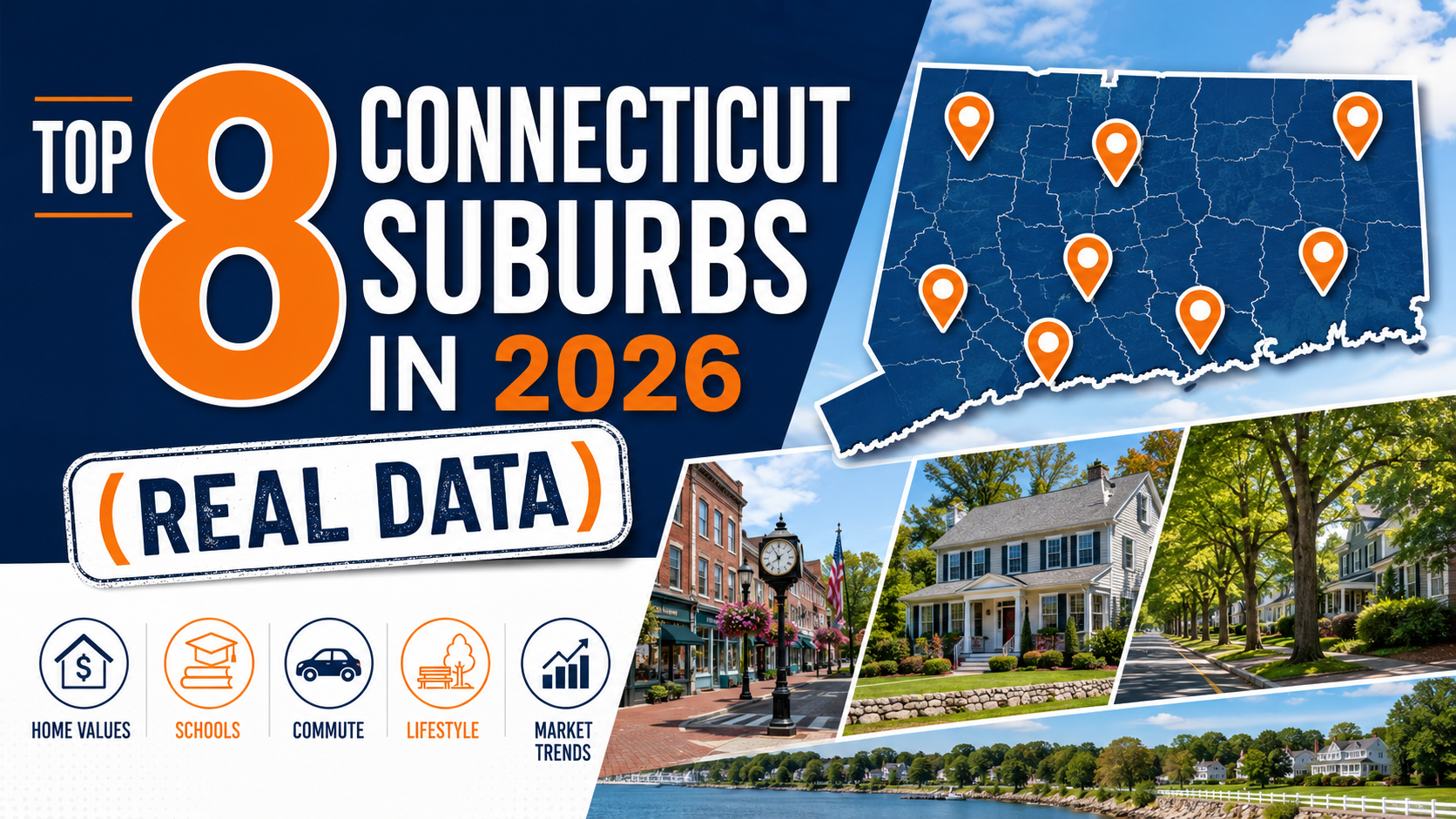
If you're thinking about moving to Connecticut — or even just moving within Connecticut — one question matters more than any other: where should you actually live?
Here's the problem. Most people get this wrong. They pick a town based on reputation, follow what a friend told them, scroll Zillow for twenty minutes, and convince themselves they've got it figured out. Then they overpay in the wrong town for a lifestyle that doesn't fit them.
So today I'm ranking what I believe are the top eight suburbs in Connecticut right now, and I'm backing it with real Smart MLS data. But I'm also going to tell you what's not so great about each town — because that's the part most rankings leave out, and it's usually the part that matters most.
I'm Dave Jones with Dave Jones Realty, I've lived here my whole life, and I run one of the largest independent brokerages in the state. This is my list.
One quick note on the numbers: everything below is a snapshot from early 2026. Market data moves fast in Connecticut, and in smaller or higher-end towns a handful of sales can swing the percentages dramatically month to month. Treat these as a point-in-time read, not a permanent truth — and if you want current figures for any town, reach out and I'll pull them.
And two things I deliberately don't rank on: schools and crime. Those are personal, they change, and they deserve your own research. I'll always point you to GreatSchools.org for school data and the state's official sources for crime stats, but that's your due diligence to do.
#8: Washington — Quiet Luxury in Litchfield County
This one will surprise people. Washington isn't a typical suburb — it's where you go for space, privacy, land, and to not be bothered. You're in Litchfield County, which means rolling hills, working farms, and hiking trails. It's one of the most peaceful places in the state.
The data tells an interesting story. Around the time of writing, the median sales price was about $1.165 million, up nearly 50% year over year, with roughly 123 average days on market, only about 19 homes available, and around 4.6 months of inventory.
What that tells you: this is a slow-moving, high-priced market. It isn't fast and it isn't cheap, but when something sells, it sells at a premium. Sellers were getting around 90 cents on the dollar, which means there's negotiating room if you know what you're doing. It's also one of the biggest second-home markets in the state — New York buyers have been coming here for years for the weekend escape, the estate homes, the big lots, the farmers markets, the bookstores, and Lake Waramaug.
The downside: you're not close to much, and there's no major highway nearby. If you need to commute regularly, this probably isn't your town. But if lifestyle is your priority, Washington is hard to beat.
#7: Simsbury — Photogenic and Polished (Hartford County)
Simsbury is one of those towns where everything just feels like it was done right. Driving through, it almost feels like a movie set — a great town center, biking trails, the Farmington River, and a clean, organized, calm feel. It's popular with people who want real suburban living without the isolation of a town like Washington.
At the time of writing, the median home price was around $443,000, with a year-to-date median closer to $532,000 (up about 20% from the prior year), and homes selling at roughly 107.8% of list price — meaning buyers were routinely paying well over asking. Supply was extremely tight at under one month, with very few closed sales year to date.
That over-asking number and the sub-one-month supply tell the whole story: when something good hits the market here, you have to move fast and above asking.
The downside: it's not one of the cheaper towns on this list, and it can feel quiet, especially coming from a city. Easy daily highway access isn't its strong suit either. But the overall quality of life is tough to beat.
#6: Shelton — The Secret Weapon (Fairfield County)
This is one of my favorites and a genuine value play. More and more people are figuring Shelton out, and once they do, they don't leave.
Here's what's happening: people want Fairfield County but not Fairfield County prices, and Shelton is the perfect middle ground. You get lower taxes than most surrounding towns and great access to Route 8, the Merritt Parkway, and I-95 — a location that makes daily life work.
As of early 2026, the median sales price was hovering around $645,000, up nearly 20% year over year. Closed sales had doubled compared to the prior year, pending sales were up sharply year to date, and homes were selling at about 103% of list price. Those aren't subtle numbers — that's a market with real momentum.
The downside: Shelton doesn't have the same polish as the higher-end Fairfield County towns. Some areas feel spread out, and there's no strong downtown identity yet — no obvious "let's meet downtown" spot. That's beginning to change, but it isn't there yet. For value and access, though, it's hard to ignore.
#5: Madison — Classic Shoreline (New Haven County)
Now we're talking coast. Madison is one of the best ways to get that classic coastal Connecticut lifestyle without going all the way into Fairfield County pricing — beaches, a beautiful town green, great restaurants and shops, and that genuine New England coastal feel. People don't just buy the house here; they buy how it feels to live here.
That charm comes at a price. At the time of writing, the median sales price was about $770,000 (up 15% year over year), with an average sales price closer to $973,000 year to date (up around 30%). Inventory had dropped to roughly 29 homes at about 1.6 months of supply, with closed sales up 30%. When average prices push toward a million and inventory keeps falling, demand is outpacing supply — and that's Madison in a nutshell. It's not a market you wait on.
The downside: you're paying for the shoreline, and there's no way around that. Inventory is limited, which means competition, and the town can feel seasonal — lively in summer, quieter in the off-season. But if lifestyle ranks high for you, Madison delivers.
#4: Cheshire — The Balanced One (New Haven County)
Cheshire — our neighbor here in Prospect — is one of the most balanced towns in the state. It doesn't try to be flashy. It just works. Central location, easy access to New Haven, Hartford, and Waterbury, and quiet without being boring. It's a place people move to and stay — which is great until you want to buy and there's no inventory.
As of February 2026, homes were averaging around $557,000, with days on market down significantly from a year earlier (roughly 100 days the prior February to about 40 this February). Inventory had fallen about 36% to just 23 homes, closed sales were up 45%, and supply sat at about one month.
The read: buyers are moving faster to Cheshire, and it's no surprise given everything happening there — the new Whole Foods, Barnes & Noble, and high-end condos. Homes that used to sit for four months are gone in weeks. Faster sales, less supply, more transactions — that's a classic tightening market.
The downside: there's no major walkable downtown, so if you want urban energy or nightlife, this isn't it. Coming from a big city, it can feel a little sleepy. But for consistency, stability, and a community that functions, Cheshire is excellent.
#3: Ridgefield — Premier and Walkable (Fairfield County)
Now we step into a different category. Ridgefield is one of the premier towns in the entire state — top-tier reputation, a true walkable downtown with arts, culture, and real restaurants, and still within reach of New York City. That combination is genuinely rare.
The numbers reflect it. Recent stats showed a median sales price around $1.374 million, though I want to be transparent: in a luxury market, a small monthly sample creates big percentage swings, so I'd weight the year-to-date median of just over $1.038 million more heavily. Either way, this is a legitimately expensive market, and the prices reflect real, sustained demand.
What sets Ridgefield apart is that it doesn't feel like a typical Connecticut suburb — the organized, almost European downtown is something you rarely find here, and it's part of why demand never lets up.
The downside: it's expensive, and there's no sugarcoating that. Inventory is tight even at entry level, and commuting logistics need real thought depending on where in town you are. But if it fits your budget and lifestyle, Ridgefield is among the best the state offers.
#2: Glastonbury — The Well-Rounded Bet (Hartford County)
I'll say it plainly: Glastonbury is one of the most well-rounded towns in the state. Strong reputation, tons of shopping, great restaurants, a real community feel, and a nice mix of suburban and rural depending on where you are — polished and developed in some spots, then you turn a corner onto a country road with farm stands and open land.
Recent stats showed a median sales price around $575,000, with a year-to-date median near $626,000 — both up about 11% year over year — while inventory had fallen to just 18 homes at 0.7 months of supply, with new listings down nearly 50%. For context, a balanced market runs about 5–6 months of inventory. Glastonbury sitting under one month, with prices still rising, tells you buyers are competing hard for very little.
The downside: the commute into Hartford can be painful depending on timing — the bridge and main highways back up, and you need to know the side roads. Prices have been climbing and likely will keep climbing, and some areas feel more rural than buyers expect. But overall, Glastonbury is one of the safest, most consistent bets in Connecticut.
#1: West Hartford — The Most Complete Suburb
No surprise to some people. West Hartford is probably the most complete suburb in Connecticut, period. Walkability, great restaurants, nightlife, serious shopping, a strong reputation, and a location that makes sense for how people actually live. It's the closest thing Connecticut has to a mini-city feel in a suburb, and it delivers on all of it like nowhere else.
The most recent stats showed a median sales price around $567,000 (up about 20% year over year), homes selling at roughly 106% of list price, and just 17 days on market with only about 0.9 months of supply. Let that sink in: the average West Hartford home sells in about two weeks, for nearly 10% over asking.
And here's what makes it more impressive — West Hartford has held that level of demand consistently for about three years. This isn't a one-month spike. The town has been competitive for years with no sign of slowing down.
The downsides, honestly:
- Higher property taxes than most towns on this list. Not the highest in the state, but factor it into your total monthly cost.
- Smaller lots. West Hartford is densely developed, so if you want significant land, you're looking at the outer edges of town or a different town entirely.
- Real competition. When a great house hits a great neighborhood, it's often under contract before you've set up a showing. You have to be fully ready to move, not ready to think about it.
But if convenience, lifestyle, and a town that genuinely buzzes are what you're after, West Hartford is the answer.
The Real Takeaway
After all eight towns, here's the truth: there is no single best town in Connecticut. There's only the best town for you.
The data doesn't lie. Every one of these markets is moving. Inventory is tight across the board, prices are rising, and buyers who wait usually end up paying more for less.
Buyer and Seller Takeaways
If you're buying in one of these towns:
- Match the town to your life, not to a ranking. Washington and Madison reward lifestyle-first buyers; Shelton and Cheshire reward value-and-access buyers; Ridgefield and West Hartford reward those who prioritize walkable, premium living and can move fast.
- In sub-one-month-supply markets (Simsbury, Glastonbury, West Hartford), get fully pre-approved and be ready to offer at or above asking the day the right home lists. Hesitation is what costs people these homes.
- Weigh the honest downsides listed here as seriously as the upsides — commute, lot size, taxes, and seasonality are exactly what buyers regret overlooking.
- Do your own school and safety research through GreatSchools.org and official state data before you commit.
If you're selling in one of these towns:
- These are strong seller markets, but correct pricing and presentation still drive whether you land at, above, or below asking. Over-asking results follow well-prepared, well-priced homes.
- Days-on-market and over-asking percentages are powerful pricing evidence — use current local data (not last year's) to set strategy.
- Know your buyer's motivation: lifestyle, value, or prestige. Marketing to the right one shortens your timeline.
Ready to Figure Out Where You Fit?
The hard part isn't the data — it's turning it into the right decision for your budget, commute, and lifestyle. That's what my team does every day.
Whether you're moving next month or next year, reach out and we'll go through what matters most and help you get it right the first time.
Dave Jones Realty Dave Jones, Broker/Owner 📞 203-910-2638 ✉️ Dave@davejonesrealty.com 🌐 www.searchallcthomes.com