


If you've been house-hunting for a while, this may have happened to you. You found a house. You started picturing your life there — the furniture, the paint colors, the summer barbecues in the yard. And by the time you got your offer in… poof. Gone. Zillow updated to "accepting backups," and the house was already spoken for.
Here's the truth nobody says out loud: Connecticut isn't too expensive. It's that most buyers are chasing the exact same handful of towns at the exact same time. When everyone crowds into the same grocery store aisle, prices go up and the best stuff disappears.
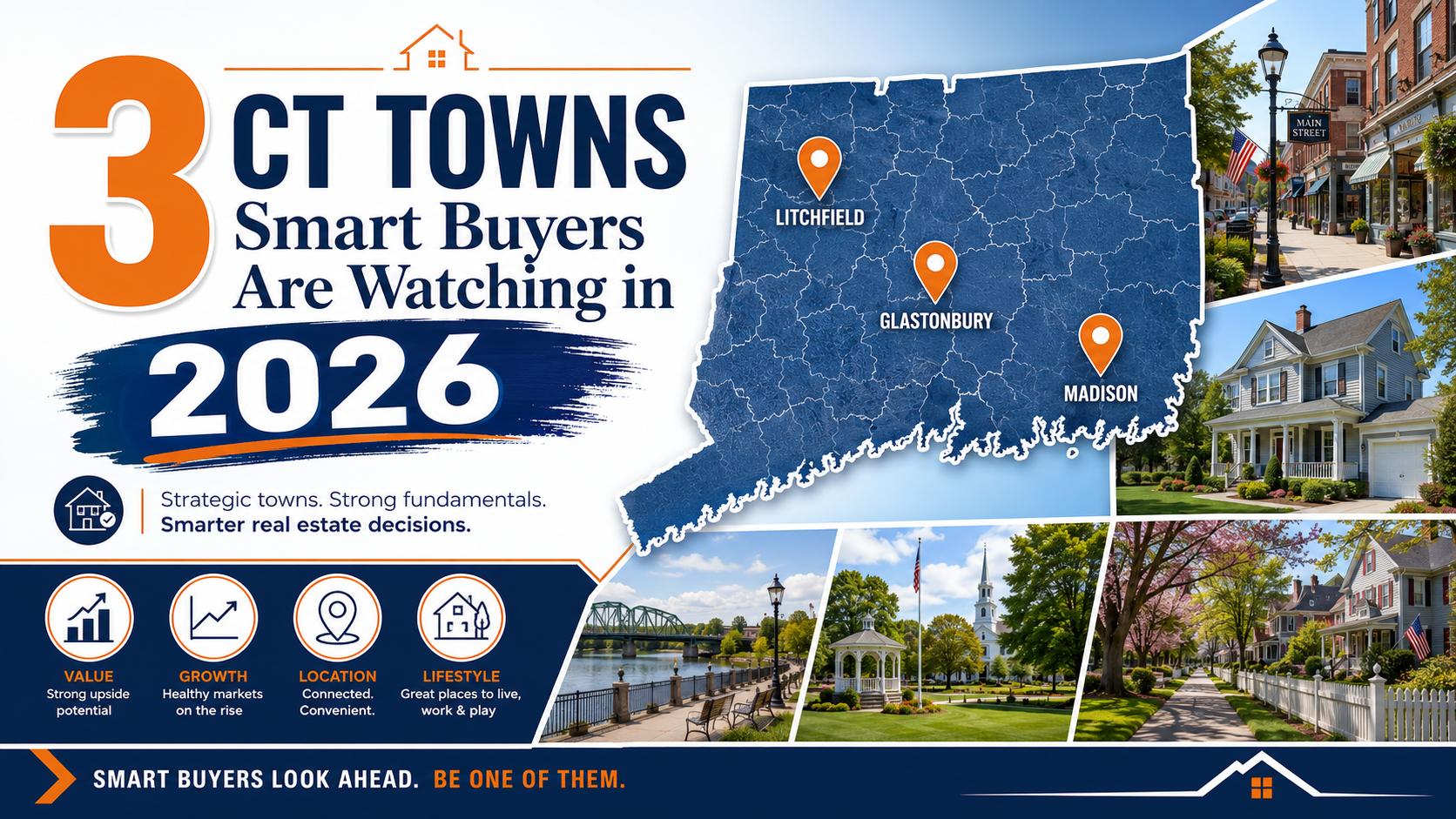
So today I'm giving you three Connecticut towns I believe have real momentum heading into 2026 — from someone who's lived here his whole life and helps people move here every day.
Town #1: Meriden
This one might surprise people, but we've been doing a lot of business here and the value is real.
Meriden is one of the best trajectory towns in Connecticut right now. It's not everyone's dream town — and that's exactly the point. A lot of buyers shop emotionally. They want the town name that earns approval from the cousin who's never paid a mortgage but has strong opinions about everything. You know that person. Smart buyers care about where demand is heading, not where it's already been.
Location that actually works
Meriden's biggest advantage is genuinely useful positioning. You're set between major employment areas — Hartford, New Haven, and a lot of central Connecticut — without feeling trapped in one orbit. In 2026, that flexibility matters. Hybrid work is still real for a lot of people, and families are juggling commutes, kids' schedules, aging parents, and a budget that doesn't magically stretch because someone online said it's a great time to buy. Meriden fits the buyer who wants access without paying an already-hot premium.
The thing buyers underestimate: downtown psychology
When a town invests in its core — housing, mixed-use projects, walkability, amenities — it changes buyer confidence. People don't just buy houses. They buy a future version of their life. They buy the belief that the town is improving and that they won't regret it.
Here's the insight most people miss: Meriden doesn't have to become cool to become expensive. It just has to become easier. Easier commute, easier errands, easier weekends. Convenience is the new luxury. When buyers can get what they need with less friction, they pay for it — even if they describe it plainly as "it just feels practical," right before they offer over asking.
The reality check
Meriden is not uniform. There are pockets that feel completely different street to street, and this is where buyers get tripped up — they see a great price, get excited, and buy the wrong pocket because nobody helped them understand the local nuance.
So if Meriden is on your list, the question isn't should I buy in Meriden? It's where in Meriden fits my lifestyle and my risk tolerance? If you're relocating and not familiar with the micro-areas, that's exactly the kind of thing my team can help you sort out — a simple short list based on your commute, budget, and dealbreakers. No pressure, just clarity, so you're not relying on a comment from someone whose only qualification was driving through once.
Opportunity in the housing stock
Meriden has a mix of older capes, colonials, and ranches where the bones are solid but the presentation is dated — which scares off the HGTV crowd. They see a kitchen from 1997 and act like the whole house needs to be bulldozed. Meanwhile, the buyer who understands what paint, lighting, and a sensible renovation plan can do is the buyer who wins.
Just remember the Connecticut basics: oil heat versus gas matters, sewer versus septic matters, and the age of the roof, windows, and mechanicals all matter. If you're not sure, that's what inspections are for. The goal isn't to avoid every issue — it's to avoid the surprises.
And on safety: do your due diligence. Check official sources, talk to locals, and visit at different times of day. Connecticut, like anywhere, is a patchwork — some pockets will fit you and some won't, and it can change street by street. That's not fear-mongering. That's just being an adult about a major purchase.
Town #2: West Haven
West Haven is one of the most overlooked towns in the New Haven orbit, and it's overlooked largely because people love old narratives. Folks have opinions based on what they heard ten or twenty years ago. Meanwhile, the market doesn't care about your uncle's opinion — it cares about access, affordability, and whether people can picture themselves living there. And in my buyers' experience, they can.
New Haven gravity without New Haven pricing
New Haven drives jobs, healthcare, culture, restaurants, events, and yes, pizza. When a hub city grows, the towns around it get pulled along. Buyers who want to be near the hub but don't want to pay for it start shopping the perimeter — and that's where West Haven comes in.
Then there's the coastal factor. Proximity to the water changes demand math more than people admit. You don't need a postcard beach to shift buyer psychology — just being near the water changes how people think about weekends, summer nights, and quality of life. In 2026, buyers aren't only buying houses. They're buying a lifestyle, and a lot of them are leaving places that feel expensive and stressful in search of somewhere they can breathe.
What growth here actually looks like
West Haven's momentum won't look like luxury. It'll look like competition for regular, normal houses — capes, colonials, small single-families, and some multi-families. The kind of inventory working buyers can actually afford. When more buyers show up for the same pool of homes, days on market compress and prices firm up before they climb. That's how a town gains value without turning into Beverly Hills.
Micro-areas matter here too
There are pockets that feel more suburban, pockets that are denser, and pockets where you need to be realistic about what you're buying. If you want quiet streets and a suburban feel, choose carefully. If you want proximity and don't mind a little more activity, you've got more options.
If West Haven is on your radar, don't wing it. The smartest thing you can do — especially relocating — is talk to someone who can translate the town into real life: what it feels like on a Tuesday night, what the commute is like at the hours you'll actually drive, which streets have the vibe you want. My team maps this out every day, and we'll tell you the truth even if the truth is "it's a fine town, but it's not your fit." The goal isn't to sell you on a town. It's to keep you from buying the wrong one.
As always: do your own research on safety and comfort, check the school reports, and visit multiple times. Don't buy blind, and don't let the internet scare you.
Town #3: Berlin
Berlin feels like it's quietly winning. Great access, real stability, and it doesn't scream for attention — which is exactly why it's still a value play.
Most buyers chase what's loud. Berlin isn't loud; Berlin is confident. It's the person at the party who doesn't need to tell you how successful they are — you just notice. It sits in the middle of a lot of life without the chaos: you can get toward Hartford and around central Connecticut easily, with major routes that make sense. And in 2026, buyers are heavily prioritizing one quiet question — how easy is my life going to be? That drives more decisions than people admit.
Controlled growth attracts the best buyers
When a town adds development in a way that feels planned rather than chaotic, it attracts planners — and planners are the best kind of buyers if you care about long-term stability. They're not impulse-buying because a kitchen has white cabinets. They're buying because the town makes sense for the next ten years.
Here's a line I use all the time: boring is profitable. People will call Berlin boring. Good. Boring means stability, fewer dramatic swings, and less chance you wake up one day wondering why everything changed. If you're buying a home to actually live in, boring is the win.
But don't wait too long
Berlin isn't a magic cheat code, and the mistake buyers make in towns like it is waiting because it feels safe. Safe towns don't stay affordable forever — they move slowly, and then suddenly they don't. The window closes quietly. First it's "we can wait," then "why are there three offers," then "why are we getting outbid again," and finally "we should have bought last year."
How to Use This Like a Smart Buyer (Not a Doom-Scroller)
- Pick two towns, not six.
- Identify specific pockets, not vibes.
- Run commute and tax math honestly.
- Compare lifestyle tradeoffs, not just list prices.
- Be honest about your non-negotiables. If you hate traffic, don't buy a commute you'll resent. If you need quiet, don't buy on a busy street and act shocked that it's busy.
On schools: I don't rank schools — it's personal, it changes, and it deserves real research. Use tools like GreatSchools.org (we have them on our website too), then verify directly with the district.
On safety: do your own due diligence through official resources, talk to locals, and understand that pockets vary. Any town has areas that fit you and areas that don't. The goal is informed decisions, not paranoia.
Buyer and Seller Takeaways
If you're buying in a value-trajectory town:
- Buy the right pocket, not just the right town. In places like Meriden and West Haven, street-level differences make or break the purchase — visit in person, at multiple times.
- In dated-but-solid housing stock, learn to see past cosmetics. A 1997 kitchen isn't a structural problem, and the buyer who understands that wins on price.
- Don't over-wait a stable town like Berlin. "Too safe to rush" is exactly how buyers miss the window.
- Run the Connecticut fundamentals on every home: heat type, sewer vs. septic, roof, windows, mechanicals. Inspections are there to kill surprises, not deals.
If you're selling in one of these towns:
- Momentum is your friend — buyers are actively looking for value-trajectory towns, so lead with access, commute math, and what's improving locally.
- If your home is solid but dated, staging and light cosmetic updates (paint, lighting) can meaningfully lift both offers and speed, since so many buyers can't see past a dated kitchen.
- In steadier markets like Berlin, "stability" is a genuine selling point for the long-term buyer — say it plainly.
Want Help Figuring Out Which Town Fits?
This is Part 1. In Part 2, I'm covering three more towns that are pure value-corridor plays: Bristol, Naugatuck, and Torrington.
If you want help figuring out which of these towns actually fits your life, reach out. My team can build you a simple short list based on your commute, budget, and lifestyle — and just as importantly, show you what to avoid so you don't learn an expensive lesson the hard way.
Dave Jones Realty Dave Jones, Broker/Owner 📞 203-910-2638 ✉️ Dave@davejonesrealty.com 🌐 www.searchallcthomes.com