Stop. Before you move to Hartford, Connecticut, give me a minute.
If Hartford is at the top of your relocation list, I don't want you to cross it off — I want you to pause. Not because Hartford is a bad place, but because a lot of people who move there realize afterward that it wasn't actually what they were looking for.
Here's the truth most relocation content skips: people usually don't want Hartford. They want what they think Hartford represents. Access to jobs, culture, restaurants, convenience, opportunity, options. What they don't want are the tradeoffs that only show up once you're living there full time — the things nobody explains during the home search.
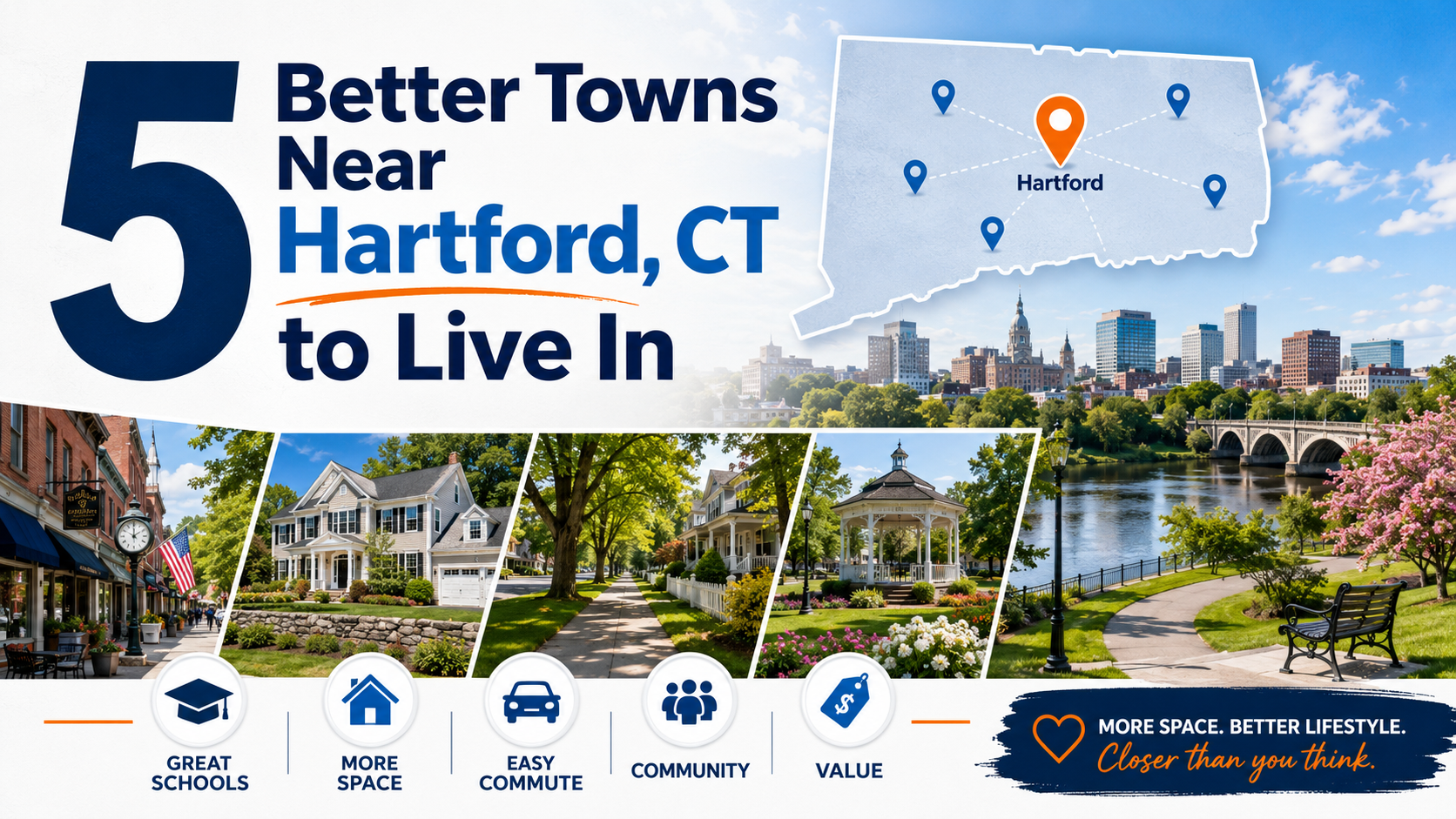
So today I'm walking through five towns near Hartford that smart buyers consistently choose instead, and exactly why.
I've lived in Connecticut my whole life and I run a real estate team that helps people relocate here from all over the country. I can tell you confidently: most buyers who start out saying "we want Hartford" end up somewhere else once they understand the landscape. This is the conversation I have before people make an expensive assumption.
To be clear, this is not a Hartford hit piece. Hartford has history, major employers, and real importance in the state. But relocation isn't about picking the most recognizable name on a map — it's about choosing a place that fits how you actually live, day in and day out.
First, Understand What Hartford Actually Is
Hartford is Connecticut's capital, but it's not a single experience. Housing stock, density, neighborhood feel, and taxes can vary dramatically within short distances.
What most relocating buyers are really after is this: easy access to Hartford jobs and highways, close enough to catch a UConn game or a great dinner — but without the nonstop city life. They want predictable neighborhoods, homes that make sense long term, and resale confidence. That combination doesn't always line up cleanly inside the city. Just outside is where it gets interesting.
One thing buyers miss: Hartford is a weekday city. During business hours it has a real professional pulse — major employers, state offices, insurance companies. But evenings and weekends can feel very different depending on the neighborhood. If you're coming from Boston, New York, or parts of the Midwest where downtowns stay active around the clock, Hartford may feel quieter than expected after 6:00. That's not a negative — but it's a lifestyle difference, and lifestyle differences are what matter most once the boxes are unpacked.
A quick word before the towns: if you're starting to feel overwhelmed because these towns sound similar online but feel completely different in person, that's normal. Most relocation mistakes don't happen at closing — they happen at the comparison stage, when buyers don't know what to measure.
Town #1: West Hartford — Energy Without the Urban Core
West Hartford is the most obvious Hartford alternative, and for good reason. This is where buyers land when they want walkability, restaurants, and energy, but don't want to live inside a dense downtown.
The town centers are active, social, and clearly designed around people who actually use them. You can grab coffee, meet friends for dinner, and still come home to a quiet residential street. That balance is genuinely hard to find inside a city.
A lot of buyers assume West Hartford is basically Hartford. It isn't, and the difference is immediate. The lifestyle gap is real, and resale performance reflects it — homes here tend to hold value even in slow markets, without dramatic swings.
Going a level deeper: West Hartford is layered. There are older historic neighborhoods with character homes, mid-century sections with practical layouts, and higher-end pockets with large colonials. You can tailor your lifestyle without leaving town.
From a market standpoint, buyer competition here rarely disappears. Relocation buyers, local move-up buyers, and downsizers are all competing in overlapping price ranges even in slower cycles. That creates liquidity — and liquidity is exactly what people mean when they talk about resale confidence.
Town #2: Newington — Functional, Stable, and Underrated
Newington doesn't generate flashy headlines, and that's exactly why it works. It attracts buyers who prioritize functionality over hype.
Commuting is straightforward. Neighborhoods are stable. The housing stock is practical and predictable. Newington appeals to people who want life to feel manageable — fewer surprises, less guessing, more consistency. It's often the town buyers choose after stretching their budget elsewhere and realizing that comfort matters more than prestige.
It doesn't sell you a fantasy lifestyle. It sells you simplicity. Errands are easy, parking is easy, and getting onto I-84 or Route 9 is easy. When you're relocating from out of state, that frictionless daily rhythm turns out to be surprisingly valuable.
Something buyers notice after a few months here is the noise level — less through-traffic, fewer major event disruptions, more consistent neighborhood patterns. For remote and hybrid workers, that calm can matter far more than proximity to a skyline.
Town #3: Glastonbury — The Step-Up, Plant-Your-Roots Town
Glastonbury is the upgrade option near Hartford. Buyers here are usually thinking long term — they want more space, a more polished feel, and neighborhoods that feel intentional. Prices are higher, but demand stays remarkably steady.
One thing that surprises relocating buyers is how manageable the commute actually is. On paper it looks far; in practice it rarely feels that way.
This town plays a different game. Glastonbury attracts buyers thinking five, ten, even fifteen years ahead — it's not usually the entry-level play, it's the "we're planting roots" decision. It blends suburban neighborhoods with scenic stretches near the river and farmland, which gives it a more spacious, polished atmosphere.
From an investment angle, Glastonbury tends to see less volatility. It doesn't spike dramatically, but it doesn't dip dramatically either. Stability attracts stability, which is why relocation buyers with higher budgets often circle back here after starting elsewhere.
An important disclaimer
There is no universally "best" town. Always do your own research on safety, schools, and crime — there are plenty of resources online, including tools like GreatSchools.org for school data, and public crime statistics for any town you're considering. Visit neighborhoods at different times of day — I always tell people to go back after dark, first thing in the morning, and midafternoon, and get a real feel for the area. This article is about fit, not rankings or guarantees.
Town #4: Rocky Hill — The Town That Wins on Math
Rocky Hill is one of the most underrated Hartford alternatives. It works for buyers who want proximity without intensity — short commutes, calmer neighborhoods, and pricing that often surprises people when they compare it side by side with other areas.
Rocky Hill tends to win when buyers do the real math: distance versus cost, convenience versus lifestyle. People often overlook it early, then circle back and realize it checks more boxes than they expected.
Distance to Hartford is minimal, access to I-91 is immediate, and the price relative to proximity is frequently favorable. It also sits along the river, which gives it a different aesthetic than most people expect from a suburb. And its layout makes commuting smoother than a quick glance at a map suggests — when buyers compare actual drive times instead of online estimates, Rocky Hill routinely moves up the list.
Town #5: Farmington — Predictable, and That's a Compliment
In real estate, predictable is a compliment. Farmington is the town people choose when they're done guessing. They want consistency, stability, and confidence that what they buy today still makes sense years from now.
Neighborhoods are well established, layouts feel intentional, and the town doesn't swing wildly with market trends. Demand stays steady even when conditions change.
Farmington appeals to analytical buyers — the ones who look at historic appreciation patterns, compare tax structures, and think about their exit strategy before they even move in. Those buyers tend to sleep well at night.
It also benefits from proximity to major employers like UConn Health and access to Route 4 and I-84, which broadens commuting options considerably. The town operates quietly, and that's its strength.
Let Me Simplify the Choice
- Want urban energy and walkability? Look at West Hartford.
- Want function and practicality? You probably want Newington.
- Want long-term upscale stability? Look at Glastonbury.
- Want commute math and value balance? Rocky Hill may be your spot.
- Want predictability and resale strength? Farmington leads that category.
Hartford itself is an employment anchor — but anchors don't always have to be where you live. Sometimes it's just where you work. That's the shift most relocating buyers make once they see the whole picture.
The Common Objections, Answered
"Isn't Hartford cheaper?" Sometimes, upfront. But affordability is more than purchase price — factor in the tax structure, insurance costs, property condition, market volatility, and your future buyer pool, and the equation often shifts.
"I want city life." That's exactly why West Hartford exists — the energy and dining without the density.
"Won't I miss out?" Not if you live 10 to 15 minutes away and can drive over whenever you want. That's the Connecticut advantage: everything is close, and nothing requires a 90-minute commute.
"I don't want a long commute." Most of these towns are closer than people assume once they measure real drive times instead of map estimates.
Buyer and Seller Takeaways
If you're buying near Hartford:
- Separate where you work from where you live. Hartford can be the job anchor without being the home base.
- Compare full monthly cost — taxes, insurance, condition, and expected resale — not just the sale price. The cheaper house isn't always cheaper.
- Test-drive your real commute at the hour you'd actually be driving it. Map estimates routinely mislead in both directions here.
- Match the town to your lifestyle honestly: density tolerance, how much quiet you need after work, and how far ahead you're planning.
- Do your own due diligence on schools and safety using objective public sources, and visit neighborhoods at multiple times of day.
If you're selling in one of these towns:
- Know your buyer. West Hartford sells on walkability and energy; Newington on ease and calm; Glastonbury on space and long-term stability; Rocky Hill on value and commute; Farmington on predictability and resale strength. Lead with the right one.
- Relocating buyers are comparing you against Hartford and against each other. Documentation on taxes, commute times, and recent updates removes friction.
- Stability and resale history are selling points in this part of the state. If your neighborhood holds value through slow markets, that's worth saying.
Deciding Between Hartford and the Towns Around It?
This is the exact comparison my team walks through with clients every single day. Sometimes Hartford is the right call — but more often, one of these towns fits better once you zoom out and look at daily life instead of the pin on the map.
Clarity early saves money, stress, and regret later. Informed decisions beat hopeful ones every time.
If you're planning a move to the Hartford area, reach out and let's figure out which ecosystem actually fits you.
Dave Jones Realty Dave Jones, Broker/Owner 📞 203-910-2638 ✉️ Dave@davejonesrealty.com 🌐 www.searchallcthomes.com