


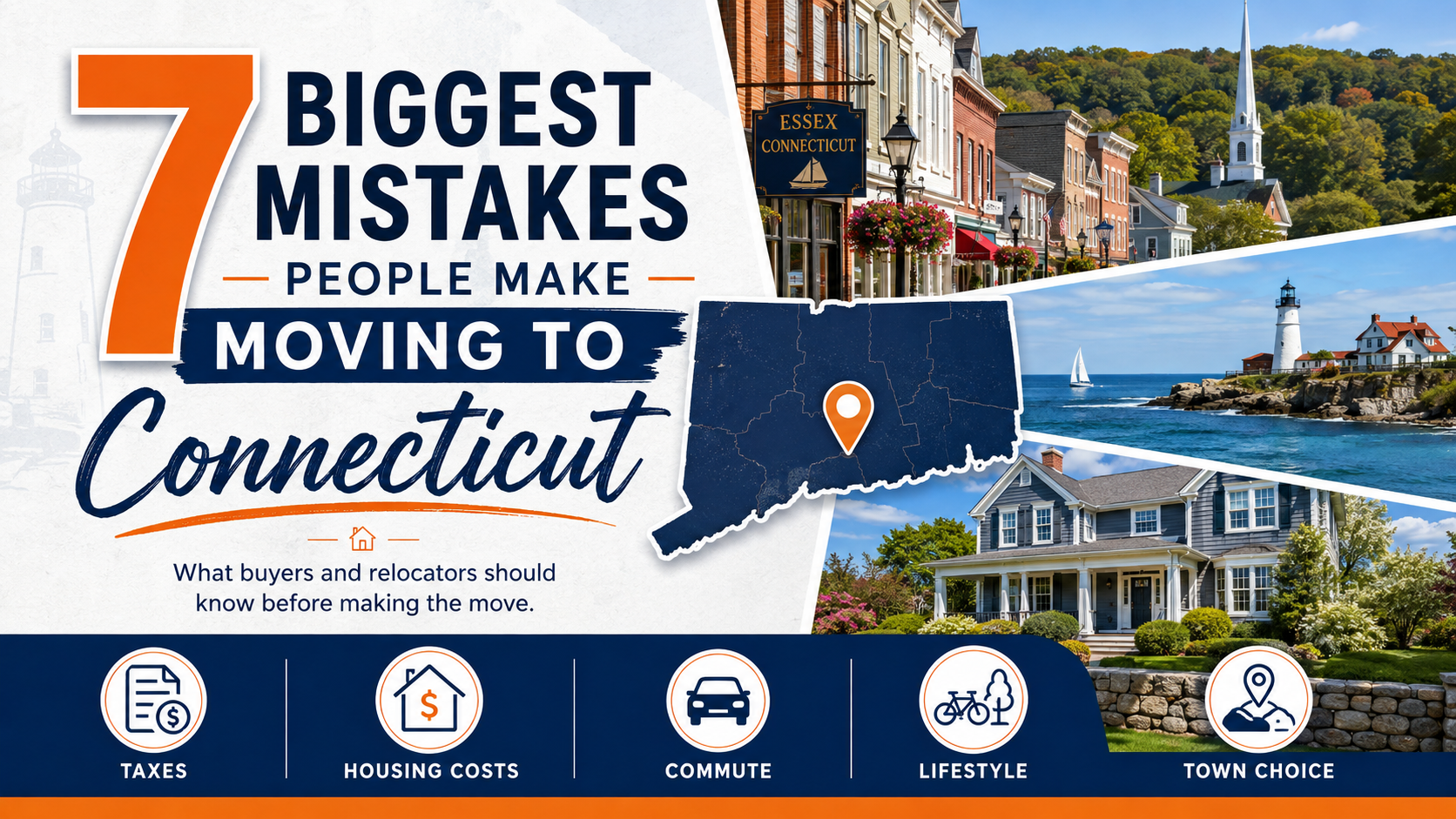
 So you're thinking about moving to Connecticut. Let me stop you right there, before you make one of the mistakes I watch almost every relocating buyer make.
I'm Dave Jones with Dave Jones Realty, and after years of helping people move here I've learned that Connecticut is one of the most town-by-town states in the country. Cross one town line and the taxes change, the commute changes, the weather genuinely changes, and the whole feel of the place changes with it.
Here are the seven biggest mistakes I see. The last one quietly causes almost every other mistake on the list.
Mistake #1 — You default to the towns you've already heard of
This is the most common one, and I understand why people do it. You're moving somewhere new, you're a little nervous, so you reach for names you recognize. Greenwich. Westport. New Canaan. West Hartford. That's where the search starts.
Psychologically it makes total sense. When you don't know a place, familiar names feel safe. It feels like the responsible choice.
Here's the trap. Those famous names got famous for a reason, and the reason is that they're expensive and everybody already wants them. The exact quality that makes a town feel like a safe bet is the thing that prices you out and puts you in a bidding war against hundreds of people who reached for the same familiar name.
Let me give you the real number so you don't have to take my word for it. Fairfield County — where most of the famous names are — had a median sales price last year of $661,500. That's the middle. Half of everything sold for more than that.
So if your budget is $400,000 or $500,000 and you've pointed your entire search at Fairfield County, you've aimed yourself directly at the most expensive corner of the state and you're going to spend months getting frustrated.
Here's the fix. Start with your life, not the name. Start with what you can spend, how far you're willing to drive, and what you actually need out of a town. Then go find the towns that fit.
There are 169 towns in Connecticut. You've probably heard of about twelve of them. The other 157 are where the deals are.
I had a buyer dead set on one of the big-name Fairfield County towns. That was the entire plan. We looked and looked, and everything in budget was either tiny or needed $100,000 of work. Two months of that. Finally I said: let me show you a town you've never heard of, just humor me.
We went twenty minutes inland. Same money. He's now in a house with a real yard, a garage, and room to breathe. And what he said afterward was, "I didn't even know this town existed."
The whole problem is right there in that sentence. He nearly missed the house that was right for him because he didn't recognize the name of the town.
Mistake #2 — You ignore the property tax until it's too late
This is the sneaky one, and it bites hardest, because it isn't a one-time cost. It's every year, forever.
In Connecticut, property tax is set town by town using the mill rate — the tax owed per $1,000 of assessed value, with property assessed at 70% of appraised value. And the spread across this state is enormous.
Hear these two numbers back to back. Salisbury, up in the northwest corner, sits around 11. Hartford, the capital, is at 68.95.
That's more than six times. Two houses at the same assessed value, one in a low-tax town and one in a high-tax town, and one owner writes a check six times larger — every single year.
Here's what that spread looks like in real money on a $500,000 home:
| Town | Mill Rate | Est. Annual Property Tax |
|---|---|---|
| Salisbury | ~11.00 | ~$3,850 |
| Shelton | 18.82 | ~$6,587 |
| Morris | 19.43 | ~$6,801 |
| Prospect | 25.57 | ~$8,950 |
| Watertown | 30.04 | ~$10,514 |
| Bristol | 33.75 | ~$11,813 |
| Naugatuck | 39.79 | ~$13,927 |
| Wethersfield | 41.22 | ~$14,427 |
| Bridgeport | 43.45 | ~$15,208 |
| West Hartford | 44.78 | ~$15,673 |
| Hartford | 68.95 | ~$24,133 |
Based on Connecticut's 70% assessment ratio. Estimates for comparison only — some municipalities apply different assessment treatments or additional district levies, and mill rates are reset annually. Always confirm the actual figure on a specific property.
Where people mess this up: they fall in love with a house, run an online mortgage calculator, work out the payment — and never look up the mill rate.
And unlike the purchase price, this one never goes away. Thirty years from now, when the mortgage is paid off free and clear, you're still writing that town a check twice a year. In the high-mill-rate towns, that check is enormous. People do all the math on the purchase and none of the math on the ownership — and ownership is the part that lasts.
(We also sell in Florida, and the same thing happens down there with HOA fees. Different name, same trap. You have to look at the whole picture.)
Here's how real this gets close to home. Shelton sits at 18.82. Bridgeport, a few miles away, is at 43.45. You could be looking at two houses at the same price a short drive apart, and one tax bill is more than double the other. Nobody moving here from out of state understands that going in. They see two houses that cost the same and assume the ownership cost is the same. It isn't — and the difference never stops.
The fix is simple. Before you fall in love with a town, look at two numbers: the price of the house and the mill rate of the town. The second one tells you what it costs to keep the house, not just buy it. The math is boring and easy to get wrong, so run it by somebody before you sign — not after.
Mistake #3 — You assume the commute is fine because it looks fine on a map
This one gets people moving from far away, because you're looking at a map on a laptop from somewhere else, and the map lies to you.
On the map two towns look about twenty miles apart. You think, fine, half an hour. Then you move here and discover that twenty miles on I-95 at 5 p.m. is closer to ninety minutes on a bad day — and it's often a bad day.
Connecticut has some genuinely brutal commuting corridors and some genuinely easy ones, and you cannot tell which is which from a map. I-95 along the shoreline is a different animal from I-84 through the middle of the state, which is different again from the Hartford Line train, which is different again from being out in the country where you drive everywhere and nothing is ever crowded.
And the trains here are their own thing. If you're near a Metro-North station along the shore, you might have a genuinely pleasant ride into the city without ever touching a highway — but you'll pay for it, because those towns cost more. One town over with no station, that same trip has you sitting in traffic. Two towns that look identical on a map, completely different daily lives, and the only thing separating them is whether there's a train platform. You'd never know that from the listings.
Here's the mistake underneath the mistake: people pick the house first and figure out the commute after. Do it the other way around. If someone in your household has to be in an office a few days a week, the commute isn't a detail — it's the whole thing. It decides whether you're happy in the house or sitting in the car resenting it every morning.
The fix: drive the actual commute at the actual time you'd be driving it. Not Sunday afternoon. Tuesday at 8 a.m. That's the only version of the drive that tells you the truth.
I had a buyer ready to commit along a stretch of shoreline because on the map it looked like a straight easy shot to work. I asked them to drive it at rush hour before signing anything. They called me afterward laughing — it was nearly double what they'd guessed. They still liked the house. But now they knew the real number and could decide with their eyes open instead of finding out a month after closing.
Mistake #4 — You only visit in the summer
Connecticut in summer is gorgeous. The shoreline, the lakes, all of it. People come in July, fall in love, and buy.
Then February happens.
I love this state and I'm not going to talk you out of it, but you need to see it in winter before you commit to a life of it. The days are short — dark at 4:30. There's real snow, real cold, and real stretches where the sky is gray for weeks.
For some people that's cozy and they wouldn't trade it. For others it's a genuine adjustment they wish somebody had warned them about. I'm not telling you this to scare you off. I'm telling you so you go in with your eyes open — because the person who moves here knowing exactly what winter is tends to be fine with it, and the person who only saw July is genuinely surprised. Surprise is expensive when it's attached to a house you already bought.
Plenty of people who give winter a fair shot end up loving it. Snow on the stone walls, fireplaces, the whole New England thing — people fly here and pay good money for a weekend of that. I just want you to have met it before you marry it.
And here's the part nobody thinks about: winter is different depending on where in the state you are.
At the bottom of the hill in Waterbury it might be raining. Up on top of the mountain in Prospect, it's snowing. Same storm. Head into the Northwest Hills in Litchfield County and you get real winter — more snow, colder, and it lingers. If the rest of the state gets a foot, Litchfield County is probably getting two. The shoreline might get none.
That's a real difference in your actual life — shoveling, heating bills, how often the power goes out. It never shows up in a summer visit or in the listing photos. Ask your agent about it specifically for the town you're considering. Ask about the roads and the plowing too.
(If winter turns out not to be for you, that's also a great reason to be a snowbird — we're licensed in Florida and can help on that end too.)
Mistake #5 — You buy the house off the school ratings
I want to be careful here, because schools matter. If you've got kids going into a school system, of course it's a real factor — and it's one of the strongest drivers of what a house is worth.
What I'm telling you is: don't let a single number on a website make the entire decision.
Those ratings are a snapshot. They're often out of date, and they flatten a whole complicated town down into one digit. People will pay a premium — sometimes tens of thousands of dollars — chasing a rating without ever setting foot in the town or the school.
I've watched people rule out a genuinely great town over a number they read online. I've also watched people massively overpay for a number that, when you actually dug into it, didn't mean what they thought it meant.
The fix: use ratings as a starting point, not a finish line. If schools matter to your family, go visit the actual school. Talk to people who live there. A town is a real place with real people in it, and you shouldn't outsource that decision entirely to a website that's never been there.
Notice what all of these have in common? Every mistake so far is somebody trusting a screen instead of boots on the ground. The map instead of the drive. The rating instead of the school. The name instead of the town.
Hold that thought.
Mistake #6 — You wait for the perfect moment
This one hurts to watch, because it's where good, careful people talk themselves out of a good decision.
I get buyers all the time who are genuinely ready. Budget's there. The reason for the move is there. They've found a town they love. And then they wait. For rates to drop. For prices to come down. For a house without the wrong wall color or the wrong floors. For everything to line up perfectly.
And here's what I watch happen, over and over. While they wait, the house they loved sells to somebody else who is now building equity in it. The prices they were waiting to fall went up instead, and the identical search now costs more than it would have when they were first ready.
I'm not telling you to rush — rushing is its own mistake. I'm telling you that perfect never comes. There's no magic moment where the stars align. There's ready, and there's not ready. And if you're ready, waiting costs more than it saves.
So get actually ready: financing lined up, budget clear, towns narrowed. Then when the right house shows up, you move on it. Because in this market the right house does not sit around waiting a week for you to think it over.
I've watched buyers lose three houses in a row this way. The perfect house comes up, they want to sleep on it, and by the time they call me back it's under contract. They never got to sleep in it. Somebody who was ready got it.
And it's heartbreaking, because these are careful people — and the carefulness is what's costing them. Ready doesn't mean reckless. Ready means that when the right house shows up, you're in a position to say yes.
Mistake #7 — You try to figure the whole thing out on your own
Here's the biggest one, and I know exactly how it sounds coming from me. Hear me out anyway, because it's real.
Everything above — the tax traps, the commute lies, the town-by-town differences, the winter that's different at the top of the hill than the bottom, the school ratings, the timing — that's local knowledge. You cannot get it from a website.
Zillow has never shoveled a Connecticut driveway after three feet of snow. It's never been stuck on the Merritt trying to get to a ballgame. It doesn't know what's coming for a town's mill rate next budget cycle. It doesn't know about the town three exits over that nobody's heard of that would fit you better than the one you're looking at.
People try to buy in a state they've never lived in using nothing but listing photos and a map, and then they're shocked when it doesn't go smoothly. Of course it doesn't. You're making the biggest financial decision of your life in a place you don't know, with nobody on the ground who knows it either.
Think about how you'd handle that anywhere else. You wouldn't have surgery from someone you found in a review and never met. You wouldn't sign a contract in a language you don't speak without a translator. But people will spend half a million dollars on a house in a town they've never lived in, translating the whole thing themselves off a website, and call that the careful approach.
It's backwards, and it's risky.
That's the whole mistake. Not that Connecticut is hard — it's that people try to learn a town-by-town state from the outside, alone. And this is exactly the kind of state where that goes wrong.
So don't. Whether it's me or somebody else, get somebody local — somebody who lives it and will tell you the truth about a town before you buy into it.
That one fixes almost every other mistake on this list.
Let's do it the other way around
Start with your life and your number. Then find the towns. That's the entire order of operations, and it's what we do every day.
We've got over 150 agents and five brick-and-mortar offices across Connecticut. Book a time to talk with me directly and I'll point you at the right agent and the right corner of this state.
Call or text: 203-910-2638 Email: Dave@davejonesrealty.com Search every home in Connecticut: www.searchallcthomes.com
Mill rates reflect FY2026 figures and are set annually; market data reflects the most recent reporting period available at the time of writing. Contact Dave Jones Realty for current numbers on any specific town, and always confirm the actual tax figure on a specific property before making an offer. For school information, we recommend GreatSchools.org and visiting districts directly. Buyers researching any Connecticut community should conduct their own independent due diligence on all factors relevant to their decision.
Dave Jones Realty LLC | Serving New Haven, Hartford, and Litchfield Counties