Aug. 10, 2026

10 Reasons People Love Living in Connecticut in 2026

If you're thinking about living in Connecticut in 2026, you clicked on the right article. I'm going over the top reasons people genuinely love it here — and I'd bet at least one of them is something you assumed belonged on the list of reasons people avoid Connecticut.

I've spent my entire life here, so this is coming from real experience — not from someone who visited once, ate a lobster roll, took a selfie in Mystic, and declared themselves an expert.

Connecticut gets seriously misunderstood. People hear "high taxes, cold winters" and picture some gloomy, expensive corner of New England where everyone wears navy blue and argues about baseball. Then they actually get here and find it's more beautiful, more comfortable, and a lot more interesting than they expected.

(We do argue about baseball, though. Yankees, Red Sox, or Mets depends entirely on which part of the state you're in and where you grew up. That's part of the fun.)

Let's get into it.

1. The Community Is Real

This is the first thing people fall in love with. Connecticut is made up of 169 towns — not sprawling anonymous cities. You're not just another face in the crowd. Even in the busier areas, you still get that small-town feel.

Neighbors talk to neighbors. People hold doors. Total strangers apologize to each other in grocery store parking lots for absolutely no reason.

We've got roughly 3.6 million residents spread across those 169 towns, and every single one has its own personality, its own traditions, and its own loyal locals who will fight you — politely, of course — over whose pizza place is actually the best.

For buyers coming from out of state, this matters more than you'd think. You're not just buying a house, you're buying a neighborhood where people notice you exist. Block parties, farmers markets, Little League games, charity 5Ks where half the people walk and everybody gets a medal. It adds up to belonging fairly quickly.

The part that surprises people

Connecticut has an unusually high rate of civic participation. Library board meetings, historical societies, volunteer fire departments (shout-out to the Prospect Fire Department). This isn't a state where people just show up, live quietly, and leave.

That means when you move here, you're not walking into a ghost town. You're walking into a place that already has structure and community — and people will welcome you, assuming you bring decent coffee to the first meeting.

2. Four Real Seasons — and Very Different Ones Depending Where You Live

Connecticut gives you all four seasons whether you asked for them or not.

Summers are warm but rarely brutal — low-to-mid 80s on average. You'll get a few genuinely gross humid weeks in July and August, but nothing like the South.

Fall is basically a three-month postcard. Pumpkins, cider, and trees that look like they're on fire with color.

Winter is cold and snowy, and perfect for anyone who secretly enjoys sweaters and complaining about shoveling.

Spring is when everything turns green again and people remember why they live here.

The microclimate thing nobody warns you about

This is real, and it affects where you should buy. I was showing property in Milford recently and they had about half the snow on the ground that we had up here in Prospect.

Coastal towns like Milford and Madison are moderated by Long Island Sound — noticeably milder winters, and cooler summers thanks to the breeze off the water. Head up into the hills and you'll get heavier snowfall and crisper air, but the views make up for it.

It's genuinely wild how different one part of this state is from another.

And we're prepared for it

Connecticut has excellent infrastructure for storms, snow removal, and seasonal transitions. Town budgets revolve around keeping roads safe and power on. When it snows, plows are out immediately. When a hurricane is coming, people already have flashlights and batteries ready.

I have friends in the Carolinas where three inches shuts down the state. Here, three inches is a Tuesday.

Why this matters for your home search: knowing which town matches your personal tolerance for snow, heat, and cold is exactly the kind of local nuance that doesn't show up online. Buyers often assume New England weather is uniform. It absolutely isn't, and choosing the right area is the difference between surviving where you live and actually enjoying it.

3. The Local Culture and Events

Connecticut packs a ridiculous amount into a small space — historic downtown festivals, holiday parades, summer concerts on town greens that predate most of our bridges, art shows, and community fairs that have been running longer than some countries have existed.

Here's something buyers never expect: Connecticut has one of the highest numbers of nonprofits per capita in the country, with roughly 20,000 registered organizations in this little state. That means almost every weekend there's a fundraiser, a cause, or a community event.

Social life here isn't entertainment for its own sake. It's tied into the community. People care about their towns and they show up.

Then there are the town rivalries and traditions — the Cheshire Fall Festival, the Prospect Pumpkin Fest, the Southington Apple Harvest Festival, the Durham Fair, the Yale-Harvard game in New Haven where people wear scarves that cost more than your car payment. Big-time energy in bite-size settings. Something fun is always happening, and you can still be home in your pajamas by 9:00 if that's your vibe.

From a real estate perspective, this is more than charm. Towns with strong traditions and real community involvement hold their value, because people stay once they get there. That's not just a nice place to visit — that's a smart place to invest.

4. Outdoor Access Everywhere

Connecticut is the third smallest state by area, and it is absolutely loaded with landscape — coastline, lakes, forests, rivers, and trails. You're never far from fresh air.

We've got roughly 250,000 acres of state parks and forests. You can kayak the Farmington River, hike Sleeping Giant, swim at Hammonasset Beach, or spend a lazy day on Bantam Lake. (If you row past, say hi.) There are trails, fishing spots, rock climbing, and hidden waterfalls all over the place — and because the state is small, you can be at the beach in the morning and biking in the woods that afternoon.

Two facts that surprise almost everyone

Connecticut is one of the most tree-covered states in the country — somewhere around 57% of the state is still forested. People assume it's wall-to-wall houses and strip malls. It's really trees with nice neighborhoods tucked in between.

And there are more than 90 named waterfalls here — in a state you can drive across in about two hours. Chapman Falls, Kent Falls, Enders Falls. Some are tourist magnets, others are known mostly to locals.

For families and active buyers, this is a genuine quality-of-life upgrade. You're not forced to choose between a city with no green space and the middle of nowhere. You get a charming town with great schools and trails ten minutes away. That balance is rare.

5. The Food Scene Is Not What You Think

Connecticut takes eating seriously — pizza especially, and I mean aggressively seriously. Tell someone from New Haven that New York has better pizza and they'll look at you like you insulted their grandmother.

We've got famous New Haven-style apizza, endless Italian restaurants, great seafood along the shore, diners serving breakfast all day, and farm-to-table spots opening constantly.

The objection I hear: people assume Connecticut is all fine dining. That's just wrong. There are somewhere north of 8,000 eating and drinking establishments here — everything from high-end steakhouses in Fairfield County that need a reservation a month out, to a hole-in-the-wall taco place in Waterbury that will change your life for twelve dollars.

You can eat like royalty or eat on a budget, and both are excellent.

One more thing buyers don't expect: Connecticut ranks near the top nationally for specialty food producers. Small-batch bakeries, craft breweries, artisan coffee roasters, award-winning creameries like Arethusa, chocolate makers shipping worldwide. We quietly compete with Vermont and Maine as a food destination — a fact most people don't discover until their jeans start fitting differently around month six.

Real estate is local, and so is food. Living near great restaurants, breweries, coffee shops, and farmers markets is a real part of why people choose the town they choose. It's not just the house. It's the life around the house.

6. Home Prices Are More Reasonable Than You've Heard

Connecticut isn't the cheapest state in the country — I won't pretend otherwise. But it's far more affordable than most people assume, especially compared to what's around us.

As of early 2026, the median home price statewide sits right around $425,000 depending on the market you're looking at. Compare that to New York City or Boston, where the median runs double or triple. Suddenly Connecticut looks like a bargain wearing a bow tie and holding a lobster roll.

Average rent statewide runs around $2,200 a month, which is why a lot of people run the numbers and realize buying makes more financial sense than they expected.

Yes, let's talk about property taxes

It's a completely fair concern, and our taxes do run higher than southern states. But what most buyers don't expect is how dramatically taxes vary from town to town.

Connecticut is a state where you can effectively choose your tax level by choosing your town. Washington's mill rate has recently sat around 10.85. Hartford's has been up near 68.95. That's not a typo — you can cut your tax bill roughly in half by choosing a different town twenty minutes away.

Towns like Watertown, Wolcott, New Hartford, and Prospect often carry meaningfully lower rates than the coastal Fairfield County communities.

The programs nobody uses because nobody knows about them

Connecticut offers a real range of first-time buyer assistance and energy efficiency incentives. Between CHFA loan programs, down payment assistance, and rebates for insulation and heating system upgrades, buyers are regularly shocked at how many financial tools exist here.

There are programs specifically designed to help people buy homes in Connecticut that go completely unused simply because people never heard of them. Ask before you assume you don't qualify.

7. The Job Market Is a Quiet Powerhouse

People underestimate this constantly.

Major employers here include Yale University, Hartford HealthCare, UConn, Sikorsky, Pratt & Whitney, Electric Boat, and a deep bench of insurance and technology companies along the Hartford corridor. These are institutions employing tens of thousands of people and anchoring entire regions.

Unemployment has been running right around 4%, and median household income sits just over $90,000 — among the highest in the country. This is not a state struggling economically.

Remote work changed things here

Recent data suggests something in the range of 14–16% of Connecticut's workforce now works from home at least part-time, and some towns saw those numbers jump dramatically after the pandemic — Weston, for example, where a very large share of residents now work remotely.

The state adapted well: co-working spaces, upgraded internet infrastructure, and towns actively courting professionals who no longer need to commute daily into New York or Boston.

And then there's defense

Connecticut ranks among the top states nationally for defense manufacturing. We build submarines, helicopters, and jet engines here. That creates long-term economic stability with strong pay scales that most people relocating here have no idea about.

Stable jobs create stable home values. When you buy in a town with strong employment, good schools, and economic diversity, you're not just buying a house — you're making a reasonably protected investment.

8. Schools and Neighborhoods

Connecticut consistently ranks among the best-educated states in America, with over 40% of adults holding a bachelor's degree or higher. That emphasis flows directly into our public schools.

Towns like West Hartford, Cheshire, Glastonbury, Ridgefield, and Greenwich are nationally recognized. But plenty of smaller towns have strong programs, safe walkable neighborhoods, and deeply involved parents. You don't have to live in the wealthiest zip code to get a great education here.

The overcrowding objection

Buyers often worry about packed classrooms. In reality, many Connecticut districts have seen declining enrollment over the past decade, which means smaller class sizes and more individual attention. That's the opposite of what most people assume.

The option most parents don't know about

Connecticut has a substantial network of magnet schools and technical high schools. Programs like Kaynor Tech and Platt Tech offer agricultural science, specialized STEM tracks, and genuine alternatives to traditional public education.

Parents moving here often discover they have more choices, not fewer — traditional public school, a magnet program focused on science and technology, or a technical school where your kid graduates with an actual trade certificate.

And good schools mean strong resale. When you buy in a town with a solid school system and reasonable taxes, your home holds value even when the market shifts.

9. You're Sitting Between New York and Boston

Connecticut's location is one of its most underrated assets.

Major highways — I-84, I-91, I-95, and the Merritt Parkway — run through the state. Bradley International in Windsor Locks gets you almost anywhere in the world. Metro-North runs straight into Grand Central, putting New York City within about two hours, with Boston in a similar range depending on where you start.

It's the ideal setup if you want access to major cities without paying to live in one. Red Sox game, Patriots game, Broadway show — all reachable.

The traffic objection, answered honestly

Yes, some highways get busy, particularly I-95 at rush hour and the Merritt (which is only two lanes each direction).

But here's what surprises people: Connecticut has more back roads and alternate routes than GPS can keep up with. This state was laid out in the 1700s, long before anyone planned for highways, so there are countless little connectors, scenic routes, and shortcuts in every single town.

Relocating buyers often assume a 40-mile commute means California-style gridlock. Here, 40 miles can mean a scenic drive through beautiful towns with almost no traffic — depending entirely on where you live and which route you take.

Understanding those patterns, and knowing which roads to avoid and which back routes to use, is a real part of smart home buying here.

10. The Charm and the Hidden Gems

Connecticut is full of historic homes, stone walls older than the country, antique shops, covered bridges, and town greens that feel like a Hallmark movie set — except people actually live here.

We have castles. Real stone castles. Gillette Castle sits along the Connecticut River, built by an eccentric actor. Hearthstone Castle is in Danbury. There are a few private castle-style estates scattered around too. Nobody moves here expecting a medieval vibe, and yet you can go visit a castle on a Sunday afternoon.

And the college density is remarkable — over 40 colleges and universities in a state this size. Yale, UConn, Wesleyan, Trinity, Connecticut College, Quinnipiac, the University of New Haven, and on and on. That keeps towns youthful, cultured, and economically strong, and it gives you access to lectures, galleries, performances, and some genuinely elite basketball.

Whether you want shoreline towns, rural horse property, classic suburbs, or a walkable downtown with coffee shops and bookstores, Connecticut gives you distinct options without a five-hour drive between them.

It's a state that rewards people who dig a little deeper.

Buyer and Seller Takeaways

If you're buying here:

  • Compare mill rates as seriously as you compare list prices. The town line can matter more to your monthly payment than the house itself.
  • Ask about CHFA programs, down payment assistance, and energy rebates before assuming you don't qualify. A lot of money goes unclaimed here.
  • Factor microclimate into your search. Shoreline and hill towns are genuinely different living experiences in January.
  • If schools matter, look beyond the famous districts — and look at magnet and technical options, which many families don't know exist.
  • Drive your prospective commute at the actual hour you'd be driving it, and ask locals about back routes.

If you're selling here:

  • Community and lifestyle sell homes in Connecticut. Farmers markets, trails, festivals, and walkability belong in your listing narrative, not just square footage.
  • If you're in a lower-mill-rate town, lead with it. Relocating buyers are actively comparing tax burdens right now.
  • Proximity to parks, water access, and highway connectors are real differentiators worth calling out explicitly.

Thinking About Making Connecticut Home?

When you're relocating, there's a lot to weigh — home prices, taxes, commute, school quality, future resale. You can spend weeks researching and still miss the details that matter most.

That's where working with a team that knows this market inside and out changes everything. Matching people with the town that fits their budget and their lifestyle is one of the biggest things we do. We know which towns are undervalued, where the tax advantages are, and which neighborhoods are genuinely on the rise versus simply overhyped.

Whether you're moving next month or five years from now, that kind of insight early saves you time, money, and stress.

If Connecticut is even on your radar, reach out and let's build a strategy that actually works.

Dave Jones Realty Dave Jones, Broker/Owner 📞 203-910-2638 ✉️ Dave@davejonesrealty.com 🌐 www.searchallcthomes.com

Aug. 7, 2026

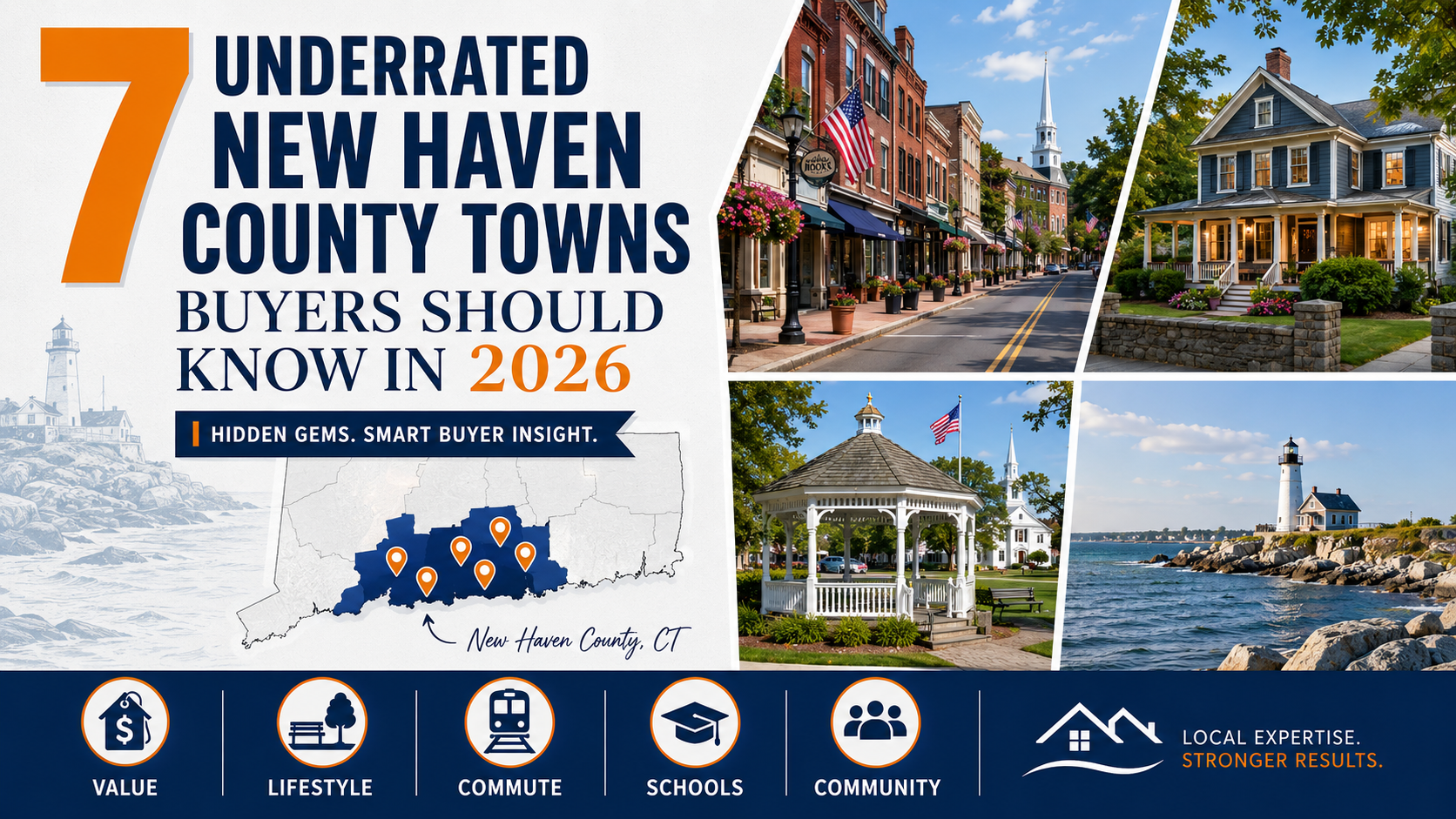
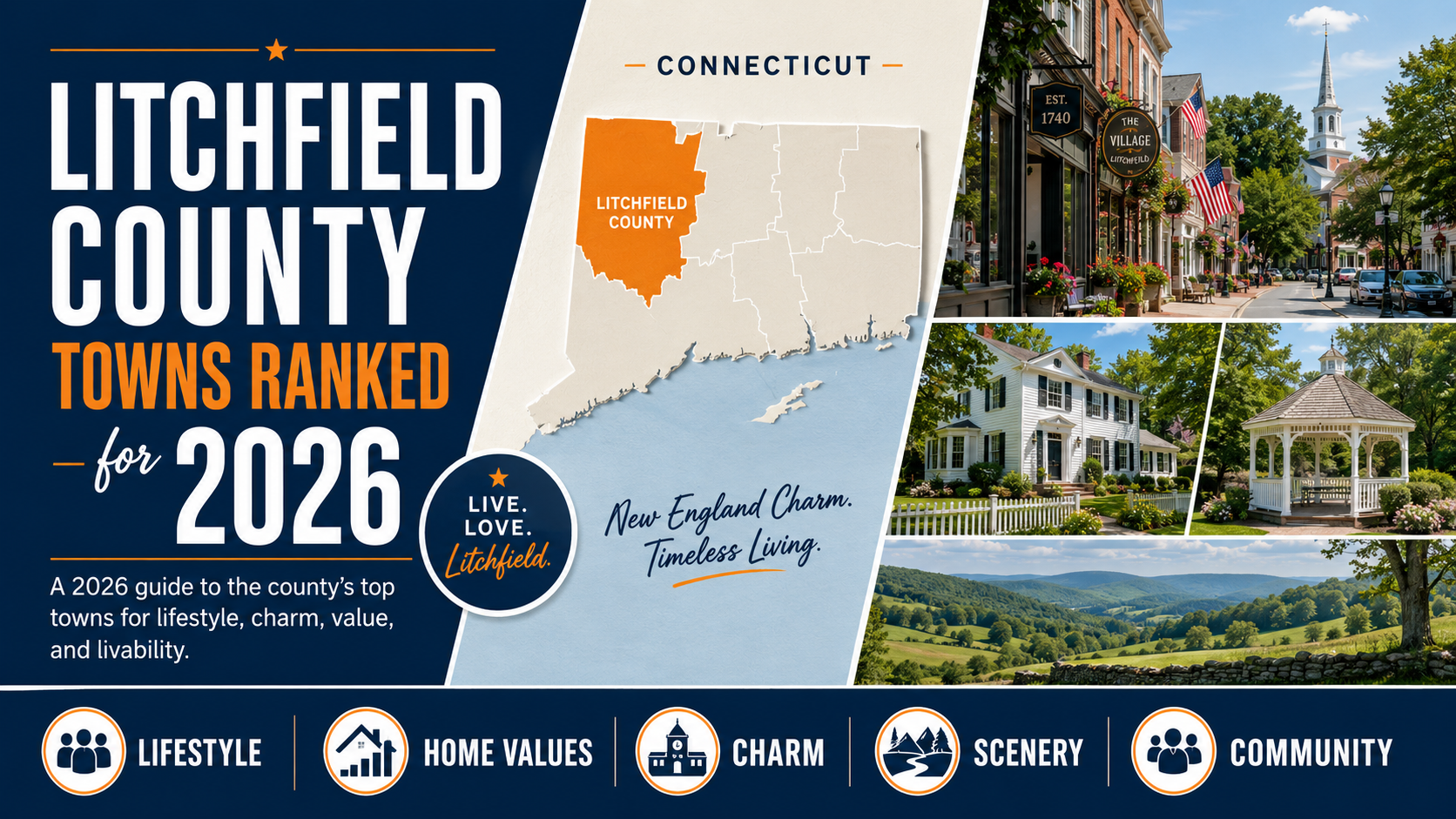
5 Most Underrated Towns in Litchfield County, CT (Affordable Homes & Low Taxes)

If you're thinking about buying in Litchfield County, you keep hearing the same three names: Litchfield, Washington, Kent.

There are five towns in this county that almost nobody talks about — and one of them has the lowest median home price in the entire county.

I'm Dave Jones with Dave Jones Realty. Let's count them down.


#5 — Barkhamsted: $465,000 median, 23.94 mill rate

The quietest town on this list and probably the one you've heard least about. (Shout out to my Aunt Sue and Uncle Tommy, who live up here.)

The median is $465,000 and it's held essentially flat over the past year — which in the market we're actually in is interesting. It means this town hasn't caught fire the way some of its neighbors have. And the mill rate of 23.94 is very low for this part of the state.

Why nobody's talking about it is simple: there's no big commercial center to drive through, no classic town green to photograph. It doesn't announce itself the way Litchfield does. (Though the historic village of Riverton in the north end of town is a genuinely charming little center — Hitchcock Chair country — and worth the drive on its own.)

What Barkhamsted has instead is space. The Barkhamsted Reservoir and Saville Dam show up in more wedding and engagement photos than almost anywhere in Connecticut. People's State Forest covers roughly 3,000 acres right here. And the West Branch of the Farmington River — a federally designated Wild and Scenic river — runs right along the town's edge.

Barkhamsted gives you more land for your dollar than almost anywhere else on this list. The buyers who end up here are usually the ones who already tried the better-known towns first.

I had a client last year who kept telling me she wanted more space, but every town I showed her felt too tight. When we finally walked the lot lines out in Barkhamsted, it was the first place she stood in the driveway and stopped talking for a minute. For her, that was basically a yes.

This is not a town for someone who needs a coffee shop within walking distance. It's a town for someone who wants to open their back door and not see a neighbor's siding. You will probably also see a bear. If fishing, hiking, and cross-country skiing once the snow hits sound like your version of a good weekend, Barkhamsted stops looking like an afterthought pretty fast.

#4 — Watertown: $365,000 median, up 7.4%, 30.04 mill rate

Another one close to my heart — and home to one of our offices, right on Main Street by the green. Stop in.

Let me be straight up front: 30.04 is the highest mill rate of the five towns on this list. You do pay a bit more on the tax side here. Here's what you get for it.

Watertown sits close enough to Waterbury that real shopping and real services are minutes away, while keeping a completely separate identity and its own town center on the green. I've shown Watertown to buyers who had already written off the whole area as "too close to Waterbury," and the reaction is almost always the same — they didn't realize you could get the convenience without actually being in the city.

The housing stock is genuinely mixed: older homes near the green, newer construction on the outskirts, and a good supply of condos. You're not boxed into one price point here.

Watertown is also home to Taft, a well-known prep school that brings activity and civic pride to the town center in a way you don't usually find in a town this size. And the roads connecting out toward Woodbury and Thomaston mean you're never locked into one direction.

For outdoor time, the Steele Brook Greenway and Crestbrook Park are right in town — no separate drive required. And you can be up in Litchfield or over at Bantam Lake in Morris in about twenty minutes.

The buyers I bring here are usually people who grew up near a small city somewhere and want that same rhythm without the price tag.

#3 — Harwinton: $439,000 median, 23.00 mill rate

Harwinton's median is almost identical to last year, which tells you the town hasn't been discovered yet. Prices are flat, which means buyers haven't started competing hard for the inventory.

The mill rate is 23.00 — the lowest of any town on this list, and that matters more than people realize once you start running actual monthly numbers.

Harwinton doesn't have a commercial strip to speak of. You're not walking to anything. It's mostly farmland, stone walls, and winding roads, wedged between Litchfield and Torrington, with Burlington close by — which means you're never more than about fifteen minutes from a real downtown even though your own town feels like the middle of nowhere.

Low taxes, real privacy, short drive to everything. That combination is exactly why I think this town is due for a jump — and towns like this tend to get discovered all at once rather than gradually, because there's nothing gradual about word getting around a small town.

There are working farms here that have been in the same family for generations, a handful of small country stores instead of strip malls, and the Harwinton Fair every fall — one of the oldest agricultural fairs in Connecticut.

This isn't a town you pass through on the way somewhere else. You have to actually mean to go there. No highway cuts through pulling attention toward the next exit. There's a volunteer fire department, a small library that still feels like the center of things, and enough open land that new construction here means real acreage instead of quarter-acre lots.

Buyers who want the Litchfield rural feel without the Litchfield price tag often end up here — once somebody points them in the direction.


Notice the pattern yet?

Every town so far has a mill rate under 31. Every single one. That's not an accident.

These are towns that got skipped while everybody chased the name-brand towns in this county. The skipped-over towns with the low mill rates are exactly where I tell buyers to start looking first — before they even think about the towns everyone else is bidding on.

I've been doing this twenty years and I see it over and over: the towns with the most name recognition usually have the highest mill rates, because a town doesn't need to compete on taxes when buyers are already lining up for the name alone. The towns that do have to compete are the ones handing you a better deal, if you're willing to look.


And I'm not going to tell you these towns are perfect

Because they're not, and that's not how I do business.

  • No hospitals inside any of these town limits. You're driving to Torrington, New Milford, or Waterbury. That's true of most of this county.
  • Internet and cell coverage can be genuinely spotty once you're outside the town center — especially in Barkhamsted and Harwinton. If you work fully remote, check the specific street before you write an offer.
  • You're going to drive more. That's the trade for the low mill rate and the extra land.

I'd rather tell you all of this before you fall in love with a house and then wonder where the closest grocery store is. Buyers who know what they're signing up for stay happy long after closing.


#2 — New Hartford: $388,250 median, up 5%, 26.87 mill rate

This is the town on the list with the most actual village character. There's a real center — restaurants that have been there for years — and it sits right on the Farmington River, which means kayaking, tubing, and fishing practically in your backyard depending on where you land.

The tubing run through Satan's Kingdom in New Hartford is one of the best-known stretches of river in the state. People drive from all over Connecticut for it every summer, and it's right here.

I've had out-of-state buyers ask me about river access before they asked about anything else, and New Hartford comes up in that conversation more than any other town in the county — yet it almost never appears in anybody's "best of Litchfield County" list.

The village center has a real coffee shop, a market, and a couple of restaurants that fill up on weekends. None of it feels manufactured for tourists the way some river towns do. It grew that way naturally, over decades, because people who move here tend to stay.

That stability shows up in how the town feels when you're standing in it. There's genuine civic pride — the annual downtown events pull crowds from twenty minutes away, and the town green still functions the way a town green is supposed to, as an actual gathering point instead of a patch of grass with a memorial on it.

It's the kind of downtown that makes you understand why people grow up here and rarely leave, even when they could easily afford to.


Here's what ties these four together. None has a flashy reputation. None shows up in the same sentence as Litchfield, Washington, or Kent. But every one has a lower mill rate, a lower median price, and in most cases more land for the money than the towns everybody's already talking about.

That's not a coincidence. That's what happens when a town doesn't have a marketing department behind it.


#1 — Winsted (Town of Winchester): $280,000 median, 29.17 mill rate

Before I say it, guess. It's not the one with the lowest mill rate — that's Harwinton. Not the one with the river — that's New Hartford. Not the one with the most land — that's Barkhamsted. Not the one closest to city conveniences — that's Watertown.

This is the town with the single lowest median home price in all of Litchfield County.

Winsted — which is technically a borough within the Town of Winchester. You'll see Winchester on your tax bill, but everybody local says Winsted. That alone trips up out-of-state buyers searching online for a town they can't seem to find.

Median price: $280,000. Let that sit, because that's genuinely rare in Connecticut right now. Pair it with a 29.17 mill rate and Winsted has something the other four towns on this list don't: an actual downtown. Real architecture, brick storefronts, a working main street grid, and a movie theater — the Gilson, which is one of the first places I ever took my wife, twenty-six years ago. Look it up.

Highland Lake sits right on the edge of town for anyone who wants water access without paying shoreline prices. Swimming, boating, a real beach — practically within walking distance of homes priced lower than almost anywhere else in the county.

This was a thriving mill town, and it's still working on its comeback. Which means buyers getting in now are getting in before the comeback finishes. I've watched this movie before — it gives me a lot of the same feeling Naugatuck did a few years ago. The comeback always finishes eventually. The only question is whether you own something here before or after.

Downtown Winsted has more surviving early-1900s architecture than almost any town its size, and it's slowly filling back in with small businesses the way these towns do once people start paying attention. There's a genuine sense that this place is on its way somewhere.

I'd rather buy into a town on its way up than a town that's already arrived.


All five, side by side

# Town Median Price Mill Rate Est. Annual Tax at Median
1 Winsted (Winchester) $280,000 29.17 ~$5,717
2 New Hartford $388,250 26.87 ~$7,303
3 Harwinton $439,000 23.00 ~$7,068
4 Watertown $365,000 30.04 ~$7,675
5 Barkhamsted $465,000 23.94 ~$7,793

Based on Connecticut's 70% assessment ratio. Estimates only — actual bills depend on the town's assessed value for the specific property, and mill rates are set annually.

Look at that right-hand column. Four of these five towns land within about $700 a year of each other on taxes despite median prices spanning nearly $100,000 — and Winsted comes in roughly $2,000 a year below all of them.

Every one of these towns is also within a reasonable drive of a hospital, a grocery store, and a full school system, which is what people worry about most when I bring up a town they've never heard of. Quiet doesn't mean cut off.


What to actually do with this

Don't default to the name-brand towns you keep hearing about. The algorithm shows you what gets clicked, not what fits your budget and your life.

Check the mill rate before you fall in love with the price. A lower sales price in a high-mill-rate town can cost you more month after month than a slightly higher price in a town like Harwinton or New Hartford.

And if a town feels quiet when you drive through, don't assume there's nothing there. Sometimes quiet just means nobody's told everybody else yet.

Here's my actual homework for you: take a Saturday and drive all five back to back. Start in Barkhamsted, end in Winsted. You'll come away with a completely different picture of this county.

None of these towns are secrets because they're bad towns. They're secrets because they don't have the name recognition Litchfield built over decades — and buyers default to names they already know instead of looking past them.


Call or text: 203-910-2638 Email: Dave@davejonesrealty.com Search every home in Connecticut: www.searchallcthomes.com

Let's figure out which of these fits — or whether a town nobody's mentioned yet fits you better.


Market data reflects the most recent reporting period available at the time of writing and changes continuously; mill rates are set annually. Contact Dave Jones Realty for current figures on any specific town. For school information, we recommend GreatSchools.org and visiting districts directly. Buyers researching any Connecticut community should conduct their own independent due diligence on all factors relevant to their decision.


Dave Jones Realty LLC | Serving New Haven, Hartford, and Litchfield Counties
Aug. 7, 2026

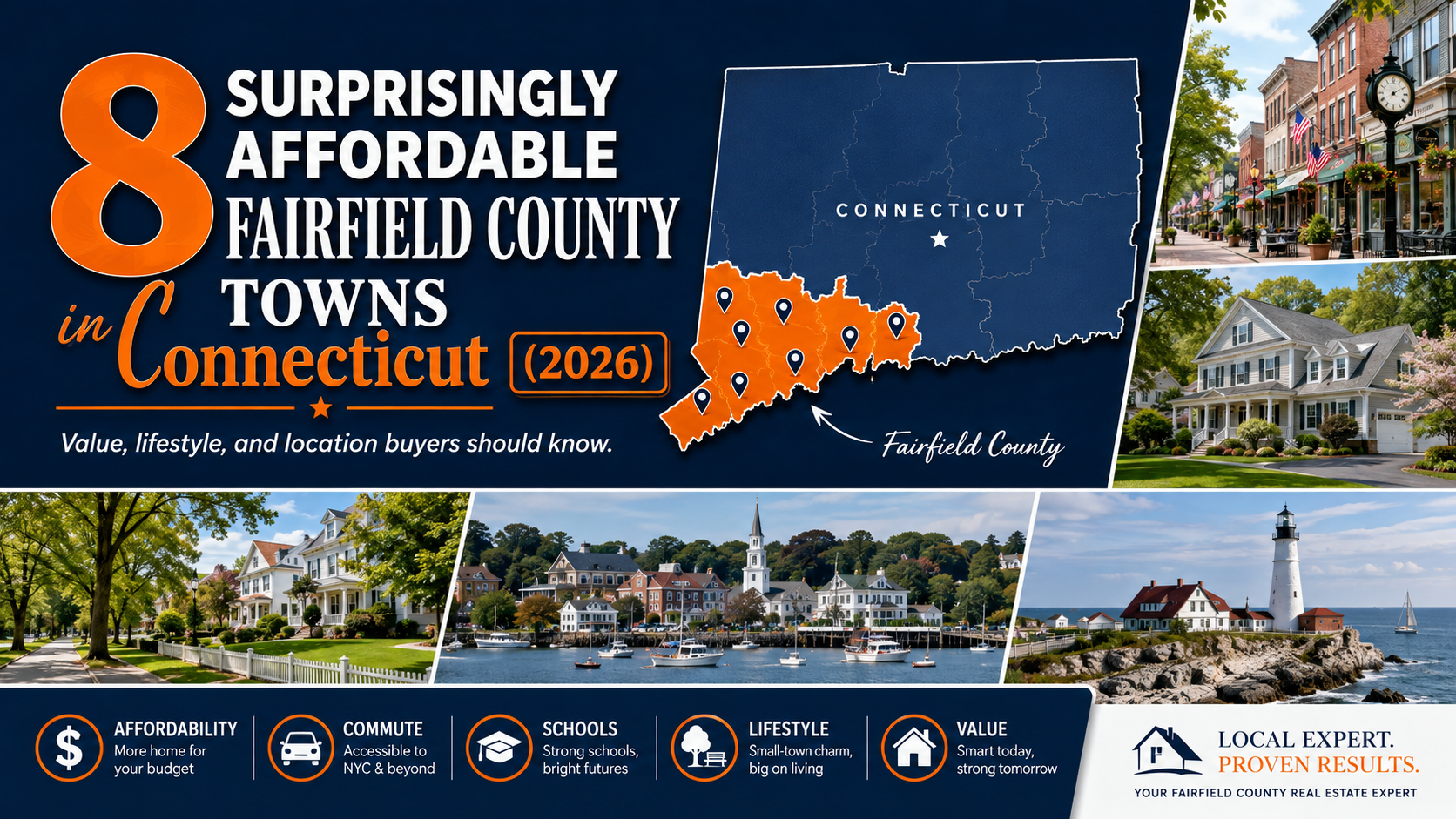
Top 8 Connecticut Suburbs in 2026 (Real Data)


If you're thinking about moving to Connecticut — or even just moving within Connecticut — one question matters more than any other: where should you actually live?

Here's the problem. Most people get this wrong. They pick a town based on reputation, follow what a friend told them, scroll Zillow for twenty minutes, and convince themselves they've got it figured out. Then they overpay in the wrong town for a lifestyle that doesn't fit them.

So today I'm ranking what I believe are the top eight suburbs in Connecticut right now, and I'm backing it with real Smart MLS data. But I'm also going to tell you what's not so great about each town — because that's the part most rankings leave out, and it's usually the part that matters most.

I'm Dave Jones with Dave Jones Realty, I've lived here my whole life, and I run one of the largest independent brokerages in the state. This is my list.

One quick note on the numbers: everything below is a snapshot from early 2026. Market data moves fast in Connecticut, and in smaller or higher-end towns a handful of sales can swing the percentages dramatically month to month. Treat these as a point-in-time read, not a permanent truth — and if you want current figures for any town, reach out and I'll pull them.

And two things I deliberately don't rank on: schools and crime. Those are personal, they change, and they deserve your own research. I'll always point you to GreatSchools.org for school data and the state's official sources for crime stats, but that's your due diligence to do.

#8: Washington — Quiet Luxury in Litchfield County

This one will surprise people. Washington isn't a typical suburb — it's where you go for space, privacy, land, and to not be bothered. You're in Litchfield County, which means rolling hills, working farms, and hiking trails. It's one of the most peaceful places in the state.

The data tells an interesting story. Around the time of writing, the median sales price was about $1.165 million, up nearly 50% year over year, with roughly 123 average days on market, only about 19 homes available, and around 4.6 months of inventory.

What that tells you: this is a slow-moving, high-priced market. It isn't fast and it isn't cheap, but when something sells, it sells at a premium. Sellers were getting around 90 cents on the dollar, which means there's negotiating room if you know what you're doing. It's also one of the biggest second-home markets in the state — New York buyers have been coming here for years for the weekend escape, the estate homes, the big lots, the farmers markets, the bookstores, and Lake Waramaug.

The downside: you're not close to much, and there's no major highway nearby. If you need to commute regularly, this probably isn't your town. But if lifestyle is your priority, Washington is hard to beat.

#7: Simsbury — Photogenic and Polished (Hartford County)

Simsbury is one of those towns where everything just feels like it was done right. Driving through, it almost feels like a movie set — a great town center, biking trails, the Farmington River, and a clean, organized, calm feel. It's popular with people who want real suburban living without the isolation of a town like Washington.

At the time of writing, the median home price was around $443,000, with a year-to-date median closer to $532,000 (up about 20% from the prior year), and homes selling at roughly 107.8% of list price — meaning buyers were routinely paying well over asking. Supply was extremely tight at under one month, with very few closed sales year to date.

That over-asking number and the sub-one-month supply tell the whole story: when something good hits the market here, you have to move fast and above asking.

The downside: it's not one of the cheaper towns on this list, and it can feel quiet, especially coming from a city. Easy daily highway access isn't its strong suit either. But the overall quality of life is tough to beat.

#6: Shelton — The Secret Weapon (Fairfield County)

This is one of my favorites and a genuine value play. More and more people are figuring Shelton out, and once they do, they don't leave.

Here's what's happening: people want Fairfield County but not Fairfield County prices, and Shelton is the perfect middle ground. You get lower taxes than most surrounding towns and great access to Route 8, the Merritt Parkway, and I-95 — a location that makes daily life work.

As of early 2026, the median sales price was hovering around $645,000, up nearly 20% year over year. Closed sales had doubled compared to the prior year, pending sales were up sharply year to date, and homes were selling at about 103% of list price. Those aren't subtle numbers — that's a market with real momentum.

The downside: Shelton doesn't have the same polish as the higher-end Fairfield County towns. Some areas feel spread out, and there's no strong downtown identity yet — no obvious "let's meet downtown" spot. That's beginning to change, but it isn't there yet. For value and access, though, it's hard to ignore.

#5: Madison — Classic Shoreline (New Haven County)

Now we're talking coast. Madison is one of the best ways to get that classic coastal Connecticut lifestyle without going all the way into Fairfield County pricing — beaches, a beautiful town green, great restaurants and shops, and that genuine New England coastal feel. People don't just buy the house here; they buy how it feels to live here.

That charm comes at a price. At the time of writing, the median sales price was about $770,000 (up 15% year over year), with an average sales price closer to $973,000 year to date (up around 30%). Inventory had dropped to roughly 29 homes at about 1.6 months of supply, with closed sales up 30%. When average prices push toward a million and inventory keeps falling, demand is outpacing supply — and that's Madison in a nutshell. It's not a market you wait on.

The downside: you're paying for the shoreline, and there's no way around that. Inventory is limited, which means competition, and the town can feel seasonal — lively in summer, quieter in the off-season. But if lifestyle ranks high for you, Madison delivers.

#4: Cheshire — The Balanced One (New Haven County)

Cheshire — our neighbor here in Prospect — is one of the most balanced towns in the state. It doesn't try to be flashy. It just works. Central location, easy access to New Haven, Hartford, and Waterbury, and quiet without being boring. It's a place people move to and stay — which is great until you want to buy and there's no inventory.

As of February 2026, homes were averaging around $557,000, with days on market down significantly from a year earlier (roughly 100 days the prior February to about 40 this February). Inventory had fallen about 36% to just 23 homes, closed sales were up 45%, and supply sat at about one month.

The read: buyers are moving faster to Cheshire, and it's no surprise given everything happening there — the new Whole Foods, Barnes & Noble, and high-end condos. Homes that used to sit for four months are gone in weeks. Faster sales, less supply, more transactions — that's a classic tightening market.

The downside: there's no major walkable downtown, so if you want urban energy or nightlife, this isn't it. Coming from a big city, it can feel a little sleepy. But for consistency, stability, and a community that functions, Cheshire is excellent.

#3: Ridgefield — Premier and Walkable (Fairfield County)

Now we step into a different category. Ridgefield is one of the premier towns in the entire state — top-tier reputation, a true walkable downtown with arts, culture, and real restaurants, and still within reach of New York City. That combination is genuinely rare.

The numbers reflect it. Recent stats showed a median sales price around $1.374 million, though I want to be transparent: in a luxury market, a small monthly sample creates big percentage swings, so I'd weight the year-to-date median of just over $1.038 million more heavily. Either way, this is a legitimately expensive market, and the prices reflect real, sustained demand.

What sets Ridgefield apart is that it doesn't feel like a typical Connecticut suburb — the organized, almost European downtown is something you rarely find here, and it's part of why demand never lets up.

The downside: it's expensive, and there's no sugarcoating that. Inventory is tight even at entry level, and commuting logistics need real thought depending on where in town you are. But if it fits your budget and lifestyle, Ridgefield is among the best the state offers.

#2: Glastonbury — The Well-Rounded Bet (Hartford County)

I'll say it plainly: Glastonbury is one of the most well-rounded towns in the state. Strong reputation, tons of shopping, great restaurants, a real community feel, and a nice mix of suburban and rural depending on where you are — polished and developed in some spots, then you turn a corner onto a country road with farm stands and open land.

Recent stats showed a median sales price around $575,000, with a year-to-date median near $626,000 — both up about 11% year over year — while inventory had fallen to just 18 homes at 0.7 months of supply, with new listings down nearly 50%. For context, a balanced market runs about 5–6 months of inventory. Glastonbury sitting under one month, with prices still rising, tells you buyers are competing hard for very little.

The downside: the commute into Hartford can be painful depending on timing — the bridge and main highways back up, and you need to know the side roads. Prices have been climbing and likely will keep climbing, and some areas feel more rural than buyers expect. But overall, Glastonbury is one of the safest, most consistent bets in Connecticut.

#1: West Hartford — The Most Complete Suburb

No surprise to some people. West Hartford is probably the most complete suburb in Connecticut, period. Walkability, great restaurants, nightlife, serious shopping, a strong reputation, and a location that makes sense for how people actually live. It's the closest thing Connecticut has to a mini-city feel in a suburb, and it delivers on all of it like nowhere else.

The most recent stats showed a median sales price around $567,000 (up about 20% year over year), homes selling at roughly 106% of list price, and just 17 days on market with only about 0.9 months of supply. Let that sink in: the average West Hartford home sells in about two weeks, for nearly 10% over asking.

And here's what makes it more impressive — West Hartford has held that level of demand consistently for about three years. This isn't a one-month spike. The town has been competitive for years with no sign of slowing down.

The downsides, honestly:

  • Higher property taxes than most towns on this list. Not the highest in the state, but factor it into your total monthly cost.
  • Smaller lots. West Hartford is densely developed, so if you want significant land, you're looking at the outer edges of town or a different town entirely.
  • Real competition. When a great house hits a great neighborhood, it's often under contract before you've set up a showing. You have to be fully ready to move, not ready to think about it.

But if convenience, lifestyle, and a town that genuinely buzzes are what you're after, West Hartford is the answer.

The Real Takeaway

After all eight towns, here's the truth: there is no single best town in Connecticut. There's only the best town for you.

The data doesn't lie. Every one of these markets is moving. Inventory is tight across the board, prices are rising, and buyers who wait usually end up paying more for less.

Buyer and Seller Takeaways

If you're buying in one of these towns:

  • Match the town to your life, not to a ranking. Washington and Madison reward lifestyle-first buyers; Shelton and Cheshire reward value-and-access buyers; Ridgefield and West Hartford reward those who prioritize walkable, premium living and can move fast.
  • In sub-one-month-supply markets (Simsbury, Glastonbury, West Hartford), get fully pre-approved and be ready to offer at or above asking the day the right home lists. Hesitation is what costs people these homes.
  • Weigh the honest downsides listed here as seriously as the upsides — commute, lot size, taxes, and seasonality are exactly what buyers regret overlooking.
  • Do your own school and safety research through GreatSchools.org and official state data before you commit.

If you're selling in one of these towns:

  • These are strong seller markets, but correct pricing and presentation still drive whether you land at, above, or below asking. Over-asking results follow well-prepared, well-priced homes.
  • Days-on-market and over-asking percentages are powerful pricing evidence — use current local data (not last year's) to set strategy.
  • Know your buyer's motivation: lifestyle, value, or prestige. Marketing to the right one shortens your timeline.

Ready to Figure Out Where You Fit?

The hard part isn't the data — it's turning it into the right decision for your budget, commute, and lifestyle. That's what my team does every day.

Whether you're moving next month or next year, reach out and we'll go through what matters most and help you get it right the first time.


Dave Jones Realty Dave Jones, Broker/Owner 📞 203-910-2638 ✉️ Dave@davejonesrealty.com 🌐 www.searchallcthomes.com

Aug. 6, 2026

Living in Waterbury CT: Honest Pros and Cons

If you're thinking about moving to Waterbury, Connecticut, you should hear this before you decide. The city is misunderstood, underestimated, and quietly changing.

I've lived in Connecticut my entire life and I help people move here every day. So today I'm breaking down the real pros and cons — the good, the not-so-good, and the "oh, really?" — for anyone considering relocating here, downsizing, investing, or just curious about how this city actually works.

This isn't hype and it isn't doom and gloom. It's data, lived experience, and the kind of nuance you only get from being here.

Waterbury has been called the Brass City since its industrial days, but today the story is really about three things: affordability, location, and opportunity — especially compared to the rest of Connecticut.

Right now, the median home price in Waterbury typically falls in the high $200s to low $300s, roughly $290,000 to $315,000 depending on the neighborhood and the month. That's dramatically below much of the state, and prices have continued rising year over year as more buyers realize this city isn't frozen in time.

Here are six pros and six cons so you can decide whether Waterbury fits your budget, your lifestyle, and your long-term plans.

Pro #1: Genuine Affordability in an Expensive State

This is the headline, and it's a big one.

The overall cost of living in Waterbury runs roughly 5% below the national average and about 20% cheaper than Connecticut as a whole. In a state where affordability is usually the punchline, that matters.

What that looks like in real life: buyers who feel completely priced out of Fairfield County, the shoreline, or even parts of Hartford County suddenly find they can actually buy a house here. A yard, a driveway, a garage — not just a technically-qualifies-as-a-bedroom situation.

I've watched families move from small apartments in New York and New Jersey into a single-family home here and still have real breathing room in their budget. That combination is getting rare.

Pro #2: The Location Is Sneaky Good

Waterbury sits between New Haven and Hartford with access to I-84, Route 8, and Metro-North connections. You're not stuck in a bubble — commuting to multiple employment hubs is genuinely realistic from here.

And here's what buyers don't expect: Waterbury traffic is very predictable once you understand it. That's the key phrase — once you understand it.

There are specific choke points that look terrifying on Google Maps and Waze, and there are side routes locals have used for decades to go around them. Knowing which neighborhood shaves fifteen minutes off your commute, or which route avoids school traffic, completely changes your daily experience.

That's the kind of practical knowledge that makes a relocation smarter. You shouldn't have to buy the house first and figure out the commute afterward.

Pro #3: Real History, Culture, and Character

Waterbury has character — and not the Instagram-filter version. You've got authentic architecture, historic neighborhoods, public art, community festivals, and venues like the Palace Theater anchoring downtown.

This is a city that grew fast, worked hard, and carried its identity forward. For buyers who want something other than a cookie-cutter development, Waterbury feels real. You don't just live here — you feel where you live.

Pro #4: Diversity and Community Energy

Waterbury is one of the most diverse cities in Connecticut. Different cultures, languages, backgrounds, and traditions all intersect here, and it shows up everywhere — the restaurants, the local businesses, the festivals, the neighborhoods.

For a lot of buyers, particularly those coming from larger metro areas, that feels familiar and welcoming rather than isolating. It's city energy without big-city scale, which is a genuinely rare combination.

Pro #5: A Stable, Diversified Job Base

Waterbury isn't a one-industry town anymore. Where it was once all brass, today healthcare, education, construction, manufacturing, service industries, and regional employers all contribute to the employment base.

It's not Silicon Valley — and for a lot of people, that's a feature, not a bug. You're not betting your family's future on a single tech cycle or a single employer. That kind of stability matters if you're planning to stay put long term.

Pro #6: The University Effect Nobody Factors In

Here's something most buyers never think about. Waterbury isn't home to just one college presence — it has multiple higher education anchors, including the UConn Waterbury campus, Post University, and Naugatuck Valley Community College, plus regional programs that bring students, faculty, cultural events, and economic activity into the city.

Why does that matter to a homebuyer? It supports rental demand, it stabilizes certain neighborhoods, and it brings consistent economic energy. Even if you're not buying an investment property, that affects housing demand and long-term value more than most people realize.

Now the Cons — Because Real Talk Matters

Con #1: Crime Rates Run Above the National Average

Let's be honest about this. Waterbury's overall crime rate is higher than the national average, and both property and violent crime statistics are elevated compared to many Connecticut suburbs.

The nuance most people miss is that these numbers vary meaningfully within the city rather than applying evenly across it.

My advice is always the same, and it's advice I'd give anywhere: do your own research using objective sources, and spend real time in any area you're seriously considering. Go in the morning. Go in the afternoon. Go after dark. Walk around. Talk to people. Look up published crime data through the Waterbury Police Department and state resources, and check the annual town-by-town rankings that outlets like Connecticut Magazine publish using real data.

You should be forming your own impressions from firsthand experience and public information — not from a stranger's opinion, and not from outdated internet chatter.

Con #2: The Driving Culture Is Aggressive

Connecticut drivers already have a reputation, and Waterbury leans into it. Some studies have ranked the area poorly for aggressive driving and related incidents. It's not just traffic volume — it's how people drive.

You do adjust. After a while you develop what I'd call Connecticut defensive driving instincts. Don't trust the blinker. Trust your instincts.

Con #3: Property Taxes Will Surprise You

Yes, the homes are cheaper. But Waterbury's property taxes catch buyers off guard constantly. If you shop the purchase price without running the tax number, you're in for a rude awakening.

City services — sewer, water, infrastructure — are built into the system, and that shows up on your tax bill. This isn't a deal breaker. It's a math problem. Smart buyers run the full monthly number before committing, and in Connecticut that's true everywhere, not just here.

Con #4: Full New England Winter

You get all four seasons. Fall is glorious, spring is refreshing, summer is solid, and winter will command your respect.

Snowfall, cold snaps, and real winter prep are all part of the deal. Waterbury has a lot of streets, and it can take public works a while to get to all of them. You'll also want off-street parking — getting plowed in is genuinely miserable.

Con #5: Urban Challenges Are Real

Like many Connecticut cities, Waterbury faces real housing and homelessness challenges. That's worth understanding if you're evaluating long-term city planning, infrastructure investment, and community support systems.

It's part of the honest picture — not something to ignore, and not something to sensationalize.

Con #6: A Mixed Online Reputation

If you've Googled Waterbury, you've already seen this. Some people trash it, others defend it fiercely. The truth lives somewhere in the middle.

Waterbury isn't perfect, but it's also a long way from what outdated online chatter suggests. Understanding which areas are actively improving and which still have work ahead is the difference between loving your move and second-guessing it.

Buyer and Seller Takeaways

If you're buying in Waterbury:

  • Run the full monthly payment including taxes before you fall in love with a price. The tax line changes the math more here than the sale price does.
  • Visit any neighborhood you're considering at multiple times of day and on different days of the week. There's no substitute for firsthand impressions.
  • Use objective public sources — police department data, state resources, published town rankings — to form your own view rather than relying on hearsay.
  • Prioritize off-street parking if you can. It matters more in winter than you'd guess.
  • Many of these homes are older, so budget accordingly for mechanicals, roofs, and updates.
  • Drive your actual commute at the actual hour, and ask about local routes around the known choke points.

If you're selling in Waterbury:

  • Your buyer pool includes a lot of people priced out of surrounding counties. Marketing that speaks directly to affordability, yard space, and commute access reaches them.
  • Have your tax figures, utility costs, and any recent system updates documented up front. Buyers here are running monthly-cost math and appreciate not having to chase numbers.
  • Off-street parking, garage space, and a manageable driveway are real selling features in this market — don't bury them.
  • If you're near one of the university anchors, that's genuine value worth highlighting, especially to investor buyers.

Is Waterbury Right for You?

We're only scratching the surface here. There are neighborhood nuances, school considerations, commute patterns, tax differences, and lifestyle factors that don't fit into one article.

That's why people relocating here reach out to my team. We help buyers think through the full picture so there aren't surprises after the moving truck leaves — whether you're moving next month or planning five years out.

Waterbury isn't for everyone. But for the right buyer, it can be one of the smartest moves in Connecticut.

If you want an honest conversation about whether it fits your situation, let's talk.


Dave Jones Realty Dave Jones, Broker/Owner 📞 203-910-2638 ✉️ Dave@davejonesrealty.com 🌐 www.searchallcthomes.com

Aug. 5, 2026

7 Things to Know Before Moving to Connecticut

If you're thinking about moving to Connecticut, hit pause for a minute. There are seven things you need to be able to handle before you make the move — and if you can't handle them, this might not be the right place for you.

I'm Dave Jones, broker/owner of Dave Jones Realty. Born in Connecticut, raised in Connecticut, still in Connecticut. I tried to escape once, but the pizza kept calling me back.

Connecticut is a fantastic state. But every year I meet people from all over the country who arrive wide-eyed and optimistic, then realize New England living is a little different than they pictured. So let's talk about what it's actually like here — before you buy.

1. The Cost of Living Is High, and So Are Home Prices

This is the one everyone talks about, but not always honestly. Connecticut is not the cheapest state in America. Home prices are near record highs heading into 2026, with a statewide median in the neighborhood of $385,000 — and in the more desirable shoreline and Fairfield County towns, you can be looking at double that.

Property taxes are the part people underestimate. Connecticut funds most services at the town level, which means each municipality sets its own mill rate. Two houses with nearly identical specs in two different towns can carry wildly different tax bills. That surprises a lot of relocating buyers.

I hear the objection constantly: "I can get more house for less money somewhere else." And they're right. But somewhere else isn't Connecticut. If affordability above all else is your goal, this state will frustrate you.

The way to handle it is with data and planning. Connecticut real estate trends are stable. Prices hold. Towns are established. You pay more, but you usually get more — and the mill rate math should be part of your search from day one, not a surprise at closing.

One more thing: our housing stock is older. You may be buying a home built in the 1950s or 60s rather than a brand-new open-concept build. That means maintenance, updates, and a real budget for both. If you can handle paying for quality, you'll fit right in here.

2. The Weather Will Test You — In All Four Seasons

Connecticut gives you all four seasons whether you asked for them or not. Cold, snowy winters. Hot, steamy summers. Rain and mud in spring. And in fall, leaves everywhere — in your car, in your gutters, somehow inside your refrigerator. I still haven't figured that one out.

Severe weather is part of life here: nor'easters in winter, the occasional hurricane, and thunderstorms that will genuinely rattle you. Just ask my dog.

The tree factor nobody warns you about

Connecticut homeowners spend a serious amount of time and money on tree maintenance. We're a heavily forested state — beautiful to look at, but tall trees plus storms equal power outages, blocked driveways, and expensive cleanup. Around here, a good tree and chainsaw guy ends up on speed dial right next to your dentist. (We've got recommendations — just ask.)

Welcome to basement season

Most Connecticut homes have full basements. That's a huge plus for storage, but it also means moisture control is a normal part of homeownership: sump pumps, dehumidifiers, waterproofing. Buyers from Texas, Florida, and Arizona regularly ask me what a sump pump even is.

Here's how I explain it: in Connecticut, there are two kinds of basements — ones that have sump pumps, and ones that need sump pumps.

If you hate winter, this state will test you. If you hate humidity, it'll test you too. We're equal-opportunity offenders.

Why weather is really a home-buying issue

Relocating here isn't just about picking a state with pretty seasons. It's about understanding how those seasons affect the specific house you buy — which neighborhoods flood, which properties sit on ledge, which streets lose power more often than others. None of that shows up on Zillow. Those are the local details my team and I walk buyers through long before they make an offer, so they're buying with confidence instead of finding out the hard way.

3. Traffic Is Real, and Public Transit Is Limited

Connecticut is small, densely populated, and running on old highways. I-84, I-91, the Merritt Parkway, and Route 8 can all get seriously congested — I've done my share of sitting in it on the way to a Mets game. Commuters heading out of New York City looking for more space add to the volume, and a lot of them land right here.

Public transportation exists — Metro-North along the coast, plus regional bus systems — but it's nowhere near as extensive as in bigger metro states. In most towns, you need a car.

How to handle it: choose your town around your actual commute, not just the house. Live closer to where you work, learn the side roads, and understand the timing windows on your route. Connecticut is very manageable when you plan instead of assume.

And a cultural heads-up: Connecticut drivers treat left-lane camping like a competitive sport. The left lane is sacred ground. If you plan to cruise along leisurely with your iced coffee enjoying the scenery, you'll have drivers in your rearview like angry bees. It's not dangerous — it's just intense. Think NASCAR with better bagels.

4. The Job Market Is Strong, But Competitive

Connecticut has real depth in insurance, healthcare, education, aerospace, and technology. Salaries are solid. But it's competitive, and certain industries cluster in specific regions rather than spreading evenly across the state.

Newcomers often worry the market is too narrow for what they do. The answer is research and networking before you move. Connecticut rewards specialized professionals — if you're willing to work within the industries that dominate here, opportunities are plentiful. If you're expecting every possible career path in every possible town, you'll need to adjust expectations.

This matters for your home search too, because it shapes which corner of the state actually makes sense for you.

5. Entertainment: Somewhere in the Middle

Some buyers imagine Connecticut is packed with things to do. Others picture a sleepy colonial museum. The truth sits right in between.

We've got fantastic local restaurants, great theaters, two of the biggest casinos in the country in Foxwoods and Mohegan Sun, terrific college sports (go UConn), beautiful lakes and beaches, and outdoor recreation everywhere. What we don't have is massive theme parks and endless nightlife.

If you need big-city entertainment every single night, Connecticut will feel quiet. If you like local charm with strong weekend options, you'll love it.

And don't overlook proximity — where else can you be roughly an hour and a half from Manhattan and two and a half hours from Boston? You don't need everything inside your own town when the rest is a short drive away.

6. The Local Culture Takes Some Adjusting

Connecticut has its own personality. Towns operate independently and take real pride in it. People care deeply about local traditions. The pace is polite but direct. Neighbors introduce themselves. Schools are the center of community life. And fall is practically a religion.

Relocators sometimes tell me it feels harder to break into social circles here. The fix is simply getting involved — go to town events, spend time on the green, get into local sports. Connecticut communities welcome newcomers who make an effort.

Just don't expect a 40-minute Southern-style conversation in the grocery checkout line. We're efficient, but we're friendly.

7. Safety Is a Street-by-Street Question, Not a Statewide One

Connecticut is overall a very safe state, but like anywhere, there are pockets newcomers should learn about first. Our cities — Waterbury, Bridgeport, Hartford — all have excellent neighborhoods and genuinely beautiful downtowns alongside areas you'd want to know more about before buying.

The common fear I hear is choosing the wrong street. Here's how to handle it:

  • Work with a team that knows the market at a hyper-local level
  • Look at actual police statistics and neighborhood trends, not online headlines
  • Drive the area yourself, at different times of day and different days of the week
  • Check the town-by-town rankings that Connecticut Magazine and similar outlets publish annually using real data

Connecticut is a state of micro-markets. Safety here isn't statewide — it's street by street. Once you understand that, most of the fear goes away.

Bonus: Get Your Financial Picture Right Before You Shop

A few things I tell every relocating buyer:

  • Know your true monthly payment, not just the sale price. With Connecticut's town-level mill rates, taxes can swing your payment significantly between two similar homes.
  • Get pre-approved with a Connecticut-based lender who understands our closing process.
  • Plan for inspections and attorney review. Connecticut is an attorney-review state, and that step is part of every transaction here.
  • Understand oil heat versus natural gas. It affects your monthly budget and, down the road, your resale.
  • Be ready to move quickly. This is a competitive market, and hesitation costs people the right house.

Buyer and Seller Takeaways

If you're relocating here:

  • Compare mill rates between towns before you fall in love with a house — the tax difference can be the equivalent of tens of thousands in purchase price.
  • Budget for an older home's realities: roof, systems, basement moisture, and tree work.
  • Pick your town around your commute and your industry, then find the house.
  • Visit in more than one season if you can. February Connecticut and October Connecticut are two different experiences.

If you're selling here:

  • Buyers relocating from out of state are asking sharper questions than they used to — about taxes, heating type, basement moisture, and flood history. Getting ahead of those answers with documentation makes your home an easier "yes."
  • Older homes sell well here when the deferred maintenance story is handled proactively rather than discovered at inspection.

Thinking About Making the Move? Let's Build the Game Plan.

Everything above is just a handful of the details that come up in a Connecticut move. There's also finding the right attorney, the right inspector, the right heating contractor, understanding the tax picture, comparing school districts, and getting your timing right.

That's where my team comes in. We do this every single day, right here in Connecticut, and connecting with us early is how you avoid the expensive surprises and build a smart plan instead of reacting to one.

Whether you're moving next month or mapping out a retirement move years from now, I'm happy to help.


Dave Jones Realty Dave Jones, Broker/Owner 📞 203-910-2638 ✉️ Dave@davejonesrealty.com 🌐 www.searchallcthomes.com

Aug. 4, 2026

Moving to Connecticut in 2026: Full Relocation Guide


If you're thinking about moving to Connecticut in 2026, you found the right guide. I'm going to walk you through everything you need to know so you can make the move with confidence, avoid the expensive mistakes, and actually enjoy landing here — instead of showing up confused and wondering why your neighbor owns a snowblower the size of a small tank.

Connecticut is a small state with a big personality. We pack beaches, real cities, postcard towns, rolling farmland, and more pizza places per square mile than should be legal. People move here for quality of life, strong schools, access to two major cities, and that classic New England character that comes with actually having history.

They also move here and get blindsided by property taxes and the discovery that a lot of homes still heat with oil. Yes, oil.

I've lived here my whole life and spent my career helping families relocate here, so this is the local insider version — not the glossy brochure version. Let's get into it.

1. The Housing Market and What It Costs

Heading into 2026, Connecticut remains one of the tightest inventory markets in the country. That means fewer homes for sale, steady buyer demand, and prices that have stayed resilient even as other markets softened.

The statewide median home price is running right around $425,000, depending on which report you're reading — up roughly 8 to 10% year over year. That's notable given how much mortgage rates have moved and how uneven the national picture has been.

Regionally, it breaks down very differently:

  • Fairfield County (closer to New York): roughly $600,000 to $650,000
  • Greater Hartford: roughly $350,000 to $380,000
  • Litchfield County: charming homes still available in the low-to-mid $300,000s

Homes are moving fast

Average days on market statewide sits around 40. In the most competitive towns, homes go under contract in under five days.

And here's the number that should reset your expectations: more than half of Connecticut homes sold recently went above asking price. If you're planning to lowball your way through this market, you're in for a rude awakening.

The most active price point is between $325,000 and $450,000, and it stays genuinely competitive — especially for updated homes. Buyers right now are tired. They don't want to renovate. They want to unpack boxes and be done.

The age of our housing stock

A huge portion of Connecticut's homes were built before 1970. Capes, colonials, and ranches from the 50s and 60s dominate a lot of neighborhoods.

You're not just buying a house here — you're often buying a piece of history, complete with quirky closets, floors that creak like they're auditioning for a horror movie, and outlets in locations that make no sense whatsoever.

Welcome to oil heat

Roughly a third of Connecticut homes still heat with oil. Not natural gas, not electric — oil. You'll have a tank in the basement or buried in the yard (most buyers want it out of the yard), and you'll call a company to fill it a few times each winter.

Welcome to New England independence, where every house is essentially its own tiny power plant. And yes, the January bill can sting.

The rest of the cost picture

Groceries run above the national average. Electricity rates are among the highest in the country. Gasoline typically runs above average too. Everything here costs a little more.

Average monthly heating costs vary sharply by fuel type — electric heat is by far the most expensive option, natural gas is the cheapest where it's available, and oil sits in between. Which system a house has will meaningfully change your monthly budget, so it belongs on your question list for every showing.

The upside: higher costs come with real services. Town services here are excellent, roads are maintained, snow removal makes other states look like they're improvising, and libraries, parks, community programs, and schools are well funded. You genuinely feel like you're getting something for those checks.

2. Property Taxes: The Thing That Separates Connecticut From Everywhere Else

This is the single most important section in this guide, so slow down here.

Connecticut's average effective property tax rate runs around 1.8% — close to double the national average. A $400,000 home can carry a tax bill anywhere from roughly $7,000 to $9,000 a year depending on the town.

But the rate isn't the story. The variation between towns is the story.

  • Towns like Greenwich and Westport have very high home prices but relatively low mill rates
  • Cities like Waterbury and Bridgeport have lower home prices but much higher tax rates
  • Suburban communities like Cheshire, Southington, Wallingford, Wolcott, and Prospect land somewhere in the middle

To put real numbers on it: Washington's mill rate has recently sat around 10.85, while Hartford's has been up near 68.95. You can cut your tax bill in half just by choosing a different town.

Why this happens: Connecticut has no county government

Here's the piece almost no relocation guide mentions. Connecticut abolished county government back in 1960. There is no county layer.

That means each of our 169 towns sets its own mill rate, its own zoning, its own trash pickup, and frankly its own culture. Two identical houses in neighboring towns can cost dramatically different amounts every single month purely because of where a property line falls.

Buyers are consistently shocked to learn that moving ten minutes down the road changes affordability more than choosing a completely different house.

The Connecticut math that feels backward

Here's the most common objection I hear: I don't want to pay high Connecticut taxes.

The answer is to zoom out and look at the full monthly picture. A slightly higher-priced home in a low-tax town is often cheaper every month than a lower-priced home in a high-tax town. It feels backward. That's Connecticut math, and it's why spreadsheets become your best friend during a search here.

Beyond the town line, there's street-level nuance too — which school district boundary you land on, whether your road gets plowed first or last, which side of a street sits in a different assessment situation. Those are the details we work through with buyers before the moving truck arrives, not six months later when the first tax bill shows up like an unwelcome housewarming gift wrapped in bureaucracy.

Say it this way: choosing the right Connecticut town matters as much as choosing the right Connecticut house. In 2026, it might matter more.

One note on insurance

Connecticut homeowners premiums are generally reasonable — until you're in a coastal flood zone, where they climb fast. If you're buying near the shore, flood insurance isn't optional and it isn't cheap. Factor it in early.

3. The Job Market Is Stronger and Weirder Than You'd Guess

People don't just move for houses. They move for paychecks — and Connecticut's economy is more diverse than its reputation suggests.

Major sectors include healthcare, education, advanced manufacturing, insurance, finance, pharmaceuticals, and technology. Anchor employers like Pratt & Whitney, Electric Boat, Sikorsky Aircraft, Travelers, Hartford HealthCare, Yale New Haven Health, and UConn aren't small operations — we're talking tens of thousands of employees and billions in economic impact.

Connecticut's unemployment rate has recently run below the national average, and median household income sits right around $90,000, consistently placing us among the top states in the country. People here earn good money.

The part nobody talks about: submarines

Connecticut is a genuine powerhouse for aerospace and submarine manufacturing. The southeastern corner of the state — Groton and New London — is booming on defense contracts. Electric Boat builds nuclear submarines. Not models. Full-size, ocean-going, billion-dollar submarines.

That means constant demand for engineers, tradespeople, welders, electricians, and project managers. A lot of buyers assume this entire state revolves around New York commuters in finance. Thousands of people make excellent livings here without ever going near Manhattan.

4. Transportation, Traffic, and Commutes

Welcome to the glamorous world of sitting in your car wondering whether you should have left fifteen minutes earlier.

Connecticut is famous for I-95 and the Merritt Parkway, and not always for good reasons. Both are beautiful drives right up until they become beautiful parking lots.

Traffic has increased compared to the peak work-from-home years. The statewide average commute is about 26 minutes, which is genuinely reasonable. Fairfield County commuters heading into New York typically see 45 to 70 minutes depending entirely on timing. Leave at 7:15 and you're fine. Leave at 7:45 and you'll be spending quality time with your steering wheel.

Metro-North runs from New Haven, Bridgeport, Stamford, and Greenwich straight into Grand Central. It's one of the best commuter rail systems in the country, and you can read, work, or nap instead of driving.

Bradley International Airport just outside Hartford connects you to the rest of the world, and JFK, LaGuardia, and Newark are all within reach when you need more international options. Sitting between New York and Boston means you're never far from anything.

5. Finding the Right Lifestyle Fit

This is where Connecticut genuinely shines, because the variety here is remarkable for a state this size.

Shoreline living — Milford, Branford, Madison, Guilford, Old Saybrook. Beaches, lobster rolls, and sunsets over Long Island Sound.

City life — Hartford, New Haven, Stamford. Restaurants, nightlife, cultural diversity, and walkable downtowns.

Classic suburbs — Cheshire, Southbury, Watertown, Southington, Glastonbury, Prospect, West Hartford. Excellent schools, active PTAs, youth sports leagues, and the kind of neighborhoods where everyone knows everyone.

The Northwest Corner — Litchfield, Kent, Washington, and anything near Bantam Lake or Candlewood Lake. Rural, peaceful, and stunning, with farm-to-table restaurants, antique shops, and hiking trails. It feels like escaping to Vermont without leaving the state.

Here's what most buyers don't anticipate: because Connecticut is so small, you can change your entire lifestyle without changing states. Want rural? Drive twenty minutes. Want urban? Drive back. You're never locked into one experience.

6. Schools and Education

Connecticut consistently ranks among the best states in the country for public education, and 2026 hasn't changed that. Student-to-teacher ratios are low, graduation rates are high, and communities invest heavily in extracurriculars, special education services, and AP programs.

Top districts include West Hartford, Cheshire, Greenwich, Darien, Ridgefield, Glastonbury, Avon, and Southington. But plenty of smaller towns have strong programs too — you do not have to live in the wealthiest zip code to get a great education here.

One caution: school assignment can vary by street within a town, not just between towns. Always verify the specific address rather than assuming based on the town name.

7. Weather and Everyday Life

Connecticut gives you four real seasons — not the half-hearted version where it's 70 degrees in December and you're looking at Christmas lights in shorts.

Warm summers in the 80s. Autumns that look photoshopped. Crisp springs where everything turns green again. And winters that remind you exactly why hot cocoa and fireplaces were invented.

Winter temperatures typically range from about 20 to 35 degrees, with statewide snowfall averaging somewhere around three feet a year — more in the northern hills, less along the coast. You'll want a snowblower or a great plow guy, and heating is a real budget line.

But here's the thing: Connecticut is prepared for winter. Town budgets revolve around snow removal. Plows run, roads get salted, and utilities respond quickly when trees come down. People here know how to live with the climate instead of being shocked by it every year. Winter happens, we deal with it, life goes on.

The rest of the year is beaches on the Sound, boating, kayaking, hiking trails, state parks, waterfalls, and lakes. Small-town festivals, apple and pumpkin festivals, county fairs, concerts on the green — there's always something if you want to get involved.

And the food culture is enormous. New Haven-style pizza is world famous for a reason. People move here and discover that picking a favorite pizza place is like picking a favorite child: impossible, but fun to argue about.

8. Practical Homeownership Details Nobody Warns You About

These are the timeless local details that save real headaches.

Trash pickup varies by town. Some towns use private haulers you hire yourself (Prospect works this way). Some include municipal pickup with your taxes. And some require you to haul it to a transfer station yourself. Yes, really. Find out which system your town uses before you're standing in the garage wondering why the truck never came.

Water can be public or private well. Septic systems are common in suburban and rural areas.

If the home has septic, get it inspected. Every time. A failed septic system can cost $15,000 to $30,000 to replace. That is not a typo, and it is not a corner to cut.

Maintenance here is seasonal. Gutter cleaning in fall, leaf removal, driveway sealing, winterizing outdoor faucets, chimney inspections if you have a fireplace. Our weather puts real stress on homes, and you can't coast through a year ignoring it.

On older mechanicals: newcomers often worry about furnaces, boilers, and water heaters that are 15 to 20 years old. The right approach is thorough inspections and choosing a home that matches your actual comfort level with maintenance. Knowledge is power. Panic is expensive.

Buyer and Seller Takeaways

If you're buying:

  • Compare mill rates side by side with list prices. Run the full monthly number — principal, interest, taxes, insurance, and heat — before you fall in love with anything.
  • Ask about the heating fuel type on every single showing, and request 12 months of actual bills.
  • Verify school assignment for the exact address, not the town.
  • Never skip the septic inspection, and get an insurance quote early if you're anywhere near water.
  • In this inventory environment, get fully pre-approved before you tour. Homes in the $325K–$450K range don't wait.
  • Ask what the trash, water, and sewer situation is. It sounds trivial until it isn't.

If you're selling:

  • With over half of homes selling above asking, correct pricing strategy matters more than ever — and so does presentation. Move-in-ready is what this market is paying a premium for.
  • Buyers are shopping monthly cost, not just price. Have your utility bills, heating system age, septic records, and insurance figures ready.
  • If you're in a lower-mill-rate town, say so in your marketing. It's a genuine competitive advantage with relocating buyers who've just learned what mill rates are.
  • Updates to kitchens, baths, and mechanicals are moving the needle right now because buyers are actively avoiding renovation projects.

Ready to Plan Your Move?

Relocating to Connecticut brings up a lot — taxes, schools, heating systems, town-by-town quirks, and timing. Having a professional in your corner is the difference between a smooth landing and an expensive lesson.

Matching people with the town that actually fits their budget and their lifestyle is one of the biggest things my team does. We know which areas are undervalued, where the hidden costs live, and which neighborhoods are genuinely on the rise versus just overhyped.

So whether you're moving next month or five years out, start the conversation early. Having a strategy in place makes everything easier when the time comes, and Connecticut is an incredible place to live — as long as you end up in the right spot.

Let's make sure that part happens.


Dave Jones Realty Dave Jones, Broker/Owner 📞 203-910-2638 ✉️ Dave@davejonesrealty.com 🌐 www.searchallcthomes.com

Aug. 3, 2026

The Real Cost of Living in Connecticut in 2026

If you're thinking about moving to Connecticut but you've heard some scary bedtime stories about how expensive it is, you're in the right place. I'm going to walk you through what it actually costs to live here in 2026 — housing, utilities, taxes, commuting, insurance, groceries, and all the sneaky little expenses that hide in the bushes waiting for your checkbook.

At least one of these is going to surprise you.

Housing: The Headline Number Isn't the Real Number

Let's start with the biggest line in anyone's budget.

Connecticut's statewide median home price is running right around $385,000 as of 2026, fluctuating up toward $400,000 depending on the month. That sounds manageable compared to a lot of coastal states — but that number is a headline, not a reality.

Get closer to the major employment hubs — Stamford, New Haven, Hartford, the shoreline — and prices climb fast. Fairfield County routinely sees medians well over $700,000 in many communities, and towns like Westport, Darien, Greenwich, Weston, and Easton make that look conservative.

On the flip side, Litchfield County, Windham County, and parts of Hartford and New Haven counties give you significantly more house for the money.

The mill rate: Connecticut's biggest budget curveball

Here's something almost no relocating buyer sees coming. Connecticut has no county government layer for property taxes. Each individual town carries the tax burden and sets its own mill rate — and those rates vary wildly.

You can have two identical $450,000 homes twenty minutes apart, and one can easily cost you $500 a month more simply because of which town line it sits on. Same house, same price, completely different monthly budget.

This is a Connecticut-specific nuance, and it catches people off guard every single time. It belongs in your search criteria from day one.

Our housing stock is old, and that has a monthly cost

Connecticut inventory skews heavily toward older homes. We're a historic state — that means charm, character, stone foundations, and beautiful colonials from the 1800s through the 1920s.

It also means older insulation, older windows, older oil tanks, and older mechanicals. A lot of them still work fine. They're just not winning any efficiency awards. You fall in love with the charm, and then the furnace introduces itself.

New construction does exist here — you'll find it in towns like Cheshire, Southington, Milford, and along parts of the shoreline — and it typically carries a higher upfront price. But newer homes often cost less to operate month to month because they're more efficient and there's simply less to fix.

That's the conversation most relocation content skips entirely. The question isn't just what does this house cost to buy. It's what does this house cost to live in.

If monthly affordability is your priority, towns like Bristol, Watertown, Prospect, Torrington, New Hartford, and parts of Southington often deliver better price per square foot alongside more manageable tax structures.

The street-level stuff that changes your budget

Two streets in the same town can carry different sewer assessments. You might sit inside a special tax district for the fire department. Some neighborhoods have public utilities while others run on well and septic. (And for the record — well and septic aren't scary. You just need to understand them.)

Some homes require flood insurance even when they're nowhere near the waterfront. And some waterfront homes don't require it at all.

My team walks buyers through these variables every day, because the goal isn't just getting the keys. It's building a budget that still works in year five.

Home Style Affects Your Monthly Costs More Than You'd Think

Connecticut housing is a box of chocolates — colonials, capes, raised ranches, split levels, antique farmhouses, condos, and new builds. Each one has its own financial personality.

  • Colonials — beautiful and spacious, but more roofline, more siding, more rooms to heat, and often a longer driveway to plow.
  • Raised ranches — strong value, but a lot of them here were built with electric heat, which your utility bill will remind you about monthly.
  • Condos — lower purchase price in many cases, but HOA fees add up. Commonly $200 to $500 a month, and I've seen them as high as $1,200.

Insurance is its own category

Insurance costs in Connecticut vary significantly based on proximity to water, the age of the home, and even roofing material. Some older homes still have knob-and-tube wiring or outdated electrical panels — and certain panels aren't insurable at all without being upgraded before closing.

That's not drama. That's underwriting reality, and it's better discovered during your search than during your financing contingency. (If you need a good insurance contact, just ask — we've got people.)

Utilities and Weather: Where Winter Meets Your Meter

Connecticut has four distinct seasons, and at least two of them seem personally offended by your electric bill.

Heating is a major monthly line item here, whether you're on electric, oil, natural gas, propane, or a pellet stove. In winter, it's typically the largest utility bill you'll pay.

Many Connecticut homes still run on oil heat. If you're coming from the South or the West where electric and gas dominate, oil delivery can feel like time travel. You fill a tank a couple times a year, prices fluctuate, and when oil spikes, your budget spikes with it.

For a typical 2,300-square-foot home, electric bills can swing from around $280 to $600 a month depending on usage and heating type. Natural gas is available in some towns but not everywhere. Propane is common. Electric heat is generally the most expensive way to heat a house here.

The savings strategy almost nobody uses

Here's one that's rarely discussed: Connecticut residents can choose a third-party electric supplier. Most people simply accept the default rate through Eversource or United Illuminating and never revisit it. But you can shop your supplier and sometimes lock in a better rate.

It's not flashy, but it's real money every month. We show new residents how to compare suppliers so they're not overpaying just because nobody told them they had a choice.

Commuting: Where Cost of Living Meets Your Sanity

The average commute in Connecticut runs around 26 minutes, which is genuinely manageable. Fairfield County commuters heading toward New York will spend considerably longer, particularly by train.

Gas prices here typically sit toward the higher end of the national average.

Two costs that never show up in a mortgage calculator:

Train station parking. Commuter lot permits in some Connecticut towns run anywhere from a modest annual fee up to several hundred dollars a year, and the popular stations can have waiting lists.

Vehicle property tax. Connecticut taxes your car annually — not just at purchase — based on your town's mill rate. Depending on the age and value of your vehicle, that can run roughly $300 to $1,300 a year. Every town does it; the amount just varies.

Beyond gas and drive time, Connecticut's back roads, side streets, and local routes can genuinely change which neighborhood fits your life. Small shifts in where you live translate into real savings in time, tolls, and stress.

Groceries, Sales Tax, and Everyday Expenses

Groceries here run slightly above the national average, but not dramatically. You'll find Stop & Shop, Big Y, Whole Foods, Trader Joe's, Costco — the usual lineup.

Here's a small advantage of a small state: you can shop strategically across town lines. Pricing patterns vary noticeably between areas, and families who pay attention can optimize where and when they shop.

Sales tax is a straightforward 6.35%.

Healthcare and Education

Connecticut consistently ranks near the top nationally for healthcare, and for good reason — Yale New Haven Health and Hartford HealthCare are genuinely strong systems. The pro is high-quality care. The con is that premium costs can run higher depending on your employer plan.

On education, Connecticut public schools rank high nationally, which is a real value add. The flip side is that towns with highly rated schools tend to carry higher property values and higher taxes.

Parents run into this decision constantly: do you spend more monthly on a house in the district you want, or buy where prices are lower and pay for private school? We have excellent private schools here, but tuition commonly ranges from roughly $6,000 to $20,000 a year. That single decision can reshape your entire cost of living.

Lifestyle: Where Connecticut Quietly Wins

This is the part that doesn't show up in cost-of-living calculators, and it's where we beat almost everyone.

Town greens, summer concerts, farmers markets, fairs, parades, fall festivals, winter celebrations — and a huge number of them are free. (If you've never been to the Prospect car show and sock hop, people cross state lines for it.)

State parks are free. Resident beach passes in shoreline towns often run just $20 to $40 for an entire season, while out-of-state visitors can pay $100 or more. That's a genuine bargain most relocation guides never mention. Lake communities may require town stickers for boat launches — small cost, big lifestyle perk.

Hiking, kayaking, mountain biking — outdoor living here simply doesn't have to be expensive.

Travel and Airport Access

You've got Bradley International in Windsor Locks, Tweed New Haven, and reasonable access to JFK and LaGuardia if you're willing to drive or take the train.

Having multiple airport options means you can comparison shop routes, which adds up over time — especially for remote workers and families who travel often.

Income Tax and the Bigger Picture

Yes, Connecticut has a state income tax. But look at the full picture: strong municipal services, well-maintained communities, good roads, strong public education, and solid healthcare access. You do get something for it.

Whether that trade is worth it depends entirely on your lifestyle and your priorities.

So — Is Connecticut Too Expensive?

The honest answer is that it depends on how you live.

You can live here very comfortably on a middle-class income if you choose your town strategically, understand the tax structure, and pay attention to heating sources and insurance requirements.

You can also overspend fast by buying purely on emotion without understanding the monthly ripple effects.

That's why the data matters. That's why planning matters.

The Pros and Cons, Straight Up

Pros:

  • High quality of life and four true seasons
  • Strong public schools and healthcare systems
  • Beaches, lakes, and hiking within easy reach
  • Airport flexibility across multiple options
  • Ability to shop third-party electric suppliers
  • Free community events and low-cost outdoor access

Cons:

  • Property taxes vary dramatically by town
  • Heating costs are significant in many older homes
  • State income tax
  • Annual vehicle property tax
  • Flood insurance requirements near shore, rivers, and lakes
  • Traffic on the major corridors

Connecticut can absolutely feel expensive. It can also be surprisingly manageable — if you understand the details before you buy.

Buyer and Seller Takeaways

If you're buying here:

  • Compare mill rates alongside list prices. A cheaper house in a high-mill-rate town can cost more monthly than a pricier house one town over.
  • Ask for 12 months of actual utility bills, not estimates — especially on oil-heated homes.
  • Confirm sewer versus septic, well versus public water, and whether the property sits in a special tax district.
  • Get an insurance quote early. Roof age, electrical panel, and water proximity can all move the number significantly.
  • Run the true monthly payment — principal, interest, taxes, insurance, heat, and car tax — before you fall in love with a listing.

If you're selling here:

  • Buyers are shopping monthly cost, not just price. Having recent utility bills, a documented heating system age, and current insurance figures ready makes your home an easier decision.
  • If you've made efficiency upgrades — windows, insulation, a newer furnace, an updated electrical panel — market them explicitly. They directly address the objection that's slowing down comparable listings.
  • In lower-mill-rate towns, the tax advantage is a legitimate selling point worth putting in front of relocating buyers.

Want a Real Number for Your Situation?

I'm only scratching the surface here. There are dozens more variables that shape what it actually costs to live in Connecticut, and they change from town to town.

If you want a custom breakdown based on your lifestyle, your budget, and your commute, my team helps buyers compare towns, utilities, tax implications, and long-term operating costs — so you can build a confident plan instead of a hopeful one.

Reach out by phone, text, or email, and we'll personalize a timeline that fits you.


Dave Jones Realty Dave Jones, Broker/Owner 📞 203-910-2638 ✉️ Dave@davejonesrealty.com 🌐 www.searchallcthomes.com

July 31, 2026

3 Underrated CT Towns Buyers Are Choosing in 2026


Everyone talks about Hartford, Waterbury, and Bridgeport when they start looking at Connecticut. But the smartest buyers I'm working with in 2026 are looking just outside those areas — and if you wait too long, the window on some of these towns closes.

I talk to people relocating to Connecticut every single week, and more and more of them aren't choosing a downtown. They're choosing space. They're choosing fit. And that shift changes everything about how you should be searching.

Before we dive in, let me be clear: this is not a ranking. I'm not crowning a winner. Each of these towns attracts a completely different buyer living a completely different life. My goal is to show you what each area is actually like so you can decide.

Because here's where most people go wrong. They Google a city name, see a pretty house online, fall in love with the photos, and completely miss the surrounding towns that would have offered better value, better quality of life, and a better long-term investment.

So let's slow it down and do this the right way — Kent and Washington Depot, West Hartford, and Branford. Three lifestyles, three very different buyers.

Kent & Washington Depot: The Most "Connecticut" Connecticut There Is

Most people overlook this corner of the state entirely, and that's the first mistake.

Kent and Washington Depot sit up in Litchfield County, northwest of Hartford. Depending on exactly where you land, you're looking at roughly an hour or so to Hartford and about 90 minutes to Bradley International Airport. It's not next door — and that's the whole point.

This area feels like stepping into a postcard. Rolling hills, stone walls, covered bridges, real New England charm. If you've ever watched Gilmore Girls and thought you wanted that small-town America feeling, you weren't imagining it: Washington Depot is widely credited as the inspiration behind Stars Hollow.

Life here is slower, quieter, and more intentional. People move here when they're done with traffic, done with congestion, and done with overdevelopment.

What the market looks like

Heading into 2026, Litchfield County has continued to see steady demand from out-of-state buyers looking for second homes and remote-work retreats. Inventory stays very tight.

Median sale prices in Kent and Washington Depot regularly run well past the Connecticut statewide median. Depending on acreage and condition, you're often looking at the $500,000 to $900,000 range. This is not bargain-hunting territory — it's lifestyle investment, and you should approach it that way.

The tradeoff

You're driving for major shopping. There's no Target or Costco around the corner up here. You're trading convenience for peace, and there are excellent local shops that make that trade easier than it sounds.

The local detail almost nobody asks about

Lake Waramaug. If you're searching this area and you're not asking about proximity, access rights, and seasonal restrictions around Lake Waramaug, you're overlooking one of the biggest lifestyle assets in northwest Connecticut. It's one of the cleanest, most natural lakes in the state, and properties near it carry a serious premium — waterfront can reach into the millions, and even vacant lots command significant prices.

The Mayflower Inn is the other anchor up here. It's luxury New England done right, it draws a certain caliber of buyer, and it lifts the whole area's long-term desirability.

When people ask me whether Kent is too far from Hartford, my answer is always the same: it's only too far if you need Hartford every single day. If you're remote, if you commute occasionally, if you value land and privacy over proximity to a mall — this might already be your town.

Where local guidance really matters

There are sections of these towns with conservation restrictions, wetland limitations, historic district overlays, and private road maintenance agreements. None of that appears on a listing site, and all of it affects value, financing, and long-term resale. My team navigates these every week with relocating buyers, and honestly, it's the difference between a great purchase and a frustrating one.

West Hartford: Growth Without the Chaos

If Kent and Washington Depot are peace and simplicity, West Hartford is the opposite end of the spectrum — energy, walkability, and convenience.

West Hartford sits directly west of Hartford, roughly 10 minutes from downtown (easy for a Yard Goats game) and about 25 minutes to Bradley. Westfarms Mall is right next door, you've got a Whole Foods in town, and Blue Back Square gives you a genuinely great concentration of shops and restaurants.

This is one of the easiest lifestyle transitions in the region. It attracts first-time buyers, young professionals, people upgrading their lifestyle, and empty nesters looking to downsize into something walkable.

The restaurant scene is the underrated part

For a town this size, West Hartford punches far above its weight. Blue Back Square alone has a density of restaurants, boutiques, fitness studios, and evening activity that rivals some of Connecticut's larger cities. You can go upscale or casual patio, and you never really feel like you're missing out on urban energy.

What the market looks like

Median home prices in West Hartford sit meaningfully above the state average — commonly in the $450,000 to $600,000 range. Inventory stays competitive, multiple offers are still common, and move-in-ready homes under $600,000 don't sit around.

Two things buyers consistently miss

Property tax variation within the same neighborhood. West Hartford has real variance in effective tax burden depending on assessed value, assessment cycles, and improvements to the property. Two homes on the same street can carry noticeably different tax bills. That's not something most relocation content mentions, but it absolutely belongs in your budget math.

School boundaries move demand fast. Micro-neighborhoods around certain elementary schools carry premium pricing. That isn't random — it's behavioral economics playing out in real time, and knowing where those lines fall can save or cost you real money.

Traffic here has increased over the years, but it's predictable traffic, not gridlock. There are back routes and neighborhood connectors locals use to skip peak congestion — small things that make daily life meaningfully smoother once you know them.

Branford: Shoreline Living Without Shoreline Pricing

Now let's head to the coast, because nothing quite beats the Connecticut shoreline.

Branford sits along Long Island Sound, roughly 45 minutes from Hartford depending on traffic, and it doesn't get talked about nearly enough. Branford gives you real water access without Greenwich or Fairfield pricing.

It draws buyers upgrading from inland towns, people priced out of the higher-end shoreline communities, and families who want balance — not rural isolation, not urban congestion.

The thing that surprises everyone: flood zones

If you're looking anywhere near the water here, flood zone status is not a footnote. You'll want to pull the FEMA map, talk to an insurance broker early, and understand whether an elevation certificate is in play.

Two houses a block apart can have completely different insurance requirements. That affects your monthly payment and your long-term appreciation. It's not dramatic — it's just real, and it's far better to know before you're under contract.

The commuter advantage people overlook

Branford has multiple rail access options via Shore Line East, plus easy proximity to New Haven's Metro-North service. That gives you a genuine path into New York City without paying to live in Fairfield County. Flexibility like that is a real long-term value play, and it's one of the more underrated things about this town.

What the market looks like

Median pricing in Branford typically lands in the $400,000 to $600,000 range, with true waterfront properties running multiples of that. Inventory fluctuates seasonally, which is normal for shoreline markets — timing matters more here than it does inland.

The lifestyle is beaches, boating, seafood, walkable town greens, and strong local pride. You're close enough to New Haven for culture and dining, close enough to Hartford for a commute or a game, but you wake up near the water. That's a different kind of morning.

The Real Takeaway: Stop Asking Which Town Is Best

Kent and Washington Depot aren't competing with West Hartford. West Hartford isn't competing with Branford. They're three different lives.

  • Kent & Washington Depot — peace, space, land, classic New England charm
  • West Hartford — growth, walkability, restaurants, convenience, strong resale stability
  • Branford — balance, shoreline living, commuter flexibility, long-term desirability

The biggest mistake buyers make is asking which town is best. The smarter question is which town fits how you actually want to live. That's how you protect your investment, that's how you avoid regret, and that's how you make a move that still feels right five, ten, and fifteen years from now.

Buyer and Seller Takeaways

If you're buying:

  • In Litchfield County, ask specifically about conservation easements, wetlands, historic overlays, and private road agreements before you make an offer. These affect what you can build and how you finance.
  • In West Hartford, verify the school assignment for the exact address and pull the actual tax bill rather than estimating from the sale price.
  • In Branford or anywhere on the shoreline, get flood zone status and an insurance quote early in your search, not during your inspection period.
  • Match the town to your commute reality. If you need to be somewhere five days a week, that constraint should drive your search before anything else does.

If you're selling:

  • Shoreline sellers: having flood zone documentation, elevation certificates, and current insurance figures ready removes the single biggest hesitation buyers bring to the table.
  • Litchfield County sellers: the out-of-state second-home buyer is a real segment right now, and marketing that speaks to remote work and retreat use reaches a different, often less price-sensitive pool.
  • West Hartford sellers: with move-in-ready inventory under $600,000 moving quickly, preparation and pricing strategy matter more than square footage.

Not Sure Which Town Fits You? Let's Figure It Out Together.

I only covered three towns here, and there are dozens of micro-markets across Connecticut that each behave differently. Commute times, pricing, schools, and timing all shift from one town line to the next.

Whether you're moving next month or planning five years out, reach out and my team will help you build a real game plan for your timeline — so you're making a decision, not a guess.


Dave Jones Realty Dave Jones, Broker/Owner 📞 203-910-2638 ✉️ Dave@davejonesrealty.com 🌐 www.searchallcthomes.com

July 30, 2026

7 Things Nobody Tells You About Living in CT


When you look into living in Connecticut, you'll find plenty of rankings, rumors, and hot takes from people who visited once in October and became instant experts. What you won't find is the stuff you only learn after you've moved in and spent your first month trying to figure out which trash can goes out on which week.

So here are seven things nobody tells you about living in Connecticut — the real, lived-in version.

1. The Cost of Living Has Line Items You've Never Budgeted For

Most people look up home prices and property taxes, decide they've got it figured out, and then move here and meet a few expenses that never showed up on any cost-of-living calculator.

Oil heat. Everybody pictures the charming New England winter with snow on the trees. Nobody pictures their first oil delivery bill. A lot of homes here still run on oil, and prices swing. A genuinely cold winter can cost far more to heat than you planned for. This is one of the first questions I tell buyers to ask about any house they're considering.

Car taxes. Yes — Connecticut charges property tax on your vehicles. You buy a beautiful new SUV, and the town sends you a welcome-to-the-neighborhood postcard. Except it's a bill. Out-of-state buyers almost never see this one coming.

Septic systems. A large part of the state, especially the rural towns people fall in love with, runs on private septic rather than public sewer. Pumping, inspections, and the occasional engineered upgrade are real dollars. Worth knowing before you're under contract, not after.

The good news is that incomes here are strong — Connecticut consistently ranks near the top nationally for median household income, in the low $90,000s. But budget for the full picture, not the Zillow picture.

2. The Weather Isn't the Same Across the State

Connecticut gives you four full seasons, occasionally all in the same week. What surprises people most is how dramatic our microclimates are.

Shoreline towns like Milford, Branford, and Fairfield often run noticeably warmer than places just thirty minutes inland. If you're up in Litchfield County — or on the mountaintop here in Prospect — you're living in a different weather world. It affects your utility bills, when your flowers bloom, and how much snow you actually shovel. People coming from bigger states assume the weather is uniform statewide. Two Connecticut towns can feel like different planets. (One of them usually has better pizza, too.)

Winter daylight is the other shock. New England sunsets come early — in December it's often dark by 4:15. Newcomers are genuinely surprised by how much that affects their mood and daily routine. Locals adapt: outdoor activities move earlier, social life gets cozier, and you develop a healthy appreciation for good lamps.

And here's one you'd never think to ask about: many Connecticut towns have strict snow removal ordinances. Some municipalities will fine homeowners whose sidewalks aren't cleared within a set number of hours after a storm, and parking bans dictate where you can leave your car. Nobody mentions that until you're outside at 6 a.m. bonding with your shovel.

All of these seasonal details — which neighborhoods get drifting snow, which streets flood, which roads hold ice the longest — are exactly the lived-in knowledge my team and I bring to a home search. We help people choose based on real winter performance, not just summer curb appeal.

3. Town Identity Is Practically a Sport

Connecticut is packed with traditions that make it feel like a small town wearing a state costume.

We don't just say we're from Connecticut. We announce our exact town like it's a team. I'm from Prospect. I'm from Cheshire. Wolcott. Greenwich. Every town has its own vibe and its own parade, and outsiders don't realize how seriously we take it.

Then there's fall, which is less a season than a civic obligation. Pumpkin festivals, apple picking, hayrides, corn mazes, schools closing for town fairs. Entire weekends revolve around a farm and cider donuts. If you don't like autumn, Connecticut is going to be a little judgy about it.

And of course, pizza. New Haven-style isn't just food here — it's a belief system. Newcomers find it charming for about a decade, and then one day you'll catch yourself arguing about coal-fired ovens like a constitutional scholar.

4. Where You Live Inside Connecticut Matters More Than Living in Connecticut

People tend to picture Connecticut as either ultra-luxury suburbs or sleepy rural hamlets. The reality is far more layered. There are pockets in nearly every town that offer better value, better community, and better long-term appreciation than the headline neighborhoods.

Buyers relocating here often target the famous towns they've heard of. Plenty of lifelong residents quietly choose the neighboring community that's just as nice without the name-recognition price tag.

School boundaries are the biggest blind spot. Districts don't always line up the way outsiders assume, and assignments can change street by street. One road can be red hot because it feeds a top elementary school, while the next street over sits on the market longer with nearly identical homes. That's a detail worth verifying before you write an offer, not after.

On pricing: the statewide median single-family home price has been running in the neighborhood of $385,000. Fairfield County runs substantially higher, while parts of Litchfield and Windham counties come in below. Connecticut isn't one market — it's dozens of micro-markets stacked next to each other.

5. The Commute Truth: Check Google Maps at 7:45 on a February Friday

Almost everyone checks the drive time before relocating. Almost nobody checks it during a real weekday rush in the middle of winter.

Our highways were designed decades ago. I-84 and the Merritt Parkway are historic and genuinely scenic, but they were not built for the population we have now. The Merritt doesn't even allow commercial trucks, which sounds peaceful right up until you're stuck behind someone doing 42 miles an hour enjoying the view like they're in a Hallmark movie.

Train commuting is a huge part of life here. Metro-North runs direct to Grand Central. What newcomers rarely hear about is commuter parking: some towns have multi-year waiting lists for station permits. That alone can change whether a particular community makes sense for your life.

Locals know the timing, the alternate stations, and the neighborhoods with easier access. We help clients plan commutes realistically — which on-ramps back up, which exits are quietly smoother, and which intersections turn into metal yoga at rush hour.

6. The Social Scene Is Warm, But It Warms Slowly

Connecticut is friendly in a cautious New England sort of way. Newcomers sometimes expect instant best friends. What you get is neighbors who wave for about six months, and then one day invite you to the barbecue. After that, you grow together.

Communities here are deeply rooted. I've been in my house 24 years and some of my neighbors still consider me the new guy. That's not coldness — it's just the timeline.

One practical tip: towns here run on Facebook community groups. Lost dogs, roofer recommendations, spirited debates about leaf blower etiquette — it all lives there. Getting plugged into those networks is one of the fastest ways to actually enjoy living here. And if you're shy about joining things, Connecticut will patiently wait you out like a very calm Labrador.

7. The Unwritten Rules (and a Few Written Ones)

This state has more unwritten rules than a middle school cafeteria. You'll learn to pronounce the local street names correctly. You'll learn that everyone measures distance in minutes, not miles.

But here's the one that catches buyers off guard: Connecticut takes wetlands seriously. Even a small stream or wet area on your property can trigger conservation restrictions. Want to add a deck, put in a pool, or even build a shed? The town's inland wetlands commission may need to weigh in first. That's not red tape — that's green tape. If you're buying with plans to build or expand, check this early.

And a few blue law leftovers remain. Alcohol sales rules still vary by town and by day. Out-of-state buyers assume national norms apply. Connecticut smiles and says: not quite.

Bonus: Test for Radon

Here's one more that people from other regions rarely think about. Large portions of Connecticut test high for radon, and our older housing stock makes it worth taking seriously. Smart local buyers test the basement before closing. It's both a health issue and a resale issue — and it's a cheap test relative to what it can save you.

Buyer and Seller Takeaways

If you're buying here:

  • Ask about the heating system type and request recent fuel costs. Oil versus gas can meaningfully change your monthly budget.
  • Confirm sewer versus septic, and if it's septic, get it inspected and pumped as part of your due diligence.
  • Verify school assignment for the exact address, not just the town.
  • If the property has any wet area, stream, or low spot, ask about wetlands setbacks before you plan any addition.
  • Add a radon test to your inspection. It's inexpensive and it's a real factor here.
  • Visit the house — and drive the commute — in winter if you possibly can.

If you're selling here:

  • Out-of-state buyers are asking sharper questions than they used to. Having your septic records, fuel usage history, and radon results ready in advance removes friction and objections.
  • If your home sits in a strong school boundary, make sure that's clearly communicated. It's one of the most powerful differentiators in this market.
  • Winter listings can perform well when the home shows it handles the season well — clear walks, warm interior, no ice dams.

Relocating to Connecticut? Let's Get You Dialed In.

I'm only scratching the surface here. There are dozens of small nuances that shape whether a move to Connecticut feels smooth or stressful, and they're different in every town.

That's what my team does every day — helping people move to and from Connecticut with a real game plan instead of guesswork. Whether you're looking to move next month or you're mapping something out five years down the road, reach out and we'll personalize the process for you.


Dave Jones Realty Dave Jones, Broker/Owner 📞 203-910-2638 ✉️ Dave@davejonesrealty.com 🌐 www.searchallcthomes.com

July 29, 2026

Moving to Connecticut in 2026? Here Are the 3 Towns I'd Actually Recommend


Before you move to Connecticut in 2026, there's something almost nobody tells you — and it's not the taxes, the winters, or the tired jokes about New England attitudes. It's the tiny, hyper-local details that quietly make your life easier or slowly drive you crazy. Most relocation videos skip them. Zillow definitely won't warn you about them.

I've lived here, raised my family here, and built my business here, so I'm not going to hand you pretty pictures and a screenshot of a listing. I'm going to give you the boots-on-the-ground version: property values, everyday lifestyle, schools, commutes, and the little stuff you only learn by actually living in a place.

So here are the three areas I'd personally move to if I were relocating to Connecticut in 2026 — and why.

Area #1: Glastonbury & South Glastonbury — Classic Connecticut with a Modern Pulse

Glastonbury feels like someone took New England's best qualities, folded in some great coffee, and left the pretentiousness at the door. You get colonial charm, modern amenities, and more parks than you have excuses not to get outside.

Location and commute

You're a quick hop to Hartford with easy access to I-91, but you never feel like you're living inside a commuter highway. That balance — real accessibility without losing the small-town feel — is rare, and it's a big part of why the town holds its value.

Here's something most videos never mention: the timing of traffic in these towns genuinely matters. There are side streets and alternate patterns the locals lean on that can shave real minutes off your daily drive. Those are exactly the kinds of details my team and I share with people moving here so they don't spend their first month stuck behind the wheel wondering what they signed up for.

Lifestyle

Riverside parks, local breweries, and trails so good your Apple Watch might ask for a break. It's an easy place to actually live outside instead of just talking about it.

Schools and community

The schools here earn strong ratings, and the community engagement is real. The town events feel like an actual community showing up for each other — not a tourist-trap version of small-town life.

The detail most buyers miss

Glastonbury has one of the higher concentrations of pre-1800 colonial homes in the state — well over a hundred of them. That's a level of architectural heritage most buyers never think about until they're sitting through an inspection and realizing an antique home comes with an antique home's quirks. Beautiful houses, but you want to go in with your eyes open.

Area #2: West Hartford — Urban Energy, Suburban Ease

If Glastonbury is cozy and classic, West Hartford is culture meeting convenience. Museums, restaurants, art galleries, and walkable neighborhoods — all while still feeling safe and livable.

Location

People consistently underestimate how close you are to everything. Bradley International Airport is right there, major employers are within reach, and you've got time-saving routes toward Boston and New York without the sticker shock of living in either.

Lifestyle

West Hartford Center and Blue Back Square are the heart of it — locally owned cafés, boutiques, weekend markets, and some of the best restaurants in the state. It's the kind of place where you run into your neighbors and you're actually glad to see them.

Appreciation and investment

Demand in West Hartford has been strong, and homes here regularly sell at or above asking. According to recent market data, several West Hartford zip codes have ranked among the stronger-performing markets in the country for sellers over the past year. That kind of demand translates into liquidity and equity — and that matters whether you're buying your forever home or thinking about long-term resale.

A market trend worth watching

Recent forecasts have pointed to the greater Hartford and West Hartford area as one of the stronger home-price growth markets heading into 2026. That's not a headline most relocation videos put up front, but it's the kind of thing that shows up in your equity a few years down the road.

Area #3: The Route 8 Valley — The Smart Money Move

This one's a personal favorite, and it needs a quick definition first, because it's more of a practical, lifestyle-based grouping than a strict official region. I'm talking about the lower Naugatuck Valley and the Route 8 corridor — Shelton, Derby, and Ansonia — reaching over to nearby Trumbull, Cheshire, and Prospect. Different towns, similar spirit.

This part of Connecticut doesn't chase trends. It waits for them to get expensive somewhere else, then quietly does its own thing. You'll find lifelong locals, young families priced out of Fairfield County, New York City commuters who did the math, and buyers who care more about how life feels than which zip code they're in. Nobody moves here by accident — they move here on purpose.

Location and commuter strategy

Route 8 is the backbone, but it's not the whole story. From Shelton to Trumbull you're minutes from Route 15, I-95, and Metro-North. From Cheshire to Prospect you're tied into I-84 and Route 10, with the Hartford corridor in reach without feeling boxed in.

Here's the insider part: traffic here is predictable, but it isn't perfect. There are windows when Route 8 flies and windows when it backs up — and there are specific on-ramps and exit ramps that completely change your commute once you know to use them. That's the difference between "this drive is annoying" and "this actually works for my life." Those patterns don't show up on Google Maps. They come from living here.

Lifestyle that fits real life

A lot of "lifestyle" marketing is really just code for you'll never park easily again. Out here, lifestyle means you have a driveway, your kids play outside, you've got a yard for barbecues, and you can grab dinner without a 45-minute wait. Weekends don't feel like logistical warfare.

Shelton has quietly become a corporate and restaurant hub. Derby and Ansonia are seeing thoughtful reinvestment along their riverfronts. Cheshire and Prospect offer quieter, more traditional suburban living with easy access to everything. It's the kind of area where you coach a team, know your neighbors, and your house actually feels like a place to exhale.

Schools and community

Trumbull and Cheshire stand out academically. Shelton keeps improving year over year. Prospect and its surrounding towns shine on community involvement and consistency — Region 16, covering Prospect and Beacon Falls, has picked up recognition in recent years for its schools and leadership.

But here's a nuance a lot of buyers miss: school quality can vary street by street, not just town by town. Boundary lines matter, especially for elementary schools, and some towns assign schools by street. This is exactly where a buyer either makes a smart move or unknowingly compromises — and it's why families who work with a local team tend to feel calmer six months in. Fewer surprises, better alignment, more realistic expectations.

Housing variety and hidden inventory

This region has one of the widest housing mixes in the state — entry-level homes with real upside, mid-century neighborhoods with great bones, and pockets of new construction tucked away where you'd least expect it, sometimes on large, private lots without feeling rurally isolated.

And here's something a lot of buyers don't realize: some of the best opportunities out here never hit the open market. They trade quietly, they move fast, and they go to buyers who are prepared. That's not luck — that's positioning.

Outdoor access without the crowds

River walks, state parks, trails, lakes, and golf are all part of the package here, and you're not fighting weekend tourist traffic to enjoy them. It becomes part of your daily routine instead of a once-a-season plan — and you're still within striking distance of both New York City and Boston.

Appreciation and long-game value

As Fairfield County pricing continues to push buyers out, the Route 8 corridor absorbs that demand without the volatility. Appreciation has been steady, inventory stays tight, and turnover stays healthy. Plenty of people who bought here three to seven years ago have more equity than they ever expected this quickly. This is a long-term play that rewards patience and local knowledge.

If you want strong value, great neighborhoods, predictable communities, and a home that supports real life, this region deserves serious consideration. It isn't flashy — it's smart. And smart tends to age well.

The Objections I Hear About Connecticut — And My Honest Answers

"But the cost of living is higher." It can be. You're also getting one of the best education systems in the country, strong infrastructure, good healthcare access, and proximity to two major cities. Where else can you be this close to both Boston and New York? Value isn't just price — it's lifestyle plus future resale, and you have to weigh all of it.

"I hear Connecticut traffic is terrible." There's congestion, sure. But locals know the alternate routes and the timing that make it manageable. That's exactly why working with someone who actually lives here pays off — the right shortcuts can save you hours every week.

"Isn't it expensive?" Homes here are priced for the quality of life, but there are absolutely pockets of opportunity. Look at parts of the Hartford suburbs and some of the southeastern towns, and you'll still find buyers landing great deals. There are affordable corners of Connecticut if you know where to look.

Buyer and Seller Takeaways

If you're buying:

  • Ask about the local commute patterns, not just the Google Maps estimate — the on-ramps and timing windows you use daily matter more than the mileage.
  • Verify school boundaries at the street level, especially for elementary schools. Two houses on the same block can feed different schools.
  • Get positioned early. In tight markets like the Route 8 corridor, the best homes often move before they're widely marketed, and prepared buyers win.
  • With older colonial homes, budget for the inspection realities of an antique property before you fall in love with the charm.

If you're selling:

  • Demand in towns like West Hartford has been strong, and well-prepared homes are selling at or above asking — pricing and presentation strategy matter more than ever.
  • Steady appreciation along the Route 8 corridor means many owners are sitting on more equity than they realize. It's worth knowing your real number before you assume you can't make a move.

Thinking About a Move to Connecticut? Let's Talk.

Every one of these areas has nuances that don't make it onto any list — the specific streets where buyers get more home for less, the developments coming that won't show up in an online search, the road patterns you only learn by living here. Those details are exactly why people reach out to me every day, whether they're moving next month, next year, or just starting to plan.

The market can be competitive, but preparation and local insight win homes almost every time. If you'd like my team and me to break down the right area for your life before you make a move, let's connect.

Dave Jones Realty Dave Jones, Broker/Owner 📞 203-910-2638 ✉️ Dave@davejonesrealty.com 🌐 www.searchallcthomes.com